
Here’s a little map I made a while ago.
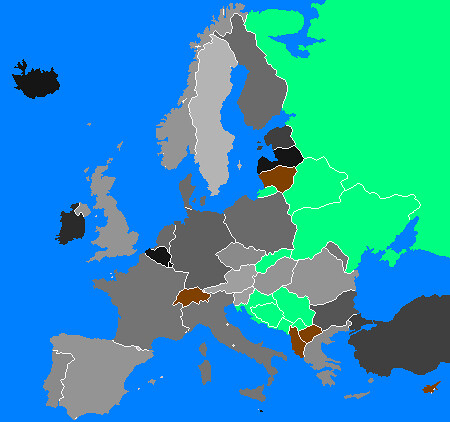
It shows the political allegiance of the heads of government from 1989 to 1/1 2009. The lighter the hue the more years the country had a leftleaning head of government.
The most obvious thing you could say is that centre-right parties have been more successful in most countries, even more so than I expected. The supermajority coalition type countries in Benelux and Finland actually exaggerate leftwing performance by some counts, and Tony Blair wasn’t much of a leftwinger. I think most earlier starting points would show even greater rightwing dominance in western Europe. I think I’ll refrain from speculating as to why right now, but feel free to do so in comments.
The correlation between rightwing government, and rightwing policies is obviously weak, (cf Belgium) but I think the dark hue of the Baltics and Ireland seem about right, and Iceland’s less incongruous than you’d have thought a year ago.
On reflection, I think the tendency is to understate the importance of partisan affiliations. Britain and Spain have become tangibly more progressive in some ways in the last 20 years. That can’t be said of too many other countries.
Green means too few easily categorizeable heads of government. Brown means I couldn’t be bothered.
Unfortunately the contrasts can make countries seem darker or lighter than they are.
I could make a less imperfect map, but that’s never gonna happen.
In a similar vein (but less half assed) here’s a chart of the rich-poor gap in conservative vote share in a bunch of countries, courtesy of Andrew Gelman.
…Slightly reworded to be clearer. By rightwing I mean mainstream liberal, conservative and christian democratic parties.
I guess it must be due to that contrast, because on my screen, Finland is of the darker shade. Contrary to what you’ve stated in your post, the colour of the country may perhaps exaggerate the _right_-wing performance.
This in spite of the fact that during those twenty years, a right-wing candidate held the post of the Head of Government for only those first two years. A Social Democratic honcho occupied the post for eight years, and a Centrist leader for ten years.
But, of course, as you noted, the composition of the government matters; and the National Coalition was part of the government coalition for sixteen years, whereas the SDP was in for fourteen years, and the Centre for only ten. On the other hand, the Left-Wing Alliance – which still includes a few old hard-core Stalinists – was in for eight years, and the Greens were in for ten.
And, of course, the presidency – which, for those first eleven years, was still a position with serious authority – was occupied by Social Democratic candidates for that entire period.
Sweden looks lighter. Not sure what to make of it; sure, during that same period, Sweden had fifteen years of Social Democratic rule, but on the other hand, they also had right-wing PMs for five years. There were no prime ministers from the Centre Party.
(Nota Bene: the Finnish National Coalition and the Swedish Moderates are both members of the IDU, and qualify as equally “right-wing” in this comparison.)
For Finland, an earlier starting point would show a considerably poorer record for the right-wing party. The National Coalition happened to be in opposition continuously in 1966-1987.
I’m not sure what you meant by the statement that Britain and Spain have “become tangibly more progressive in _some_ ways during the past 20 years” and that the same “can’t be said of too many other countries”.
If your intention was to indicate that Britain and Spain have started from a lower base than the other countries, then I have no problem with your assessment.
Cheers,
J. J.
I’m saying most countries have not become moved drastically to their left in any major policy area, except Britain and Spain has. Gay rights would be one counterexample, maybe there are others.
The Center Party I coded right of center, and I don’t see how you could disagree.
Ah, so you equate “progressive” with “left”. Well, that’s your privilege, of course. I do have a feeling that it tells more about your own personal political leanings and your own cultural background, but that’s fine; it’s OK to have political leanings, and everyone looks at things based on their own background.
N. B., classifying gay rights as a “left-wing” goal would make absolutely no sense in this country. Apart from the Greens, who adopted a pro-gay-rights position right from the start (… and who, by the way, are not a left-wing party, never mind how your own local Greens are classified), the traditional homophobia has existed all across the political spectrum, left and right.
I may have some problems with English again, and I’m probably unable to interpret your message. However, suggesting that Britain has moved “drastically” to the left, when you’ve just stated that Tony Blair wasn’t much of a left-winger… um?
And the Centre Party is exactly what the name indicates, a centrist party. Assuming that you’re unable to see why and hold on to this impression that it’s actually “right-of-the-centre”… well, I’m sorry, I just have to say that either your knowledge of Finnish political history is somewhat incomplete, or perhaps your own personal political opinions are colouring your judgement.
(N. B., I am not, nor have I ever been a member of the Centre party, nor have I ever voted for any of its candidates. I’ve never been a member of any other political party, either.)
Other than that, I’m reminded of the statement of our national newspaper back when Fortuyn was killed: “The time-honoured concepts of left, centre, and right don’t really help one much when it comes to understanding why a Vegan animal rights activist would put several bullets into a gay anti-immigrationist politician in Holland.”
Cheers,
J. J.
Edward,
I appreciate your views, but on Belgium you completely missed the marker. We have had a government of socialists/Christian-democrats/liberals and the right-parties have never been able to participate in the governments.
I do not see, with the best of my will, how this can classify as very rightwing.
regards
You’ve got Sweden at gray. It should be darker. The Center Right (Moderatorna) party currently has the helm and their support figures are increasing dramatically. They are ruling in a right wing coalition with the Center part and the Christian Democrats.
All of the left versus right wing government is foolish IMO. The “left wing” communist parties have more in common with the “right wing” fascists than with moderates leaning to either side.
You may want to redo the scale to one of more government control on the right to less government control on the left. This puts things into a much truer perspective than left=communist and right=fascist. Both sides in this view are for more control and less freedom. They have more in common than differences from a personal freedom point-of-view.
I respectfully stand by my little map, without saying it’s anything more than what it is.
It obviously doesn’t tell you how rightwing or leftwing a country is, as I noted in the post.
The Center Party is certainly quite centrist, but so is the social democrats and most other large parties all over Europe. Nearly all of them can still be characterized as centre-right or centre-left, whether they embrace the label themselves or not.
I didn’t count authoritarian heads of government, so no fascists or communists.
Ah, ok. So it’s just a colorful map. I get it. Thx.
David, I disagree. I find your ‘little map’ offending and stigmatising and think it is unsuitable for the high level of foe.
You characterise your ‘little map’ as “It shows the political allegiance of the heads of government from 1989 to 1/1 2009. Blacker means more right-wing.”. However, the right-wing party in Belgium never even had the power! Most of the time it was socialist/Christian democrat, after 2000 mostly liberal/Christian democrat.
Still typifying Belgium is either racist or bad research. Either way, it is stigmatising and offending. I ask you to change it.