

The above still comes from a recent Financial Times video entitled “Portugal’s Brain Drain”, which can be found here, and which I encourage everyone to watch. The issue being raised revolves around the current acceleration of emigration from countries on the EU periphery, largely towards the EU core. Typically the emigrants are young educated people who can’t find work. There is nothing especially surprising in this, since the tendency has long existed for people to move from more depressed areas to economically more dynamic ones. The exodus from Detroit in the United States immediately comes to mind. Or Scottish people getting on the bus to make the fateful journey from Edinburgh or Glasgow to London. The Schengen accord simply extends this process which used to take place within nation states to single market zones, or currency unions. But does this extension have consequences for the participating states which were not anticipated at the outset, and are these consequences all benign?
In addition, this time round in an important sense something is different since these movements are occurring in the context of a long and difficult economic adjustment, indeed one could almost argue that the people leaving form part of that adjustment. What’s more it is hard to accept that this is the kind of adjustment that countries like Spain and Portugal really need. Renovation in these countries implies these people and their talent are injected into the local economy to dynamise it, and not shot out the side like water from a high pressure hose with holes in it. So the big question I want to ask here is whether the economic programs which are being implemented in these countries take sufficient account of the demographic impacts they are inducing, and of the fact that the population loss involved – which most likely will become permanent – is going to cast a long shadow over the history of the countries concerned.
In earlier generations, migrants used to leave behind them what were comparatively high fertility societies. There were more children being born than the local economy could absorb. We can still see this phenomenon in the world around us, as highlighted by the recent tragedy near Lampedusa, Italy. But the EU periphery case is rather different becuase – as the article I publish below indicates – the countries people are leaving are going to be short of working age population in a not too distant future. Again, as blogger Valter Martins argues, maybe the impact of stagnating working age populations was already being felt before the global crisis broke out. Certainly, as I argue here, a case can be made that in Latvia it was the labour force limitation which lead to the excessive overheating and then the roller coaster landing that hit the country in 2008.
True, all these countries are suffering excessive levels of unemployment. But unlike the case of, say, Nigeria or Ecuador, this is not because there are too many young people for the economy to absorb, it is because the economy is stuck in a bad place and can’t grow. Structural reforms are needed, but some of the reforms simply don’t make sense. What is the point, for example, in lengthening the working life of older, less productive, workers while going to the airport to wave goodbye to their innovative and educated grandchildren who are forced to leave as a result. Surely a better solution would be sustainability in the pensions system – what goes out in total can be no greater than what comes in – and no reduction in the retirement age in the short term. Yes, this will mean lower pensions, but if the young leave the lower pensions will be even lower in the long run. There’s a problem of priorities somewhere, and a generational imbalance in how the adjustment is being implemented which is not only unfair, it will lead to far from optimal outcomes in the longer run.
As it happens, just a couple of weeks ago three IMF economists (including chief economist Olivier Blanchard) presented a paper to the Brookings Institute which reviewed the performance of the Latvian economy since the EU-IMF intervention. It was a kind of informal post program evaluation. Interestingly enough, during the course of that paper they raise the very point I am raising here.
“The question,” they say, “is whether this emigration [from Latvia, EH] is, in some sense, a failure of the adjustment program.”
They are right. This is exactly the question we should be asking ourselves. And in Portugal, Spain and Greece too. Their answer – from an economic point of view emigration raises overall welfare:
“In the United States, migration rather than unemployment is the major margin of adjustment to state specific shocks ….. These adjustments are typically seen as good, indeed as the main reason why the United States functions well as a common currency area: If there are jobs in other states, and if moving costs are low, it is better for workers to move to those jobs than to remain unemployed.”
This is the typical “non answer” we keep getting to this issue in the EU context. Obviously, from the point of view of optimal output, and the maximizing resources across a continent, most probably such movements are beneficial. But to whom are they beneficial? Which “collective” community is it whose overall welfare is being raised here? Arguably not those in Latvia and Portugal. EU countries are not US states, and a United States of Europe does not exist. Again, this point is obvious, and agreed on by all, but when the problem this raises in terms of emigration from countries who have been running birthrates well below the replacement level is put on the table all we get is silence.
Now assuming policymakers are not simply stupid this silence suggests that the whole issue touches on some very fundamental raw nerve. There is no answer in terms of sustainability for those countries who are net losers unless there are reverse direction transfers, as under the US Federal system, and that no one wants to talk about, at least in public.
As the IMF economists admit in their paper – “the largely permanent departure of the younger and more educated workers may indeed be costly for those who stay”.
So the question they pose – could things be done differently? – remains, at least from the demographic point of view, unanswered.
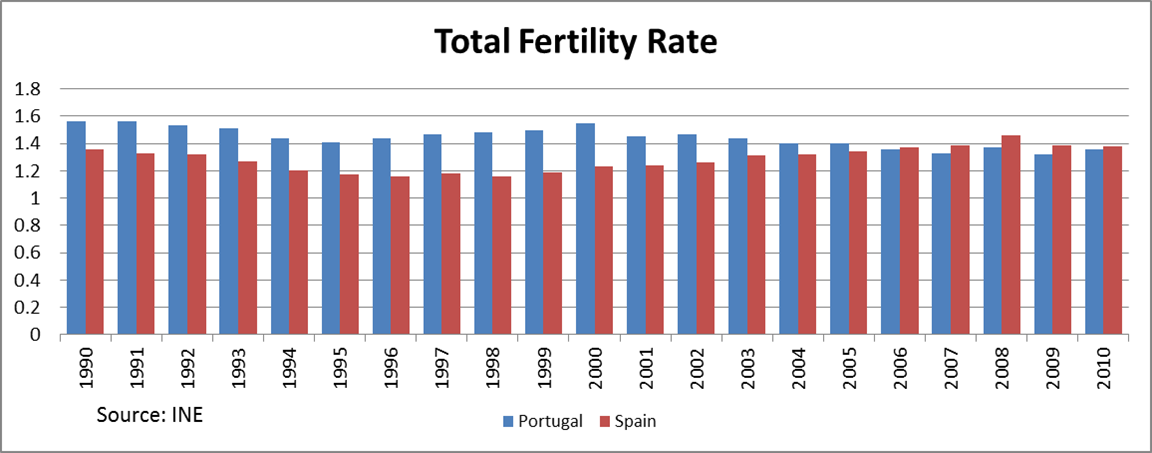
Portugal isn’t Latvia, but it does have a very serious demographic problem. In Latvia the total population declined by about 14 percent (340 thousand people) between 2000 and 2011. Emigration was responsible for about two thirds of this decline while low fertility accounted for the remainder. An estimated 200–215 thousand people left, mainly young people – roughly 9 percent of the population. Obviously Latvian emigration long predates the crisis. The average net emigration rate was 0.5% from 2000-2007. It increased to an average 1.3% from 2008 to 2011, but by 2012, was roughly back to its pre-crisis average. So emigration isn’t a product of the crisis, it was simply made worse by it. But the basic underlying reality is – given the ongoing fertility shortfall – even with the pre-crisis rate of emigration the population pyramid isn’t sustainable.
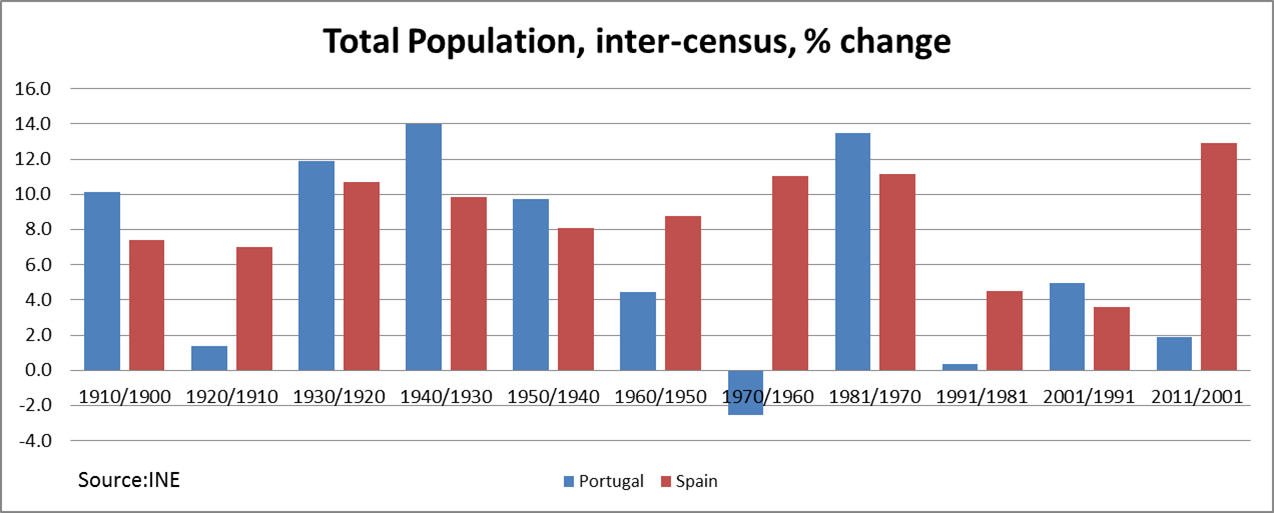
Portugal’s case is not so severe, but the pattern is similar. Between 1998 and 2008 about 700,000 Portuguese nationals left their home country according to research carried out by the former Economy and Employment Minister Álvaro Santos Pereira. In the pre-crisis years the outpouring was to some extent offset by an inflow of immigrants from other countries, but now the migrants are leaving too so the country’s working age and total population are both declining.
Which conveniently brings me to the second guest post I would like to present from the Portuguese blogger Valter Martins. As Martin’s coherently argues below, the drying up of Portugal’s labour supply was already affecting sustainable trend output before the crisis set, so what I am suggesting we might like to ask ourselves is one very simple question – how is an adjustment which accelerates the longer term decline in the country’s workforce, and leads some of its younger and abler members to abandon the country, possibly for good, going to help raise the country’s long term growth rate? Instead of alleviating this problem it seems to me it is likely to make the long term situation worse.
Can demography explain Portugal’s slump before the crash?
Is the Eurozone suffering from a “Shortage of Japanese”?
Guest post by Valter Martins
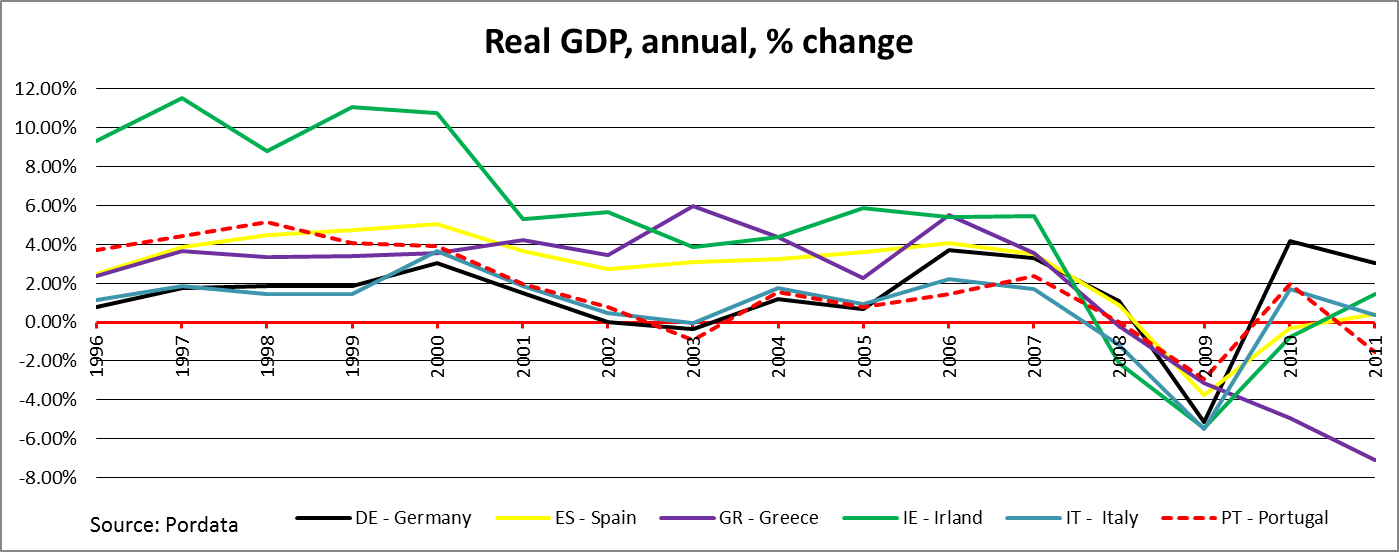
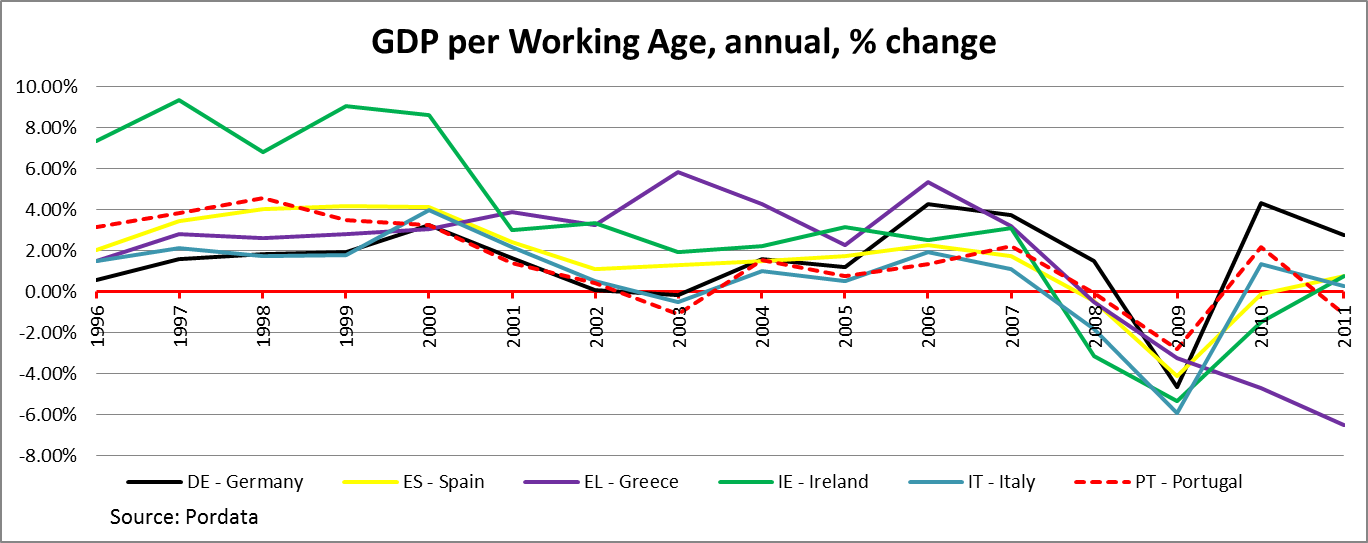
In Portugal, unlike other countries now experiencing economic difficulties in the Eurozone – Spain, Greece and Ireland, for example – anemic economic growth was all too evident well before the financial crisis of 2007-08. Accession to the Euro club brought a significant reduction in interest rates in those countries that had experienced historically high ones, triggering real estate bubbles (in Ireland and Spain), and public overspending (in Greece) this cheap money allowed these countries to maintain rates of economic growth above their long term potential and also above the European average. Portugal, on the other hand, suffered a mild housing bubble and government overspending, yet growth was much weaker and more in line with countries that have had fairly lackluster performances in the European context:, like Germany or Italy. (See chart below)

So what lies behind the relatively low growth that took place in Portugal when compared with other countries that are now in the same situation? To put it another way, what’s the factor that differentiated Portugal from the other countries before the crisis of 2007-08? A number of recent papers and articles have attempted to explain the causes of this relative weak performance, but although some of the factors mentioned surely contributed to the weak Portuguese growth they do not fully explain it since many of them were also present in the other – higher growth – countries before the crisis.
So we need to look a bit deeper. Essentially, long term economic growth can be split into labor force growth and productivity growth. Invariably, the main cause cited for the Portuguese low growth has been productivity growth, or the lack of it, but although this certainly has been a problem in the last decade, it was not so much of a problem before, and it hardly appears sufficient on its own to explain the relative weak performance. The differences in productivity gains don’t seem large enough to justify the sizable difference in GDP growth, even in the cases of Ireland and Greece (where productivity growth was higher than Portugal), and certainly not vis a vis Spain since productivity growth there was lower than Portugal, as can be seen in the chart below. In the last decade, productivity growth in Portugal was threefold that of Spain but its growth was less than half.



.png&filetimestamp=20130129121040)

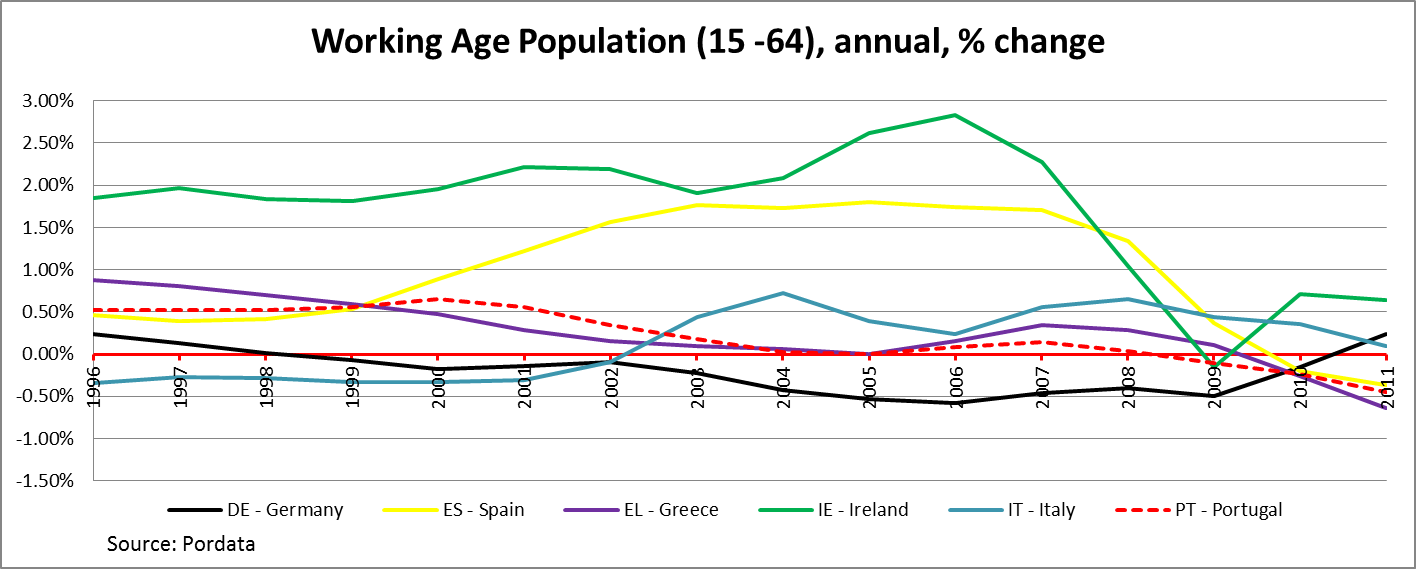
Despite some regional variation as a result of internal migration, the reality is that working-age population in the Eurozone as a whole has now initiated a long downward trend that will have major repercussions in terms of its economic growth, as explained in the previous post, and therefore, we can also conclude that Europe is starting to suffer from a “shortage of Japanese” as shown in the graph below.

As such we cannot fully comprehend the situation that Portugal, Spain and Greece face at the moment without looking into their adverse demographics. This already exerted an disproportional role in the last decade, namely in Spain, whose migration-induced working-age population growth goes a long way explaining its outstanding economic growth, while for Portugal the contrary it’s true, as the lack of population growth made its economy lose steam as it joined the Euro. More worryingly tough, is that working-age population in Europe as a whole has started a long, perhaps irreversible, path of decline that will act as a drag on its economic growth, making the economic recovery for these countries even more difficult.
From this website we have now detailed investigations about the impact of demography on the economy of Portugal, Latvia, Japan and Spain. The situation of Italy, Bulgaria, Romania, Ireland and other Baltic states (possibly a bit better than Latvia, but not shiny) have been also touched.
We have some very well defined pieces of the puzzle, but a global view is still lacking.
Wouldn’t it be time to have some European overview of the situation? What about Poland? Hungary? Slovenia? Croatia? What about the supposedly successful countries like the Netherlands, Austria or Germany? One big question I have, especially in the view of the emigration of qualified German personnel notably to Switzerland, is whether this imbalance (highly qualified persons emigrating, less qualified — but not necessarily low or not qualified — immigrating in ever lower numbers or departing) is reproduced at the European level (people emigrating to Australia for instance).
Pingback: Eurosphere roundup: “EU discusses how to deal with refugees..”Wildlife makes a surprising comeback in Europe | Erkan's Field Diary
Pingback: Links 10/8/13 « naked capitalism
Edward, you may wish to take the US migration example a step further: the US federal government (aka the taxpayer) has been perferctly happy to keep depopulated states solvent for decades. So, without fiscal transfers to that effect within the EU, the free movement of labour will indeed do a lot of harm, it is in fact already doing it.