Estonia’s Economy Contracts At Record Pace At The End Of 2008

Estonia’s economy contracted at the fastest year on year rate in at least 15 years in the fourth quarterof 2008. Commenting on the news the Estonian Finance Ministry restricted himself to the obvious, “the recession may deepen this year”, he said. The economy shrank an annual 9.4 percent, the second-worst performance in the European Union (after Latvia), following a 3.5 percent year on year contraction in the third quarter. The contraction was 4.2% quarter over quarter. That is 16.8% annualised. Absolutely horrible.

“This is the worst economic crisis in Estonia since Estonian independence” in 1991, Lars Christensen and Violeta Klyviene, analysts at Danske Bank A/S said in an e-mail today. “Nobody can now deny that the crisis in the Baltic economies is at least as bad as the Asia crisis of 1997-1998 or the Argentinean crisis of 2001-2002.”

The Czech Republic Probably Entered Recession At The End Of 2008

Well as forecast on this blog (see also here), the Czech Republic’s economy contracted in the last quarter of 2008. Since the economy is still contracting sharply, we will more than likely now see a second quarter of negative growth, which means the CR is now in recession.

The Czech economy contracted less than expected in the fourth quarter but the outlook for this year remained grim due to collapsing demand in the euro zone slashing Czech exports. The Czech Statistical Bureau said on Friday the central European country’s output dropped by 0.6 percent quarter-on-quarter, adjusted for seasonal and calendar effects, the worst number since 1997. Year-on-year, the economy eked out 1.0 percent growth, much better than 0.2 percent expansion forecast in a Reuters poll of analysts but a drop from 4.2 percent growth in the third quarter. “It doesn’t really change the outlook going forward,” said Raffaella Tenconi, analyst at Wood & Company. “We’re looking at -2.0 percent growth for all of 2009, and if anything, there are downside risks to it,” she said.

Continue reading

Germany’s Incredible Shrinking Economy

The FT says this is worse than feared, and I say it is just what I was expecting (see here, I do hope that doesn’t make me one of those “visionaries” you are all so busy talking about).

Germany’s economic slump in the final quarter of 2008 proved worse than feared, official figures showed on Friday, with the country posting the sharpest fall in gross domestic product since the country was reunified in 1990.The larger-than-expected 2.1 per cent plunge in GDP in the final three months of the year showed Europe’s largest economy contracting at a faster pace than the UK in the same period and threatening to drag down the performance of the 16-country eurozone.
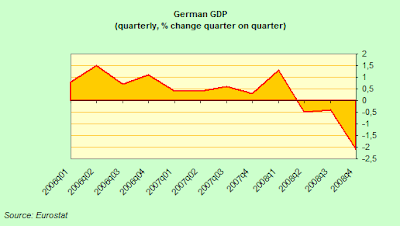
A 2.1% quarterly contraction, for those who are confused by the way we economists do things is equivalent to an 8.4% annualised rate of contraction, which is quite something (although in fairness some of this comes from Q3 when there was a big build up in inventories, which has now unwound). But the real question, when all the dust settles, is going to be why it is that economies like those in Germany and Japan are so incredibly export dependent (remember, all those “decoupling” arguments which were so in fashion not so long ago). My view is “its the demography silly”, but then we can’t go back 30 years and change all that with the wave of a wand, so we really don need some out of the box thinking on the global imbalances soon (see Claus’s arguments in his last post).

Meantime the EU are working furiously away on the next “top secret” European bank bailout proposal (does this have anything to do with the unexpected rapid departure of Michael Glos last weekend? – all of this was most strange, see here). Details are sof the coming bank bailout proposals are still scarce at this point, but the excitable Telegraph do come up with a very hair-raising number (16.3 trillion pounds, see here). As I have been arguing, far from Germany subsidising the rest of the EU, Germany may well be at the heart of the bailout, needing support from the rest of us, which is why we need EU bonds, and we need them now. United we stand, divided we go down the plughole!

And if you have any doubt about the export connection, just look at the chart below, not an exact fit, but an obvious close correlation. Germany needs a demographic fix, simply going for longer shopping hours (and the like) won’t work in a case like this.
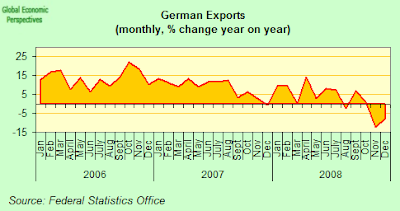
And as for labour market reforms, just look how many jobs Germany created this time round.

Words Of Wisdom On Krugman And Protectionism (Wonky)

Well I’m putting this piece from Claus Vistesen up here wholesale, since I think he advances some very important arguments that need a wider airing. Basically I started off agreeing with Paul here, but now Claus has convinced me: we cannot get out of this if we don’t address the global imbalances which produced the whole situation, and we can’t address the imbalances if we don’t start to think about the asymmetric demography which lies behind them (I wonder what the “visionary” Taleb set have to say about all this?). As Claus himself says:

First of all, I think that the Economist’s intuition is fundamentally right; the probability that short term protectionism would be anything but this is very large. I am not necessarily referring to the historical example with Reed Smoot and Willis Hawley, but rather to the point that since this crisis is going to be long lived the risk of using protectionism in what ever explicit form is too large.

Secondly, I think that global current imbalances are important to take into account here and if we want to allow economies to enjoy the ability to substitute consumption for saving (and vice versa) over time one fundamental pre-requisite is a commitment to openness. This does not mean that this will be the solution in and of itself. As I also pointed out above, this openess and the factors which may be deliberate in a political sense (e.g. pegging to the USD forming BW II) or more structural (demographic) are also one of the roots to why we are here. Yet, I think that we are still better off not considering protectionism for the simple reason that I believe whole economies (and not just small ones) would be devastated as a result.

Continue reading

Watching it all on TV

There is a lot to pick over in Gordon Brown’s testimony to the House of Commons Liaison Committee yesterday and in particular one suspects that his account of what the Financial Services Authority did or did not tell the Treasury about problems with the HBOS business model is an issue of which we have not heard the last.  But there was another claim deserving of scrutiny because it goes to the heart of the lack of preparedness for the crisis —

Continue reading

Hit and Run

North and south of the Caucasus mountains:

Azerbaijan’s air force commander was shot and killed as he left his home on the morning of February 11 … Lt-Gen. Rail Rzayev, the head of Azerbaijan’s Air Force and Anti-Aircraft Defense Force, was shot in the head as he was sitting in a Mercedes in front of his Baku apartment building. Doctors at a military hospital could not save 64-year-old Rzayev’s life, the Interior Ministry announced. … Rzayev had served as Azerbaijan’s air force commander since 1992, after previously heading Baku’s anti-aircraft defenses. …

Most recently, in December 2008, Rzayev attracted media attention after reports surfaced that Azerbaijani military planes had forced a helicopter carrying Minister of Emergency Situations Kamaladdin Heydarov to land. No official explanations were issued for the incident. Azerbaijani mainstream media outlets, however, reported that Heydarov, arguably the government’s most influential minister, had failed to inform the Anti-Aircraft Defense Forces about his flight, allegedly to his villa in the central Gabala region. …

Lt. Gen. Rzayev was among those Azerbaijani generals who strongly opposed any compromise resolution of the Nagorno-Karabakh conflict with Armenia, noted Rauf Mirgadirov, political columnist for the Russian-language daily Zerkalo (The Mirror).

Azerbaijani military politics are murky, to say the least, but this bears watching.

Speaking of murky, the murder of a Chechen in Austria may have some interesting fingerprints on it:

A Chechen refugee killed in Vienna last month was the key witness in an Austrian criminal investigation into Chechen President Ramzan Kadyrov that could have led to Kadyrov’s arrest last year, prosecutors and lawyers said Wednesday.

The revelation fuels speculation that the killing of Umar Israilov, a former bodyguard of Kadyrov, was aimed at silencing a vocal critic of the Chechen leadership. Israilov was gunned down on Jan. 13, just four days after The New York Times informed the Russian government that it was planning to publish a report based on interviews with him implicating Kadyrov of murder and torture. …
Israilov last year offered information implicating Kadyrov of torture and murder to a team of lawyers in Austria and Germany, who in turn asked Vienna prosecutors to arrest Kadyrov during an expected visit to Austria for the European football championship, the Berlin-based European Center for Constitutional and Human Rights said Wednesday. …
Around the same time as the request for the arrest, Austrian police arrested a Chechen man who claimed that he had been sent by Kadyrov to kill Israilov, Der Falter reported Wednesday, citing police records.
Jarosch said the case of the Chechen man was not pursued because Austrian prosecutors believed and still believe that they lack jurisdiction.

Oops. Now that Israilov is dead, Austria may have jurisdiction. At least for one crime.

Prosecutors have arrested seven suspects in Israilov’s death, all ethnic Chechens, and five remain in prison, Jarosch said. He said it was not clear whether the killer was among them.

a lost sheep back in the fold

Well, will you look at this? Remember Tory MEP Syed Kamall, who was the author of a proposal to implement total Internet surveillance in the EU, in order to make the French record industry happy? (I’m sorry to say I spelt his name wrong.) We beat that one. But now look at him – here’s a letter he sent to today’s Guardian.

Lord Woolf and his colleagues were right to point out that the recent erosions of civil liberties are “one of the most significant changes in the life of the nation since the end of the second world war” (Report, 6 February). We already have the largest DNA database in the world and, under the terms of the Prum treaty, more and more personal data can be shared with other EU member states.

It is vital that we weigh up whether we are sacrificing too many of our hard-won freedoms in our quest to tackle crime.
Dr Syed Kamall MEP
Con, London

Quite astonishing; Dr. Kamall has been saved as a brand from the burning. Did we turn him on to a weirder life? Or just scare him? Or has his local talking points cache been refreshed? Certainly, it’s a pretty impressive statement from someone who was looking for a mandate for compulsory deep-packet inspection throughout Europe only a few months ago.

Not a Fountain of Optimism

Dieter Wermuth, over at one of Die Zeit’s blogs:

Judging from December’s [2008] industrial production numbers, Germany’s social product will have shrunk by 1 percent to 2 percent, real and seasonally adjusted, in the fourth quarter compared with the third. That means that it retreated between 0.6 percent and 1.6 percent compared with the previous year.

To put it more dramatically, or as dramatically as it actually is: Industrial production including construction was in December 12 percent lower than it was a year previous. The crash has been ongoing since September. Extrapolating the fall from August to December to a year’s duration yields a trend of -33.6 percent (104.6/119.9 cubed, as four months are a third of a year) That is a considerably stronger contraction than in the USA (-16 percent) or the UK (-17.6 percent). In a year-on-year comparison, the German contraction is also larger. (My translation, original beneath the fold.)

Much more at the link, but the bottom line is that the crash will hit industry harder than services, and countries oriented toward export more than those oriented toward domestic demand. Germany is a world champion in both.

A decade ago when I worked in financial markets, I knew Dieter as a solid macroeconomist for WestLB. Glad to see he’s been writing for Zeit.

Continue reading

Russian Debt And The Euro

Keynes’s genius – a very English one – was to insist we should approach an economic system not as a morality play but as a technical challenge.
Martin Wolf, Financial Times

The euro fell again yesterday, by 1.1 percent against the dollar (to $1.2860) and by 1.2 percent against the yen (to 117.52 yen). The change, even if quite large in a short space of time, is hardly dramatic, but what is of more interest is the why. Russian companies announced yesterday that they were thinking of opening negotiations to “restructure” their debt. Bloomberg:

The euro fell after a Russian bank official said the nation’s lenders asked the government to help moderate talks with foreign lenders on $400 billion of loans, adding to speculation financial turmoil in Europe is worsening.

The euro fell versus 13 of the 16 most-active currencies after Anatoly Aksakov, president of the Russian Association of Regional Banks, said in an interview with Bloomberg News that the group has written to the government after talking with foreign banks. He said $135 billion of the loans are due this year and the remainder of the $400 billion within four years.

The “report of rescheduling debt is driving the euro lower because European financial institutions have a bigger exposure to Russia than their counterparts in other countries,” said Takashi Kudo, Tokyo-based director of foreign-exchange sales at NTT SmartTrade Inc., a unit of Nippon Telegraph & Telephone Corp., Japan’s largest fixed-line phone company.

And then there is Kazakhstan to think about:

Kazakhstan’s banks may have their ratings cut as the devaluation of the nation’s currency makes it harder for them to repay foreign debt and “substantially increases” credit risk, Moody’s Investors Service said yesterday.

Continue reading