Poland’s Industry Continues To Contract In February

I suppose industrial output numbers for Poland are not exactly the sort of thing that set most Afoe readers alight with blazing interest. They are, however, not without some significance, since one of the issues every right thinking European needs to be trying to assess right now is just how valid the “each Eastern Economy is different” actually is in reality.

Well, it is, and it isn’t is my view, since evidently there are differences, and some of them are important, but equally evidently there is one common underlying reality: an ongoing and extensive regional economic crisis. In this context the fact that Polish industrial production fell for the fifth straight month in February is not simply an incidental piece of news. It offers us and easy to understand indicator of the problem which exists, as well as providing the latest signal that the Europe’s economic crisis really is having an impact on domestic economic growth in Poland and other parts of central Europe. In fact annual output dropped by 14.3 percent in February, following a revised decline of 15.3 percent in January. Output was however up 2.7 percent month on month.

Continue reading

Here We Go Time Draws Near With Unicredit

I have been warning on the parlous position of Italy’s Unicredit for some time now (see this initial EU Bonds post, or the earlier history of the Unicredit problem, here, here, here, here, here). Well, today the story took another turn for the worse.

It all started yesterday, when Bloomberg came in with a report about Unicredit’s eastern exposure, outlining how a decade long expanison, which saw more than $65 billion of acquisitions in operations stretching from Poland to Kazakhstan is now alarming analysts who forecast that loan defaults in eastern Europe, where the bank focused its growth, are set to balloon. Unicredit’s stock is down 76 percent in the past 12 months, the second-biggest decline among Italian banks.

“Eastern Europe is the new bogeyman,” said Massimiliano Romano, an analyst at Concentric Italy in Milan. “UniCredit has subsidiaries in 17 different countries there. We used to see that as diversification, now we see it as a risk.”

Then came the news, again yesterday, that the bank had suffered a 57 percent decline in fourth-quarter profit. Finally, this morning, the bank informed us that they are planning to ask for as much as 4 billion euros in government aid. In fact the profit results were not as bad as some analysts had been forecasting, but then these results are for 2008, which, as the company said in its statement, was still a “very good year” in eastern Europe. 2009 looks set to be quite a lot worse, and 2010? As Unicredit CEO Alessandro Profumo said, the bank is “monitoring countries including Ukraine very closely”.

In fact the bank is going to apply for aid in both Austria and Italy, and this is not surprising since according to a statement from the Bank of Italy earlier this week, Italy’s national debt climbed to 105.8 percent of gross domestic product at the end of last year, up from 103.5 in December 2007. So the credit rating agencies’ patience is already being badly strained, even if the quality of their mercy might not be.

Oh, and just to cap it all, and a very bad day for Unicredit, HVB Group, their German banking unit, announced this morning that they had a loss of 671 million euros last year because of writedowns on investments and higher provisions for risky loans. HVB’s trading results were “severely affected by the extreme market turmoil which intensified in the fourth quarter of 2008,” according to the company statement.

Basically, this is that well known proverbial situation, where Europe’s leaders twiddle their thumbs, while Rome, almost literally, burns.

Devaluation, Euro Membership And Loan Defaults – Some Thoughts For My Critics

Joke – How do you know when a country is in crisis? Well, on the buses on the way to work, and in the bars and cafes during the mid morning break, everyone is reading the economy rather than the sports section in the local newspaper.

Several pieces of news out over the last week are relevant to the whole debate we are having about how to drag the Estonian economy (kicking and screaming it would seem) out of its current slump. In the first place the Estonian parliament passed a supplementary 2009 budget at the start of the week, in an attempt to address the ongoing crisis in the economy and the dramatic decline in revenues. The cuts were approved by 61 votes to 35 against in what was also an effective vote of confidence in the present government. So at least it is clear that the majority of Estonia’s politicians back the present course, and the degree of public support for the current path is greater than it would seem to be in, say, Latvia. That is, naturally a very positive point.

The supplementary budget lowers the amount of revenues in the annual budget by EUR 615.5 mln and of expenditure by EUR 419.9 mln. According to the revised budget, state revenue this year is now anticipated to be EUR 5,635 mln and expenditures EUR 5,871 mln. Both these numbers are of course conditional on the economic contraction for 2009 only being the forecast one (on which the budget is based) of 9.5%.

The second piece of news is that the Estonian Finance Mininistry have sent an official loan application today to the European Investment Bank, with a request to borrow Eur 550 million for 5 years. And this point is important, since obviously, as I will argue below, Estonia’s private sector (households and companies) is now basically very overleveraged (in too much debt) and the government is being forced to step in and assume greater responsibility for the collective debt as the correction continues.

The third relevant piece of news is that the number of unemployed registered with the Estonian Labour Board was up again last week, and reached 50,527, which means 2418 more people signed on with the board during the week, following the 3,019 who joined the list in the previous week. Meanwhile the Estonian Parliament has been having a debate about what kind of labour market reforms the country needs to handle the present crisis. Since one witty soul appropriately baptised me in my most recent post the “excel economist” I would just like to add-in my own chart-based contribution. People are leaving Estonia. How do I know that, well just take a look at the spike at the end of the time series shown in the grphic below, the volume of income transfers to Estonia (largely worker remittances) has been on the increase ever since the crisis started in 2007, and during the last quarter of 2008 they really spiked up, just (coincidentally?) as the economy spiked sharply downwards.

We don’t know too much about the murky topic of out-migration in the Baltics, since no one seems to consider it a particularly pressing issue. In fact, migrant labour flows could be considered to be a leading indicator for a modern (open) economy (in both directions), but surprisingly little attention is paid to the matter. We do have an old “estimate” that around one third of those working abroad are working in Finland, and now somewhat dated reports of young people working in Finland repairing motorway crash barriers for 150 kroon an hour, but that’s all we seem to have, anecdotal evidence. Maybe one of the reforms all those very busy parliamentarians could think about agreeing to would be the introduction of a question in the labour force survey about whether or not the interviewee currently has (or has had in the recent past) a family member working abroad. Continue reading

Those stabilizers

Couldn’t someone, somewhere try to calculate how much the automatic stabilizers of European economies compensate for the difference between our stimulus packages and the US? I could settle for something problematic and rough and ready. Put a number on it.

Getting Ready

Paul Krugman has a reasonably to the point Op-ed in the New York Times today. It starts off like this:

I’m concerned about Europe. Actually, I’m concerned about the whole world — there are no safe havens from the global economic storm. But the situation in Europe worries me even more than the situation in America.

and ends up like this:

For much of the past decade Spain was Europe’s Florida, its economy buoyed by a huge speculative housing boom. As in Florida, boom has now turned to bust. Now Spain needs to find new sources of income and employment to replace the lost jobs in construction. In the past, Spain would have sought improved competitiveness by devaluing its currency. But now it’s on the euro — and the only way forward seems to be a grinding process of wage cuts. This process would have been difficult in the best of times; it will be almost inconceivably painful if, as seems all too likely, the European economy as a whole is depressed and tending toward deflation for years to come.

Does all this mean that Europe was wrong to let itself become so tightly integrated? Does it mean, in particular, that the creation of the euro was a mistake? Maybe.

But Europe can still prove the skeptics wrong, if its politicians start showing more leadership. Will they?

Amen to that!

Meanwhile, Spain’s Economy Minister Pedro Solbes has been talking about EU Bonds:

The euro zone is not yet ready for a joint bond but states in the 16-member currency area could coordinate their debt issuance more closely, a German newspaper on Wednesday reported Spain’s economy minister as saying. ‘I think the currency union is not yet ready for something like that,’ Economy Minister Pedro Solbes, referring to the idea of a joint bond, told Germany’s Handelsblatt in extracts of an interview to run in the business daily’s Thursday edition.

So the argument isn’t that they are not a good idea, it is that – with Spain’s unemployment now at 3.5 million, and money starting to run out on the public works “stimulus programme” – we aren’t yet ready for them. When will we be ready, when Spanish unemployment here hits 5 million, or six, or seven, or when we have 5 million people who have run out of unemployment benefit payments, when things eventually start to fall apart at the eurozone level, or after the German elections, perhaps? Come on. Enough of all this passivity. Let’s have some action up there. The issue is we set up a currency union without the necessary political architecture to make it work, so now we need to go to work on the architecture. Do our leaders have the mettle to finish the job, or, as Krugman fears, are they simply intent on proving all the skeptics right!

You can find some explanation of what EU Bonds are, and how they might work, in this post here.

A little map I made

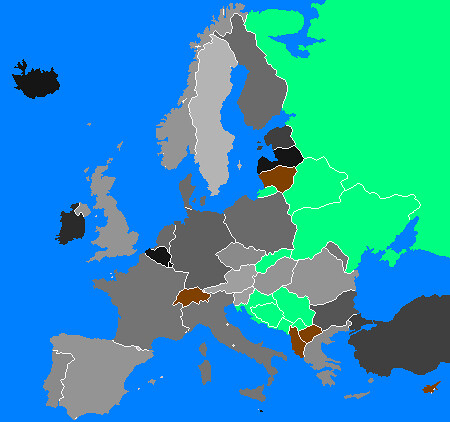
Here’s a little map I made a while ago.

Right-left-europe

It shows the political allegiance of the heads of government from 1989 to 1/1 2009. The lighter the hue the more years the country had a leftleaning head of government.

The most obvious thing you could say is that centre-right parties have been more successful in most countries, even more so than I expected. The supermajority coalition type countries in Benelux and Finland actually exaggerate leftwing performance by some counts, and Tony Blair wasn’t much of a leftwinger. I think most earlier starting points would show even greater rightwing dominance in western Europe. I think I’ll refrain from speculating as to why right now, but feel free to do so in comments.

The correlation between rightwing government, and rightwing policies is obviously weak, (cf Belgium) but I think the dark hue of the Baltics and Ireland seem about right, and Iceland’s less incongruous than you’d have thought a year ago.

On reflection, I think the tendency is to understate the importance of partisan affiliations. Britain and Spain have become tangibly more progressive in some ways in the last 20 years. That can’t be said of too many other countries.

Green means too few easily categorizeable heads of government. Brown means I couldn’t be bothered.

Unfortunately the contrasts can make countries seem darker or lighter than they are.
I could make a less imperfect map, but that’s never gonna happen.

In a similar vein (but less half assed) here’s a chart of the rich-poor gap in conservative vote share in a bunch of countries, courtesy of Andrew Gelman.

…Slightly reworded to be clearer. By rightwing I mean mainstream liberal, conservative and christian democratic parties.

Russia’s “Pillars of Strength”

Is Stratfor worth paying attention to? I’ve never been clear on this. Some of their articles seem pretty insightful, but on the other hand some of them seem like something a bright sophomore might come up with after half an hour with google.

This recent article about Russia seems closer to the latter category to me, but maybe I’m missing something. The article discusses six “pillars of Russian strength”:

Geography — Russia is adjacent or close to all the areas that are strategically important to Russia.

Politics — Russia has a stable authoritarian system. The government is securely in power and doesn’t have to worry about what anyone else thinks.

Social System — Russia’s population is docile .

Natural Resources — Lots!

Military — Getting better. Also, nukes.

Intelligence — Best in the world, and still has most of the “Near Abroad” wired for sound.

Well, hum. Continue reading

Is The Condition of Hungary’s Economy Really As Bad As It Seems To Be?

On the face of it Hungary’s situation is pretty dire. As I keep reminding readers of this blog, even Angela Merkel recently claimed that “you cannot compare the dire situation in Hungary with that of other countries” as if the worst off you could be was where Hungary is now, effectively turning Hungary into the benchmark case for economic “badness” (at least as far as the EU goes, Ukraine is obviously “another country” in this respect). I cannot agree. As I have suggested time and again on this blog, although Hungary’s situation leaves little to be envious of, it is not as bad as some are making out in the current “demonisation” process, nor are the other Eastern Economies (even those in the Eurozone as I argue here in the cases of Slovakia and Slovenia) really as sound as some have been making out. Indeed in my view the Hungarian economy is not the worst case in the EU27 (I would rather suggest that either Bulgaria or Romania will be battling it out soon enough for that dubious honour). Obviously Hungary is in the midst of a major correction, and has been for nearly three years, but during that time Hungary has made considerable progress along its appointed road, and now has an industrial export sector which no one should be sneezing at. The problem is simply that Hungary (for reasons to be explained below) is now an export dependent economy, and such economies are among the worst affected in the short-term by the present slump in European (and global) economic activity.

This simple fact was brought home only last week by January’s export figures, which show the dramatic nature of the recent decline in Hungary’s external trade, since both exports and imports were down at a rate of around 30% year-on-year. The decrease was slightly higher for exports than for imports, and consequently the trade balance was once more negative. Exports were down by 31% compared with January 2008, showing the extent to which Hungary’s export driven economy has been affected by the recession in the rest of Europe.

Continue reading

“One can lead a column to Prishtina every day”

Interesting when two hobbies cross-connect. One: that odd, isolated episode at the end of the 1999 NATO bombing of Yugoslavia, when a Russian unit based in Bosnia suddenly rushed through Serbia and occupied Prishtina airport just ahead of the advancing NATO troops. — It ended up being an empty gesture, but only just; the Russians were ready to funnel thousands of soldiers into the airport, and would have if Hungary and Romania hadn’t stood firm and kept their airspace closed. And it wasn’t entirely without consequence: it re-established Russia as the Great Power Protector of choice for Serb nationalists, a position it still occupies today.

Two: Russia’s problems in Ingushetia. Ingushetia is a province in the northern Caucasus next to Chechnya, and it’s just a hell of a mess. It’s full of refugees, the economy has collapsed, bombings and shootings are a constant background drumbeat. Nobody pays much attention to the North Caucasus — it’s formally part of Russia; the Chechens are quiescent at the moment; Shamil Basayev is dead, and the Beslan atrocity didn’t seem to lead to anything — but Ingushetia is a bubbling low-intensity conflict with the potential to erupt into something nastier. Continue reading

Slovenia’s Economy Falls Off The Roof, While Slovakia Slides Into Recession

“Most other countries in the region are faring much better, though….Like Slovenia, which joined two years ago, Slovakia can enjoy the full protection of rich Europe’s currency union, rather than just the indirect benefit of being due to join it some day.”
The Economist

“Saying that the situation is the same for all central and eastern European states, I don’t see that……you cannot compare the dire situation in Hungary with that of other countries.”
Angela Merkel

“Happy families are all alike; every unhappy family is unhappy in its own way”
Tolstoy

Slovenia’s economy contracted for the first time in more than 15 years in the fourth quarter of 2008, and is almost certainly heading for quite a deep recession as a construction boom came to an end while demand dropped for exports to other economies in the European Union. Gross domestic product shrank 0.8 percent year on year following a revised 3.9 percent expansion in the previous quarter. More astonishingly, quarter on quarter GDP contracted a seasonally adjusted 4.1 percent. Only Estonia and Latvia contracted at a faster rate.

Continue reading