From the noisy phase to the quiet phase

Is it meaningful to say that the Egyptian revolution is calming down, or petering out? I ask because a common flaw of the reporting on it has been to treat the basic dynamics of mobilisation as if they were signs of huge political shifts behind the curtain. It’s obviously true that both revolutionaries and reactionaries need to sleep and eat. When the revolutionaries want to, they have no great difficulty in putting over a million people on the streets in Cairo and probably a bit more again elsewhere in Egypt. These are peak efforts. Idiot management-speakers like to talk about maintaining peak performance, but they are idiots: the word peak implies a supreme effort that cannot be maintained continuously. People have to eat and sleep, they have families, they have jobs, although many millions of Egyptians have been taking part in the revolution silently by essentially going on strike. Even revolutionaries have to maintain their barricades, update their blogs, and hold meetings to decide what to do next.

The result of this is that there’s been a sort of media cycle – one day the papers are full of pictures from the latest day of rage, the next it’s all about people grandly speculating on what happens next, and the regime’s spokesmen explaining how they intend to preserve the substance of the regime. Perhaps they talk about that on the other days, but nobody is listening. Or perhaps they believe it, when they wake up and hear that there are only tens of thousands of rebels in Tahrir Square rather than hundreds of thousands. Then, the next callout of the demonstrators resets the clock again.

Today, we seem to be in one of the ebb-tide phases. So it’s a good moment for a bit of speculating. What is important, in these terms, is that the government doesn’t seem to be regaining much ground in between waves of protest. Instead, there seems to be a ratchet in operation – each wave extracts a new concession. Mubarak sacked his government. And appointed a vice president. Then he promised not to stand again. Then talks were opened with the opposition. Then the military accepted to talk directly with the opposition, independently. Then the NDP hierarchy was purged. Then Suleiman renounced becoming president himself. And the regime’s own peak effort – Wednesday’s thug raid – was dramatic and violent at the time, but with hindsight was nowhere near enough in terms of numbers to change anything. Arguably, it wrecked the government’s remaining legitimacy and only demonstrated its lack of mass support.

The fear is that this is no ratchet, but a sort of retreat into the Russian hinterland, a trap. On the other hand, it’s a common pattern in the end of dictatorship, a sort of political Cheyne-Stokes breathing. You may think you are saving the structural realities of power and giving away the forms, but how will those realities stand up without the Emergency Law and the special constitutional amendments and the practice of having political prisoners and the ban on opposition parties and the censorship of the press? After all, there must be a reason, rooted in the structural realities of power, why you wanted them in the first place. If owning hotels was enough to sustain a tyranny, there’d be no need for Central Security or private thugs on camels or sententious TV broadcasts or bulk SMS messages with faked originating numbers.

Revolutions come with years, like New Order remixes used to. Prague ’89. Paris ’68. Probably the most relevant ones now are the Polish ones – Solidarity feat. Jaruzelski ’81 and ’89. The first one was a lot like what everyone fears for Egypt and also quite a lot like the official preferences of our governments. There was violence, but not as much as there could have been, and a safe military dictator won. He, in turn, turned to a religious and conservative pseudo-opposition to give his rule some foundation. The second was more optimistic but less spectacular. In 1989, the end of communism in Poland involved far more negotiating than it did street-fighting, and it involved putting up with Jaruzelski sticking around for the rest of his term as a sop to the powers that be, or rather the powers that were.

Egypt is already some way beyond 1981 – there is something like a round table, and the officially designated military strongman is getting very close to the exit, having disclaimed supreme power for himself. Probably the communists of 1989 thought they were cunningly playing for time. Suleiman has a far more ruthless reputation, though; the big issue is whether he can be trusted or better, constrained from trying to either crush the opposition between here and whenever the election date is set or else to start a civil war like the Algerian generals of 1991.

One argument has been that there would be a fake revolution, leaving the security state in charge, as Jamie Kenny put it. I think this is now out of date. Similarly, although they are now talking to the Muslim Brotherhood, I think my own prediction is also out of date. We’re past the point where a few Brothers in the government would convince anyone. In fact, Jamie and I saw our predictions first validated and then rendered irrelevant within a week.

Looking ahead, it’s worth remembering that 1989 took time to deliver. After the original moment of success, there was a long and uncertain haul of getting rid of specific individual bastards, changing laws, moving editors around the State TV and inspectors around the police force. I think we’re now into this phase. Some people seem to agree, from very different points on the spectrum. Changing the union confederation and the university professors’ club is very much to the point, whether you’re thinking 1989 and maintaining enough forward momentum to protect the revolution or 1917 and the second wave.

Take it easy ya Ahmad. Every revolution in history always has this carnival-like side. The insurrection will come later. #Jan25

I think I’d rather have that man on my side.
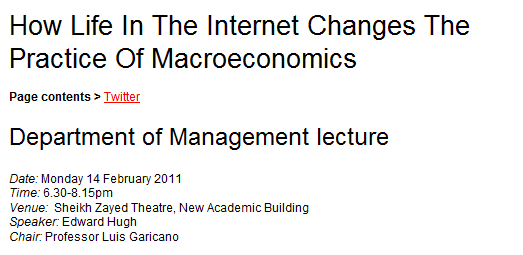
How The Internet Changes The Practice Of Macroeconomics

I have been invited to give a lecture at the LSE next Monday (14 February) about how new sources of information, and access to multiple points of view, affect how we carry out the practice of macroeconomic analysis. It is an open – first-come-first-served – lecture, and all are welcome.

Among the obvious topics I will deal with, like access to information and the role of social networks, I will also be looking into that tricky little issue of why it is so much mainstream academic theoretical output would seem to have contributed so little to our understanding of the present global crisis. Many practitioners of economics neither saw the problem coming, nor have a coherent strategy for finding ways of getting out of it.

In order to “frame” this discussion I will take as my starting point the issues raised in Ricardo Caballero’s recent paper in the Journal of Economic Perspectives: Macroeconomics after the Crisis: Time to Deal with the Pretense-of-Knowledge Syndrome (User friendly downloadable copy here)

Interestingly, the lecture will be chaired by Luis Garicano, who was the man to whom the Queen of England put the awkward and now famous question as to why so few economists actually saw it all coming.

Since I actually studied economics at the LSE, many, many years ago, this event is a kind of homecoming on the personal level.

ancient warfare

Incredible stuff:

The pro-Mubarak crowd suddenly retreated, and the pro-democracy protesters advanced a moveable wall of metal shields to a new front line much further up.

A side battle erupted down a street behind the pro-Mubarak lines, with rock throwing and molotov cocktails.

which means that the anti-regime protestors have organised flank protection. Army input here?

An armored personnel carrier opened fire into the air, shooting red tracers up over Cairo, in an apparent effort to disperse/frighten the pro-Mubarak crowd, who contracted again.

The pro-democracy protesters are now advancing their line of staggered metal shields farther and farther and seem to have gained decisive momentum.

This war nerd piece is absolutely recommended (cheers to Chris).

The journalists on scene are obviously trying to make it clear who, in the general picture, is doing the attacking and who are the victims. But what's equally clear is that there's terrific resistance from the demonstrators; that's why they're still occupying the square. And they appear to be making a fantastic job of it.

i see dominos

The Jacksonauts make their contribution to public discourse:

MPs were given a stark warning this week: "We've already lost Turkey, Lebanon is gone too" – and now the west can't afford to lose Egypt.

The bearer of this message was Mort Zuckerman, the American newspaper and property mogul. He was in Westminster as a guest of the neoconservative Henry Jackson Society, which boasts Michael Gove and Nick Boles among its supporters.

Well, yeah: thanks for that. Allegra Stratton says that the Tories are divided over Egypt and suspicious of their soft-on-the-muslims coalition chums. Well, probably. It’s not a three line whip issue. Personally I think Cameron has been a distinct improvement on this predecessor but one on this. I heard him yesterday going on about how despicable the violence was and thought he sounded…well, quite sweet, really.

The worst prospect for people like the Henry Jackson Society is if the Egyptian revolution succeeds and doesn’t lead to the Brothers establishing the Nilotic branch caliphate. It’s not a result you’d welcome if your financing and raison d’etre is threat-mongering. A lot of so called anti-jihadists have already flipped over into alternate reality, but that’s not an option if you have pretensions to respectability. Not so much, anyway.

goons of yore

Mubarak’s goon squads remind me a bit of the countergangs organised by the Indonesian army to try and terrify the population of East Timor into voting against independence in 1999. They’re described at length in Richard Lloyd Parry’s In the time of Madness.

A number of recruits for these outfits – with names like Red and White Iron – were drawn from children orphaned by the TNI in the original round of massacres after the 1975 invasion and raised in Indonesian orphanages. There was a payroll vote, as you’d expect, and criminal elements raised through various rackets run by Kopassus* partly as a means of harvesting street muscle as required. Quite a few were recruited through an organisation called Gardapaski, supposedly a local version of the Grameen Bank. What it actually did was front money to unemployed young men in return for their support when necessary.

Obviously, Mubarrak’s people will have their own channels for getting the meat on the street. I guess the point here is that a reasonably imaginative dictatorship has all sorts of ways to get the people it needs to do the things it wants done while not wearing official uniforms and that we won’t find out what they are until the system that does it is brought to an end.

And it’ll have to end now. A couple of days ago it was pretty clear that if they put Husni on a plane then the policy status quo could stay basically unchanged; that the removal of Mubarrak would carry enough of a symbolic charge to preserve most of the power of the local overclass, though of course things would have to become more inclusive. I thought that was the strategy: make Husni, or his absence, the change we can believe in, and yay reform. But not now. How can you hope to have an even partially fair election in nine months with the power structure that caused today’s carnage still basically in control?

also: buy gold

"I believe that I can make a case in the end that there are three powers that you will see really emerge. One, a Muslim caliphate that controls the Mideast and parts of Europe. Two, China, that will control Asia, the southern half of Africa, part of the Middle East, Australia, maybe New Zealand, and God only knows what else. And Russia, which will control all of the old former Soviet Union bloc, plus maybe the Netherlands.

A lot of this isn’t too far away from what a lot of rightwingers seem to believe, but what’s the business about Russia and Holland?