About Edward Hugh

Edward 'the bonobo is a Catalan economist of British extraction. After being born, brought-up and educated in the United Kingdom, Edward subsequently settled in Barcelona where he has now lived for over 15 years. As a consequence Edward considers himself to be "Catalan by adoption". He has also to some extent been "adopted by Catalonia", since throughout the current economic crisis he has been a constant voice on TV, radio and in the press arguing in favor of the need for some kind of internal devaluation if Spain wants to stay inside the Euro. By inclination he is a macro economist, but his obsession with trying to understand the economic impact of demographic changes has often taken him far from home, off and away from the more tranquil and placid pastures of the dismal science, into the bracken and thicket of demography, anthropology, biology, sociology and systems theory. All of which has lead him to ask himself whether Thomas Wolfe was not in fact right when he asserted that the fact of the matter is "you can never go home again".

Going Dutch – One Possible Solution To the Euro Debt Crisis?

Looking back over the last 18 months of Europe’s debt crisis, European Central Bank Executive Board member Lorenzo Bini Smaghi recently invoked Winston Churchill’s famous quip, “You can always count on Americans to do the right thing — after they’ve tried everything else.”

Europeans too, he assured his audience would also get it right, eventually. Unfortunately all the coming and going, procrastination, denial and half measures we have seen since the Greek crisis first broke out have not come without a cost, and this cost can be seen in the growing lack of confidence in the markets that a lasting solution to the underlying problems of the common currency will finally be found. Only adding to the problems, even the Americans seem to be having difficulty finding the right thing to do this time round, or at least doing it at the right moment, as the market turbulence following the S&P downgrade has served to underline.

It’s probably too soon to say whether what Europe’s leaders are about to agree on what will ultimately be the “right thing”, but at least there now does seem to be a general recognition that a defining moment is fast approaching, and fundamental changes to the continent’s institutional structure are now on the table. Among the options now being openly advocated and debated is to be found a measure thought unthinkable a year ago — ending Europe’s 13 year experiment with a single currency. But even if this ultimate possibility – the so called nuclear option – were to come to pass, as always there would be a right way and a wrong way of going about it. Continue reading
Is The Risk Accompanying Estonia’s Eurozone Membership Really So Low?

“But the go-ahead Estonians are already scenting the next challenge. Should the single currency crumble, they are determined to be on the inside track for any new German-centred “super-euro”. Goodbye “eastern Europe”; welcome to the “new north”.”
Edward Lucas, writing in The Economist

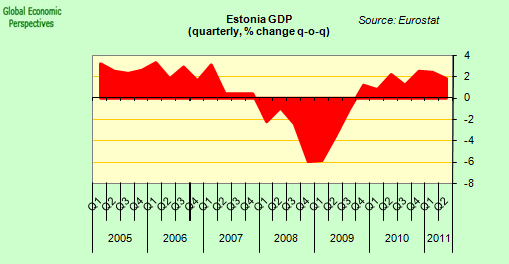
Estonia’s economy put in another sterling performance in the second quarter of this year, even if the expansion rate fell back to quarterly 1.8%, down from 2.4% in Q1, and 2.5% in the last quarter of 2010. Well, you didn’t expect the economy to keep growing at such strong rates for ever, did you? Evidently not. The interannual rate peaked at 8.5% in the first quarter, and dropped back slightly during the last three months to 8.4%, still this is no mean pace.

Continue reading

Could There Really Be A Recession Risk In Germany?

Oh, come on Edward, surely this time you are going too far? The Germany economy is the strongest in Europe, time and again we have been told it is powering and powering ahead. It has just demonstrated record growth performances. So where the hell could you possibly get the crazy idea that Germany might be in for a double-dip recession? Must be the summer Spanish heat. Continue reading

Spain’s High Risk Election Process

As Mr Zapatero put it on Saturday, when he announced the date of Spain’s general election, the decision “is in the country’s interest” since from now on there will be certainty, and “certainty is stability”. While it is quite possible that almost all of Spain’s politicians shared this sentiment, and welcomed the bringing forward of the election date, they may very well be the only ones to do so. Certainty is undoubtedly a strong positive, but when the only thing about your country which people can be certain of is the election date, then maybe on balance you won’t have gained much. Continue reading

A Hungarian Waltz On The Wild Side

The Hungarian government’s much publicised unorthodox plans to cut the country’s public debt level has been attracting a lot of attention of late, both from the media and from the rating agencies. Some observers have been quite positively impressed. Fitch Ratings, for example, raised their outlook on Hungary’s sovereign credit rating in early June from negative to stable, citing government plans to reduce what is currently the largest accumulated public debt among the European Union’s eastern members. Others, however, continue to have their doubts. Moody’s, for example, has decided to maintain a negative outlook on the country’s due to concerns about the general trend in government policy, and the possibility of slippage with deficit objectives. Either way, these are changes within very defined margins, since at the end of the dat Fitch currently still rates Hungary at BBB- and Moody’s at Baa3, in both cases these ratings amount to the lowest investment grades. Continue reading

Recession Warning On Europe’s Periphery

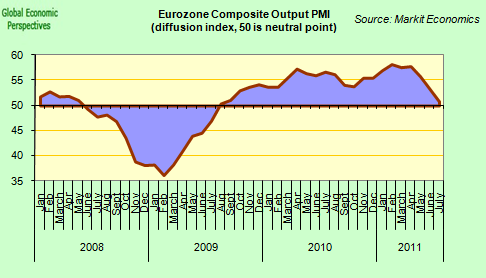
As Europe’s leaders struggle to convince markets that their Greek debt problem-resolution-proposals are actually viable, and will really do the trick, last week’s flash PMI readings seem to have attracted rather less attention than they might. Nonetheless, the fact of the matter is that it is steadily becoming clearer that the current slowdown in Eurozone economic growth is turning into something more than just another one of those pesky “soft patches”. The pace of economic expansion in core Europe has slowed dramatically, falling back in July for the third consecutive month, according to the latest flash PMI. Commenting on the flash results Chris Williamson, Chief Economist at Markit said: “The Eurozone recovery lost almost all of its momentum in July, recording the weakest growth since August 2009 when the recovery first began. Excluding the financial crisis, the July survey was the most downbeat since the Iraq war in 2003, and consistent with a flat trend in quarterly gross domestic product.

Continue reading

Smoke On The East European Horizon?

“The market is pricing these sovereigns at much wider levels than where their agency ratings would imply,” said Diana Allmendinger, a director at Fitch Solutions.CDS on Italy imply a rating of BBB, five notches below its agency rating of AA-minus. And Spain’s implied rating is BB-plus, nine notches below its agency rating of AA-plus.

With so much emphasis being placed on what has been happening farther to the South, economic realities on Europe’s Eastern periphery have largely been escaping the close scrutiny of media and analyst attention. In the wake of the belated recognition of the region’s vulnerability which followed the bout of acute stress experienced during the post-Lehman crisis, a new consensus has now emerged (for an in-depth study of the Latvian example see this piece) that the IMF-guided programmes put in place at the time have essentially set things, if not entirely straight then at least on the right track. In particular, as a result of the extensive fiscal discipline and willingness to sacrifice shown a much brighter future now awaits these countries well to the sidelines of all those horrible Greek debt concerns. Continue reading

Can Italy Grow Its Way Out of Debt?

What follows is simply a follow-up note to my earlier (Elephant in The Euro Room) piece on Italy. The decision by S&P to put Italian sovereign debt on negative outlook, and the subsequent announcement by Moody’s that it was considering a downgrade has been widely commented on by analysts, and it might be interesting to take a look at some of the views that have been advanced on either side of the argument (although for the detailed analysis see me earlier post). But first, a summary of the problem. Continue reading

Nine Reasons Why Spain’s Economy Is More Different Than You Think!

Spain, as those 1990s tourist brochures used to tell us, is different. And it certainly shouldn’t be confused with Greece. Even a cursory look at the most basic of maps should satisfy any doubts we might be harbouring in that regard. But being different is not the same thing as being economically sound. Which is what Societe Generale’s Klaus Baader has just tried to argue in a recent research note: “The Spanish bond market was hit hard in the wake of the quantum leap in the Greece crisis. But fundamentally the case for Spain remains strong”.

In singling out the nine points that Klaus advances in support of his thesis for detailed examination, I do not do so because I find the arguments particulary bad (or even especially “noteworthy” in the negative sense). He has a point of view, and he is doingh is job, and in neither case can I fault him for this.

The reason I have decided to single Klaus out for special treatment here is because he conveniently brings together, in a clear and succinct fashion, a number of arguments which are widely accepted and used by both analysts and policy makers. Unfortunately the fact that arguments are widely held does not make them valid, or in anything other than the most trivial conventialist sense “true”. Indeed it is precisely because I feel that these arguments are not well founded that I have decided to reply to them in this rather detailed way. Basically I don’t buy the idea that Spain is simply suffering from a crisis of confidence, one which, in its turn, puts pressure on the government bond spread. I think Spain has a problem in the fundamentals department, and unless this problem is first accepted and then addressed the wrong (inadequate) remedies will continue to be applied, putting the Eurozone and its citizens at risk of financial catastrophe in the medium term. Continue reading

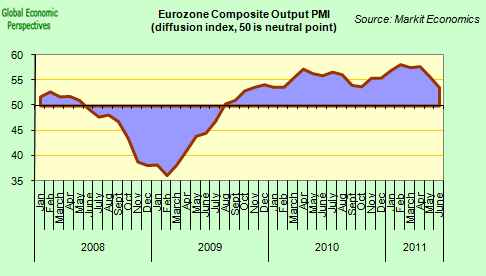
Red Lights Flashing For Eurozone Growth

The June Flash PMI reports, which were out on Thursday, make do not make agreeable reading, in the sense that while the French and German economies both continued to expand during the month, their rate of expansion, and in particular in the leading manufacturing sector, seems to have dropped sharply, and for the second month running. In contrast, the economies on the Eurozone periphery moved closed to outright contraction. All in all the survey results only add to concerns about the global recovery which came into focus after the May PMI results (see my To QE3 or Not to QE3).

Continue reading