About Edward Hugh

Edward 'the bonobo is a Catalan economist of British extraction. After being born, brought-up and educated in the United Kingdom, Edward subsequently settled in Barcelona where he has now lived for over 15 years. As a consequence Edward considers himself to be "Catalan by adoption". He has also to some extent been "adopted by Catalonia", since throughout the current economic crisis he has been a constant voice on TV, radio and in the press arguing in favor of the need for some kind of internal devaluation if Spain wants to stay inside the Euro. By inclination he is a macro economist, but his obsession with trying to understand the economic impact of demographic changes has often taken him far from home, off and away from the more tranquil and placid pastures of the dismal science, into the bracken and thicket of demography, anthropology, biology, sociology and systems theory. All of which has lead him to ask himself whether Thomas Wolfe was not in fact right when he asserted that the fact of the matter is "you can never go home again".

How The Internet Changes The Practice Of Macroeconomics

I have been invited to give a lecture at the LSE next Monday (14 February) about how new sources of information, and access to multiple points of view, affect how we carry out the practice of macroeconomic analysis. It is an open – first-come-first-served – lecture, and all are welcome.
Among the obvious topics I will deal with, like access to information and the role of social networks, I will also be looking into that tricky little issue of why it is so much mainstream academic theoretical output would seem to have contributed so little to our understanding of the present global crisis. Many practitioners of economics neither saw the problem coming, nor have a coherent strategy for finding ways of getting out of it.

In order to “frame” this discussion I will take as my starting point the issues raised in Ricardo Caballero’s recent paper in the Journal of Economic Perspectives: Macroeconomics after the Crisis: Time to Deal with the Pretense-of-Knowledge Syndrome (User friendly downloadable copy here)

Interestingly, the lecture will be chaired by Luis Garicano, who was the man to whom the Queen of England put the awkward and now famous question as to why so few economists actually saw it all coming.

Since I actually studied economics at the LSE, many, many years ago, this event is a kind of homecoming on the personal level.

And Then There Were Seventeen….

“If you know your Thucydides and the Melian dialogue you know that small countries rely most on everyone following the rules. That’s why we follow the rules. If there are no rules, then the big will do what they want,”
Estonian President Toomas Ilves in an interview with the EU observer

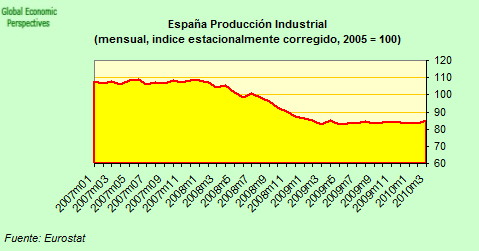
In a blog post which has gathered a certain notoriety, Paul Krugman recently sent the Estonians his condolences. I will send them, not my condolences, but my congratulations, and these not for the somewhat dubious honour of being allowed to join the Eurozone, or even for having carried out a highly successful “internal devaluation” (this outcome is still in doubt), but rather for their stubborness, courage and tenacity. These are indeed hard (and enduring) men and women. And in honour of their courage I offer them a homage, in the form of two charts. The first of these is the latest Estonian industrial production one.


While the second is the Spanish equivalent.

Continue reading

Turkey’s Audacious Experiment In “Post Modern” Monetary Policy

The recent decision of the Turkish Central Bank to lower rather than to raise interest rates in an risky attempt to quench the inflation flames that many feel are threatening to engulf what some call an “overheating” economy (or here) has lead to a good deal of heart-searching and consternation in the economic and financial press of late. After all, at the end of the day aren’t they doing exactly the opposite of what the text book says they should? Well, as is usual in the realm of the dismal science, all is not exactly what it seems to be. Continue reading

Another Lesson In How Not To Go About Things From The EU Commission

The present generation of European leaders will doubtless be remembered for many things, but somewhere high up there on the list will be the appauling sense of bad-timing they seem to have when making critical announcements. The confusion caused by certain ill-considered remarks from Angela Merkel about how private sectors bondholders would need to participate in future EU bailout processes is evidently one good example. Another, without doubt is going to be the decision by EU Commissioner Olli Rehn to appear before the world’s press today (yes, today of all days, one day after the sensitive announcement of the Irish Bank Bail-out plan and the decision to create the European Financial Mechanism), and inform the assembled throngs that as far as the EU Commission could see Spain will not be sticking to its 6% of GDP fiscal deficit committment next year, simply because according to EU calculations the deficit is going to be 6.4% – unless, of course – there is another round of fiscal reduction measures. Continue reading

Greece Is Almost Certainly “On Track” – But Towards Which Destination Is It Headed?

“There is a difficulty that is widely recognized that the amount [of debt] to be repaid is high in 2014 and 2015,” Giorgios Papaconstantinou (the Greek Finance Minister).

“We are confident that Greece will be able to return to the markets. But whether it will be able to return to the markets on a scale that allows Greece to pay off its European partners and the IMF, that is a question.”…”We have a number of options. If paying off the €110 billion loan proves to be a question, we stand ready to exercise some of those options” – Poul Thomsen, head of the IMF team in the ECB-EU-IMF troika delegation.

“In the rushed last-minute deal to forestall certain bankruptcy, everyone missed one very important fact. That the memorandum created an unrealistic and immense borrowing squeeze on the feckless Greek state for the next five years.”
Nick Skrekas – Refusing Greek Loan Extensions Defies Financial Reality, Wall Street Journal

Get On The Right Track Baby!

According to the latest IMF-EU report Greece’s reform programme remians “broadly on track” even if the international lenders do acknowledge that this years fiscal deficit target will now not be met and that a fresh round of structural measures is needed if the country is to generate a sustained recovery. My difficulty here must be with my understanding of the English lexemes “remains” and “sustainable”, since for something to remain on track it should have been running along it previously (rather than never having gotten on it), and for something – in this case a recovery – to be sustained, it first needs to get started, and with an economy looking set to contract by nearly 4% this year, and the IMF forecasting a further shrinkage of 2.6% next year, many Greeks could be forgiven for thinking that talk of recovery at this point is, at the very least, premature. A more useful question might be “what kind of medicine is this that we are being given”, and “what are the realistic chances that it actually works”. Unfortunately, in the weird and wonderful world of Macro Economics, witch doctors are not in short supply. Continue reading

Spain’s Troubling Unemployment Statistics

Spain’s statistics office continue to issue worryingly confusing press releases. The latest example is one published in connection with the quarterly labour force survey which came out last Friday.

Now the data the INE assemble in their report is very interesting, and as many observe, the complete survey gives far more reliable data about the state of the labour market than the monthly labour office signings do.

But the way they present the data isn’t interesting, in fact its downright misleading. In particular they chose not to seasonally adjust the data – which in a seasonally driven economy like the Spanish one with significant ups and downs in tourist activity doesn’t make much sense – and this omission is not only lazy, it is negligent. As I say, it is misleading, in the same way the information on VAT returns and deficit reduction progress issued by the Ministerio de Economía y Hacienda is misleading (they do not, for example, clarifying the changed VAT refunds procedure), or in the same way the notarial contracts data gives a completely topsy turvy view of movements in Spanish house prices. At best such data gives completely meaningless information, and at worst it leads reporters who cover the Spanish economy hopelessly astray. Continue reading

What Goes Up……….

Spain’s troubled banking sector is back in the news again. Despite the apparently succesful stress tests carried out over the summer problems persist, and don’t seem likely to go away soon. Foremost among these is the steady rise in problem loans which have now risen to an all-time high, potentially endangering the credit rating of the country’s financial institutions, according to a recent report from the credit ratings agency Moody’s. Continue reading

Mr Zapatero Said What……….?

Spain’s Tinsa Price Index was out last week, and showed Spanish property prices fell again in September, and at an accelerating rate. As Tinsa point out in their report, both “Metropolitan Areas and municipalities on the Mediterranean Coast,” whose rates experienced a significant drop from the previous month, have contributed decisively to this steep decline”.

Continue reading

An Unusual But Interesting Argument Which May Help To Understand Why QE2 Is Now Almost Inevitable

For reasons which aren’t worth going into now, I’m reading through a recent report by Deutsche Bank Global Markets Research entitled “From The Golden To The Grey Age” this afternoon. The report (all 100 pages of it, many thanks to researchers Jim Reid and Nick Burns who produced the thing) looks at the extent to which a variety of macro indicators – like GDP growth, inflation rate, equity yields, etc – may have been influenced by demographic forces over the last 100 years or so. It is certainly one of the most systematic reports of its kind I have seen, and well worth losing a Saturday afternoon to read. Continue reading