About Edward Hugh

Edward 'the bonobo is a Catalan economist of British extraction. After being born, brought-up and educated in the United Kingdom, Edward subsequently settled in Barcelona where he has now lived for over 15 years. As a consequence Edward considers himself to be "Catalan by adoption". He has also to some extent been "adopted by Catalonia", since throughout the current economic crisis he has been a constant voice on TV, radio and in the press arguing in favor of the need for some kind of internal devaluation if Spain wants to stay inside the Euro. By inclination he is a macro economist, but his obsession with trying to understand the economic impact of demographic changes has often taken him far from home, off and away from the more tranquil and placid pastures of the dismal science, into the bracken and thicket of demography, anthropology, biology, sociology and systems theory. All of which has lead him to ask himself whether Thomas Wolfe was not in fact right when he asserted that the fact of the matter is "you can never go home again".

Just What Is The Economist Up To In It’s Seeming Crusade Against Catalunya?

Well, this is certainly not the first time I have had cause to complain about the quality of the journalism and economic reporting served up over at the Economist, and I’m damn sure it won’t be the last. But this latest example of shoddy (I would almost even go so far as to use the word “gutter”) journalism certainly takes the biscuit. Catalunya, the august magazine informs its readers is the “Land of the Ban” – “First the burqa, now the bullfight. What will Catalonia outlaw next?” Evidently the author of the article is entitled to his opinion, but could it be that the long-standing practice of incorporating unsigned opinion pieces may now have lost its earlier justification, and may it not somehow have inadvertently converted itself into a rather cowardly way of expressing otherwise hard to justify opinions behind the safe shield of anonymity. Or would our author really like to show us that valour is, at least in this case, the better part of discretion, and enter the arena in persona in order to face the wrath of the Catalan bull?

“The bullfight is not a sport in the Anglo-Saxon sense of the word,” wrote Hemingway in his classic treatise Death in the Afternoon, “that is, it is not an equal contest, or an attempt at an equal contest between a bull and a man. Rather, it is a tragedy; the death of the bull, which is played, more or less well, by the bull and the man involved, and in which there is danger for the man, but certain death for the animal.”

Continue reading

Do The Latest European Bank Lending Numbers Reveal A Major Headache Looming For The ECB?

According to Ralph Atkins, writing in the Financial Times:

“Eurozone mortgage borrowing grew last month at the fastest pace in almost two years in a sign that bank lending across the 16-country region may be flickering back to life. Lending for house purchases rose at an annual rate of 3.4 per cent in June – the fastest since September 2008, according to European Central Bank data published on Tuesday. The acceleration pointed to a revival in consumer confidence and an increased willingness by banks to fuel the economic recovery with loans to the private sector.”

So is this really the good news it seems to be? Well the answer is (as usual) yes and no. The problem is that behind the positive aggregate data lie the individual national details (you know, the place where the devil is usually to be found), and when we dig down to this level, then we find the position is much more complicated than it seems. Nor should this surprise us, since if a one size fits all interest rate policy didn’t work in the pre 2008 world (just look what happened to Spain and Ireland for heavens sake), is there any good reason to assume that it will in a post 2010 one? Continue reading

Latvia: The Demographic Price Of Procrastination

One of the things I think we can safely say about the impact of the current economic crisis is that the face of Macro Economic theory will never be the same again. Quite what the macro economics of the future will look like is too early to say, but what is clear enough is that the existing corpus has been tested and found wanting: it’s predictive capacity is very, very limited, and this is obviously a far from satisfactory situation.

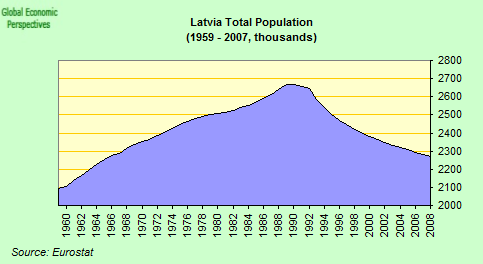
At the same time, new ideas, and new perspectives are emerging. I have already spoken earlier this morning about the key issue of “non linearities” in the context of Jordi Molins’ discussion of the weaknesses of the stress test methodology. Claus has spoken about some of the issues raised by the attempt to put macro theory on micro foundations, and now I would like to present an important, if little known, piece of research coming from Latvia – one of the canaries in the coal-mine on the whole Eurozone sovereign debt issue. Eliana Marino’s work is both extremely interesting and extraordinarily important, since what it illustrates is the negative feedback mechanism that can be activated by having an “L” shaped non-recovery in a rapidly ageing society with extremely low underlying fertility. What Eliana did was something macro economists seldom consider doing, she carried out some qualitative research, rather than running a computer model, to find out just what was happening on the ground.

The resulting survey, which she personally conducted in Riga from September to December 2009 and which involved some of the leading Latvian experts on migration issues, lead her to estimate that around 30,000 people may well have left Latvia in 2009 and the same number are likely to follow them in 2010. These numbers are considerably greater than the official register shows. As she argues these large emigration flows from Latvia will have a significant effect on the future demographic and economic path of the country, creating serious problems of labour shortage, unsustanability of the pension system and accelerating the already significant population decline.

And just why may Latvia be a canary down the coal-mine in this context? Well think about Spain, where the housing boom attracted in the best part of 6 million people – in a country where the rate of natural change in the population was stagnant. Now imagine that with 20% unemployment as the continuing outlook for the country over the best part of the next decade, what might happen there. People could vote with their feet, and the population could contract just as rapidly as it grew, leaving that 1.5 million currently unsellable housing units even more unsellable than ever. The warning signs are there. The number of those contributing to the social security system continues to stagnate, even as unemployment remains unchanged, so where are the people? Some have obviously found their way into the growing informal economy, but others have surely left, and there is plenty of anecdotal evidence to support this idea. In addition, the rate of new household formation turned negative in the first quarter, for the first time in the series history.

At the end of the day, the truth of the matter is that we really don’t know what is happening in Spain, so would the Spanish Eliana Marino please kindly step forward? Continue reading

Interpreting The Stress Tests

Evidently there is now a considerable debate out there about the famous (or should that be infamous) CEBS stress tests. Methodologically all sorts of weaknesses have been identified, but in many cases these are decidedly beside the point. It is important to be aware what the tests were (and weren’t) designed to show. They were, it seems to me, essentially designed to free up lending in the short term European interbank market, nothing more, nothing less. This would be useful since it would enable the ECB to step out of playing this particular role. And it may well happen, since if everyone can agree that no European bank is going to fail tomorrow, or be allowed to fail tomorrow, then there should be no difficulty for one bank to lend to another for 24 hours, and so on.

But this issue is a quite separate one from the longer term funding needs of the Spanish banking system, for example, or from the longer term solvency of Greek sovereign debt, where a large quantity of asset backed securities of one kind or another need to be re-financed in the months and years to come. This is a much more complicated issue, since no one has a really very clear idea of the longer term value of the securities which back the pieces of paper, either in the Spanish or the Greek cases, and the stress tests have done nothing to resolve this issue. And that is not surprising, since they were never intended to serve that purpose.

What the tests have I think made reasonably clear is that no EU bank or sovereign will be allowed to fail between now and the end of 2011. They will not be allowed to fail, quite simply because the ECB and the European Financial Stability Facility are there to guarantee that they don’t. So something is something. The Eurozone was created without due care and attention being paid to the kind of institutional backdrop which would be required to support it if things went wrong. Now things certainly have gone wrong – in ways which I think were perfectly forseeable, but let’s not push that one too hard right now – and we are in the process of putting some of the institutional support in place. Like Gaudi’s famous Sagrada Familia, what we have is a work in progress, with no evident end-date in sight, and no detailed blueprint of what the thing will finally look like. Debate about the future is, as they say, “ongoing”, and the situation is “fluid”.

At the same time issues about the per se usefulness of the kinds of tests the CEBS have just carried out remain, and continue to be legitimate areas of discussion. Some people have spoken about the likelihood of tail risk events (not forseen in the stress tests). But to some extent even this argument misses the point, since I am not sure that what we are talking about are “tail risks” in a situation like the Spanish or Greek one. The kind of cascading scenario (debt snowball, for example) we could see actually forms part of what anyone with a solid grasp of the underlying macro should actually expect to happen if no one does something to ensure it doesn’t, for the simple reason that all the various economic agents are effectively “inter-linked”, so when one part of the system goes down, then the rest can come crashing down behind it. And this is what will almost inevitably happen if someone, somewhere doesn’t find a way to revert the Spanish and Greek economies to a sustainable growth path.

With this in mind, and with due regard to the fact that most of the models conventional economists and financial analysts work with make all kinds of “linearity” assumptions when in fact many of the processes involved are decidedly non-linear, and subject to various kinds of interconnectedness issues and feedback loops, I though it might be useful to reproduce here an argument to this effect recently made by my friend, the Catalan economist Jordi Molins. So without more fuss or flourish, here its is. Continue reading

Under Stress

After a long and rather tense wait, the initial response to the publication of the European bank stress tests was always going to be something of an anti-climax. Indeed the results should hardly have comes as a surprise to anyone It is hardly breaking news to learn that a number of Spanish cajas will find themselves badly undercapitalised if the economic recovery – as surely might be expected – fails to materialise as planned. For the rest, the outcome is really a victory for politically correct: thinking. The situation, we learn, is slightly more serious than previously acknowleged, but we are a long way from seeing the imminent collapse of the European financial system. How could we be, when we have the friendly face of the ECB, always there ready to offer a helping hand. Continue reading

Oh It’s All Gone Quiet Over In The Eurozone!

Or has it? According to Anchalee Worrachate in Bloomberg:

“A report from the Bank of Spain showed Spanish lenders borrowed a record 126.3 billion euros ($161 billion) from the ECB in June as investors shunned the nation’s banks. Spain’s banks increased borrowing 48 percent from 85.6 billion euros in May. That compares with a drop of 4 percent to 496.6 billion euros that the ECB provided lenders in the whole euro area. Spanish banks haven’t sold any bonds publicly in the past two months on concern the nation won’t be able to cut its deficit without hurting the economy.”

Pretty hard to argue now the Spanish bank borrowing from the ECB is simply in line with the country’s share of total GDP I would have thought. Also, after having trended upwards ever so slightly for a couple of months, Spain’s industrial output actually fell back again in May (by 0.3%) while output in Germany roared ahead by 2.9%. Obviously not everyone is getting the same benefit from the weaker euro, could competitiveness have anything to do with it, I wonder?

Quoted in the Financial Times earlier today Klaus Regling, chief executive of the European Financial Stability Facility said the fund would be “ready to act whenever the politicians tell us to act.” I guess the situation of Spain’s banks would be one of the things he must have had in mind.

Using a footballing analogy, you get to see a lot in the press about how this club is chasing this player, while that one is chasing another one, until the moment of the actually negotiations comes. Somehow, at that point the sporting press goes strangely silent.

Of course, when those much talked of stress test finally come out, we’ll all be able to see for ourselves that Spain’s banks – apart from a few ropey old Cajas that no one in their right mind would be interested in anyway – are in absolutely sterling and tip top condition (and not like their shabby German counterparts at all). Won’t we José (Viñals)?

Or are those reponsible for the Spanish banking system finally going to face up to their responsibilities, amble out of that closet they have been tightly locked away inside for the last three years, and follow the advice of Jacques Cailloux, chief European economist at RBS, by seizing opportunity provided by this months “getting it all out in the open” fest to start restoring investor confidence by really getting down to straightening out the mess? Continue reading

Is There Global Economic Slowdown In The Works?

According to Ralph Atkins writing in the Financial Times last week, “the pace of Germany’s recovery is helping dispel fears of a “double dip” recession across the continent as a result of the crisis over public finances in southern European countries”. Coincidentally, however, on the very same day, Alan Beattie writing from Washington informed us that the IMF feel “the risk of a slowdown in the global economic recovery has risen sharply”. This left me asking myself which is it: is the global recovery a question of up up and away, or are we at the start of a renewed slowdown (whether or not you wish to term this a “double-dip”)? So I thought I would take a look through some of the most recent data (both hard and soft) to see if I could make any sense of the situation. Continue reading

Croatia: On The Brink of What?

As Croatia enters the final stage of its EU membership talks, it is perhaps a fitting moment to review the other half of the picture, namely where the Croatian economy finds itself, and what the outlook might be for a continuing convergence with the requirements of Euro membership. Understandably, EU officials are fairly cautious about the likely shape and progress of the forthcoming talks (the Union has, after all got rather a lot on its plate at the moment), but Croatian Prime Minister Jadranka Kosor is decidedly more optimistic, since while she recognises that this last phase is likely to be “really difficult and demanding” she still believes that negotiations could be concluded by the end of the year, which would mean that membership in 2012 would become a possibility. Continue reading

Migration Flows and Economic Sustainability In The Baltics

Here’s the third in the series of paper abstracts submitted to the Bologna conference in 2007 and which weren’t considered sufficiently interesting to be selected for presentation. This time the topic is migration and the Baltics, and the authors are Aapo Markkenen and Claus Vistesen. (for the two previous abstracts, and more about what this is all about, see here, and here). Evidently the subject is still highly topical. Only last Friday the Wall Street Journal had an article of the growing problem of human capital exodus in Greece. It is very important that people understand that when it comes to economic processes, no decision is ever completely free. There are always on-costs of some kind or another. In this case, a failure to act vigourously enough to restore competitiveness simply means that employment creation becomes far too slow, and people leave. This has the consequence that the population ages more rapidly, and that a return to economic growth is even slower. So more people enter despair and leave, and so on. Well, now for the abstract, and note the last paragraph:

Finally it will be argued that the directional and value component which is implicit in the current migration flows is quite simply unsustainable. Unless the Baltic States address the underlying issues of low fertility in the context of rapid ageing and to some extent reverse the ‘brain flight’ which has been so far associated with this, then absence of a sufficient supply of adequately qualified labour will in the space of a decade or so lead to a significant slowdown in the steady sectoral transition in economic activity and place a break on employment expansion in such a way that the economic growth process will either stagnate or even enter decline.

Continue reading