About Edward Hugh

Edward 'the bonobo is a Catalan economist of British extraction. After being born, brought-up and educated in the United Kingdom, Edward subsequently settled in Barcelona where he has now lived for over 15 years. As a consequence Edward considers himself to be "Catalan by adoption". He has also to some extent been "adopted by Catalonia", since throughout the current economic crisis he has been a constant voice on TV, radio and in the press arguing in favor of the need for some kind of internal devaluation if Spain wants to stay inside the Euro. By inclination he is a macro economist, but his obsession with trying to understand the economic impact of demographic changes has often taken him far from home, off and away from the more tranquil and placid pastures of the dismal science, into the bracken and thicket of demography, anthropology, biology, sociology and systems theory. All of which has lead him to ask himself whether Thomas Wolfe was not in fact right when he asserted that the fact of the matter is "you can never go home again".

Contagion Turns East

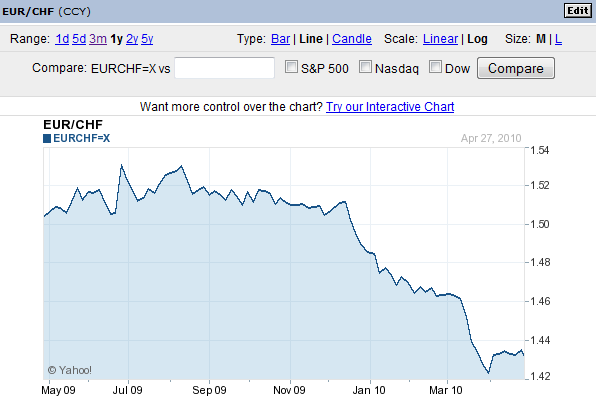
Well, I don’t know how many other people have noticed, but the Hungarian forint has been having rather a hard time of it over the past few days. The currency was down by as much 1.3 percent against the euro at one point today, today making the two-day intraday loss 3.6 percent, and this according to Bloomberg, was the biggest such fall since March last year. The Polish zloty also has weakend slightly, and fell by 0.1 percent to 3.9333 against the euro today while the Czech koruna gained 0.1 percent to 25.582 against the euro. At the same time the cost of credit default swaps on Hungarian debt rose 23.5 basis points to 240. Now virtually all currencies associated with the euro have been having a hard time of it in recent days, but what matters is the magnitude of the pressure being felt in each case, and Hungary here has been unlucky enough to have entered a period of political uncertainty at just the time when the level of market nervousness is higher than normal. There is another problem too. Over 85% of Hungarian home mortgages are not in forints, they are not even in euros, they are in Swiss francs, and the CHF has risen sharply against the euro since the start of the year. So unfortunately Hungarians don’t even benefit from the euros woes.

Really, and unfortunately, this is the one I had been waiting for, and expecting. And precisely why did has the forint tanked in this way? What is so special about Hungary? After all, aren’t many of Europe’s economies seeing the cost of financing their government debt rising sharply over recent days. Basically one of the key reasons the forint has taken such a sharp knock is that Viktor Orban, Hungary’s new premier-in-waiting, just said in public what everyone following Hungary has been thinking (and saying) for weeks now: Hungary’s fiscal deficit is going to be higher (possibly significantly higher) than the target agreed with the IMF. Other factors have also added to the level of concern about the country. What exactly will the core orientation of the incoming government economic policy be, and how much political interference might there be in the financial and monetary institutional structure? Certainly things haven’t been helped by the way Hungary’s incoming Prime Minister has publicly criticised the financial markets regulator (PSZÁF) and even gone so far as to give the impression he would like to replace central bank (National Bank of Hungary – NBH) governor Andras Simor (see Portfolio Hungary account here). In a world like the one we live in right now, what you ask for is what you get, and so get it they did. Continue reading

The Greek Tragedy Continues

The future of the Eurozone is decidedly hanging in the balance at the moment. As I said earlier in the week, the problem isn’t a simple question economics anymore: everything now is all about credibility, about who does what, and when, and how everyone else reacts. As the crisis trundles on and on, news that Greek bond spreads have hit ever higher post European Monetary Union records has become such a regular event that the process now seems almost a monotonous one. However, what happened on what we could now call this week’s Greek “Black Thursday” certainly marked a new, and more worrying milestone in the ever evolving crisis. The news this morning that Greece has demanded the activation of the EU-IMF loan – news which apparently took even the EU Commission itself by surprise it seems – only adds to the general sense of confusion that abounds. Continue reading

China’s Recent Trade Deficit: Is What You Yuan What You’re Gonna Get?

China is self-evidently both a minefield and a potential graveyard for would-be global economists, the sort of place where reputations are made and lost in the twinkle of a dragon’s eye, so I think had better tread rather carefully here. However, having duly noted that only fools rush in, here I go… Continue reading

Is Estonia’s Euro Membership A Done Deal?

Well, if you read this report from Euractiv, citing unnamed EU Commission officials, it is:

“If nothing extraordinary happens, the Commission will give its positive opinion for the accession of Estonia to the euro zone on 12 May,” an EU official said, clearing the way for Baltic country to join the euro in 2011.

There just one little snag here: that extraordinary, “fat tail” event seems to have just happened. For the Commission to be able to move forward on Estonia’s Euro Membership, the ECB have to agree. And it is here that Estonian journalist Mikk Salu steps in (in Estonian in the newspaper Eesti Päevaleht, summarised in English here) and says “not so fast”. Salu reports on a closed-door meeting of the Economic and Monetary Affairs Committee of the European Parliament held last Tuesday (April 13). The meeting had a single-item agenda: Estonia’s membership of the Eurozone, and the meeting was attended by ECB Executive Board member Jüergen Stark. According to MEPs who attended the meeting (but did not wish to be identified), Stark was “stark”: Estonia is not going to be admitted. The reason given was that in the wake of the recent crisis affecting the Eurozone, new criteria will be introduced – including per capita GDP and competitiveness sustainability – and on these counts Estonia will not qualify.

Salu also spoke to Estonian MEP Ivari Padar, who attended the meeting and confirmed the substance of the discussion, although Padar did try to mediate the situation slightly, saying, “you know, he is a central banker, and central bankers are a conservative lot”, etc etc. On phoning the ECB itself and the Commission the only reply he got to a straight question seems to have been “no comment”.

Basically, as I said, maybe the ECB are a conservative crowd, but I think it is very hard to see Estonia being admitted to the Euro without ECB backing, and indeed looking at what is happening over in Greece at the moment, and in the German Constitutional Court, I think it is very hard to see any new members at all in the immediate future. Consensus thinking right now seems to be more towards small(er) is more beautiful.

None of this surprises me, indeed when I wrote my last post on Estonia, back in February, it seemed to be an increasingly likely outcome.

But as Fitch pointed out when they raised their Estonia outlook, while eurozone membership looks increasingly possible it is not yet certain. Fitch warned in their report that even if Estonia meat all the formal Maastricht reference criteria for euro entry there is still a risk that the European authorities’ interpretation of these same criteria could lead them to reject Estonia’s application. According to Fitch, in Estonia’s case uncertainty surrounded whether the idea of “sustainable price performance” was going to be consistent with the deflation which is to be expected from such a severe recession, after inflation had so recently been in the double digit range. The agency also added that one-off measures taken by the government to reduce the budget deficit in 2009 could also count against it in the EU authorities’ judgment of whether the medium-term budget plans are credible.

The first point is an important one I think, and is reiterated by the ECB’s own Jürgen Stark in an interview given to the German magazine Der Spiegel for this weekend: “But when taking on board new members, we will need to take an even closer look, concerning the data and the sustainability of convergence,” he is quoted as saying.

Indeed if we go back to the 172 page EU Commission document leaked to the German magazine Der Spiegel last month, the EU Stability and Growth Pact is increasingly going to focus on issues surrounding competitiveness as well as on fiscal deficit ones. That is what the whole deabate over the Greek and Spanish economies which EU leaders are engaging in this week is all about. And any country which is not considered to be in completely good health under the SGP criteria is hardly likely to get the green light from the ECB and Ecofin.

It is obvious that the Estonian economy is still suffering from earlier structural distortions which have not yet been corrected. If we come to the consumer price index, this was only down about 2% in 2009, far short of the deflationary adjustment which will be needed to restore growth and competitiveness.

And to cap it all, for the first time since the start of the financial crisis, Moody’s has chosen this, of all, moments to up its ratings outlooks for Lithuania, Latvia and Estonia. The decision was apparently based on the idea that the contraction has been stabilized (which it has), but as we are unfortunately about to see, stabilization and getting back to growth are not one and the same thing. In Estonia’s case the more favourable rating was a reflection of the expectation that the country “will soon be able to join the eurozone”:

Estonia’s “economy and banking sector are exhibiting signs of a gradual recovery,” Kenneth Orchard, a Moody’s analyst in London, said. “Equally important, the government’s impressive fiscal performance in 2009 means that Estonia is likely to be permitted to adopt the euro next year.”

And if I’m reading this report aright, Latvia just declared a 9% general government fiscal deficit for 2009, well above the 6.7% which was originally estimated. Cry victory if you will, but perhaps it would be prudent to wait till the war is actually over before you cry it too loudly.

Angela Calling Update

Well, it seems the EU leadership have finally been able to take a decision on what to lend and what to charge (see original post here). According to initial press reports the German government has decided in principal to participate in loans to Greece at below-market interest rates, dropping its original opposition to the idea. The loans – which are said to total 30 billion euros from the Eurogroup countries at an interest rate of around 5% – will still be priced above the rate charged by the International Monetary Fund, which will also participate in the rescue, and will lend an additional, as yet unspecified, sum, although according to Olli Rehn, EU monetary affairs Commissioner, the IMF contribution is likely to be around 10%. Rehn also said the funds will be available if and when Greece makes a formal request for financial assistance, something it has yet to do.

So now we know how this begins. We have yet to see where and how it will end.

Angela Calling

Angela Merkel is a Chemist. In her doctoral thesis – entitled “Untersuchung des Mechanismus von Zerfallsreaktionen mit einfachem Bindungsbruch und Berechnung ihrer Geschwindigkeitskonstanten auf der Grundlage quantenchemischer und statistischer Methoden” – she demonstrated herself to be a thoroughgoing expert when it comes to analysing the speed of disintegration of chemical compounds once the bonds which hold them together are weakened. Unfortunately she is now having to apply all this acquired expertise and know-how in a determined attempt to avoid the break up and falling apart, not of a highly complex chemical substance, but of an even more complex economic and political one, and the bonds which are the focus of all her attention right now are not chemical, but financial and social. Continue reading

From A Greek Debt Crisis To A Eurozone Structural One?

When we look back five years from now, will we see this week as marking a turning point in the short, but far from uneventful, ten year history of Europe’s common currency? Certainly recent comments by the deputy governor of the People’s Bank of China have made evident what was already implicit: the dependence of EU sovereign debt on sentiment in global markets, especially in Asia and the Americas. Simon Derrick, chief currency strategist at Bank of New York Mellon even went so far as to say the trauma of recent days might well signal the point that we stop talking about a “Greek debt crisis” and start talking about a “Eurozone structural crisis” . And while Herman Van Rompuy, president of the European Council, was telling us on the one hand that the eurozone will never let Greece fail, Jane Foley, research director at Forex.com busied herself explaining, on the other, that any involvement of the International Monetary Fund in helping Greece to stabilise its fiscal position only heightens the risk that the country might one day end up leaving the eurozone. So just where are we at this point? Continue reading

Why Not Unravel The IMF Too While We’re At It?

If you’re really good at making a pigs ear of things, why not join the EU? Of course, this is not meant as a piece of solid advice, rather it is a cry of frustration at being impotently forced to watch so many things done so badly, each in turn, and one after the other. Southern Europe’s problem is essentially a competitiveness problem, and not a fiscal one, and if many states have been having growing difficulty with their negative fiscal balances, this is a symptom of the problem, and not its cause. Even in the worst of cases – countries like Greece and Portugal – the rising recourse to fiscal outlays has been a response to lack of “healthy” growth, and the root cause of this continuing difficulty in generating real growth has been the underlying lack of competitiveness, and the inability to export your way out of trouble once the burden of debt starts to rise, so simply pruning the fiscal side isn’t going to cure the problem, and by now that simple point should be obvious, I would have thought. Continue reading