About Edward Hugh

Edward 'the bonobo is a Catalan economist of British extraction. After being born, brought-up and educated in the United Kingdom, Edward subsequently settled in Barcelona where he has now lived for over 15 years. As a consequence Edward considers himself to be "Catalan by adoption". He has also to some extent been "adopted by Catalonia", since throughout the current economic crisis he has been a constant voice on TV, radio and in the press arguing in favor of the need for some kind of internal devaluation if Spain wants to stay inside the Euro. By inclination he is a macro economist, but his obsession with trying to understand the economic impact of demographic changes has often taken him far from home, off and away from the more tranquil and placid pastures of the dismal science, into the bracken and thicket of demography, anthropology, biology, sociology and systems theory. All of which has lead him to ask himself whether Thomas Wolfe was not in fact right when he asserted that the fact of the matter is "you can never go home again".

Italy’s Recession Deepens

Italian fourth-quarter gross domestic product declined at the fastest quarterly rate in nearly 30 years, sending Europe’s fourth-largest economy off into an even deeper recession. According to ISTAT preliminary estimates, Italian GDP fell 1.8% between Q3 and Q4 in seasonally and working day adjusted terms. If confirmed, this quarterly decline would be the sharpest recorded since 1980. GDP fell in the previous quarter by 0.6%. Year on year, overall output in the Italian economy dropped by 2.6% in Q4, down from both the 1.7% contraction expected and Q3’s annualized fall of 1.1%.

Across 2008 as a whole, the Italian economy fell 0.9%, ISTAT said, the most pronounced decline recorded since 1993.The Italian economy officially fell into recession in the third quarter of 2008. And one more interesting detail, Italian GDP is now back at the same level it was in Q4 2005, and falling. This is pretty worrying, and even more so given there are quite a lot more people in Italy then there were in 2005.

Estonia’s Economy Contracts At Record Pace At The End Of 2008

Estonia’s economy contracted at the fastest year on year rate in at least 15 years in the fourth quarterof 2008. Commenting on the news the Estonian Finance Ministry restricted himself to the obvious, “the recession may deepen this year”, he said. The economy shrank an annual 9.4 percent, the second-worst performance in the European Union (after Latvia), following a 3.5 percent year on year contraction in the third quarter. The contraction was 4.2% quarter over quarter. That is 16.8% annualised. Absolutely horrible.

“This is the worst economic crisis in Estonia since Estonian independence” in 1991, Lars Christensen and Violeta Klyviene, analysts at Danske Bank A/S said in an e-mail today. “Nobody can now deny that the crisis in the Baltic economies is at least as bad as the Asia crisis of 1997-1998 or the Argentinean crisis of 2001-2002.”

The Czech Republic Probably Entered Recession At The End Of 2008

Well as forecast on this blog (see also here), the Czech Republic’s economy contracted in the last quarter of 2008. Since the economy is still contracting sharply, we will more than likely now see a second quarter of negative growth, which means the CR is now in recession.

The Czech economy contracted less than expected in the fourth quarter but the outlook for this year remained grim due to collapsing demand in the euro zone slashing Czech exports. The Czech Statistical Bureau said on Friday the central European country’s output dropped by 0.6 percent quarter-on-quarter, adjusted for seasonal and calendar effects, the worst number since 1997. Year-on-year, the economy eked out 1.0 percent growth, much better than 0.2 percent expansion forecast in a Reuters poll of analysts but a drop from 4.2 percent growth in the third quarter. “It doesn’t really change the outlook going forward,” said Raffaella Tenconi, analyst at Wood & Company. “We’re looking at -2.0 percent growth for all of 2009, and if anything, there are downside risks to it,” she said.

Continue reading

Germany’s Incredible Shrinking Economy

The FT says this is worse than feared, and I say it is just what I was expecting (see here, I do hope that doesn’t make me one of those “visionaries” you are all so busy talking about).

Germany’s economic slump in the final quarter of 2008 proved worse than feared, official figures showed on Friday, with the country posting the sharpest fall in gross domestic product since the country was reunified in 1990.The larger-than-expected 2.1 per cent plunge in GDP in the final three months of the year showed Europe’s largest economy contracting at a faster pace than the UK in the same period and threatening to drag down the performance of the 16-country eurozone.
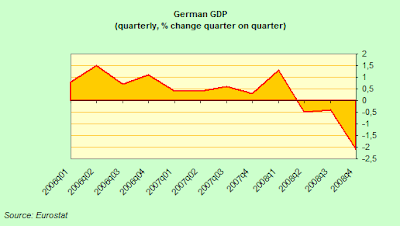
A 2.1% quarterly contraction, for those who are confused by the way we economists do things is equivalent to an 8.4% annualised rate of contraction, which is quite something (although in fairness some of this comes from Q3 when there was a big build up in inventories, which has now unwound). But the real question, when all the dust settles, is going to be why it is that economies like those in Germany and Japan are so incredibly export dependent (remember, all those “decoupling” arguments which were so in fashion not so long ago). My view is “its the demography silly”, but then we can’t go back 30 years and change all that with the wave of a wand, so we really don need some out of the box thinking on the global imbalances soon (see Claus’s arguments in his last post).

Meantime the EU are working furiously away on the next “top secret” European bank bailout proposal (does this have anything to do with the unexpected rapid departure of Michael Glos last weekend? – all of this was most strange, see here). Details are sof the coming bank bailout proposals are still scarce at this point, but the excitable Telegraph do come up with a very hair-raising number (16.3 trillion pounds, see here). As I have been arguing, far from Germany subsidising the rest of the EU, Germany may well be at the heart of the bailout, needing support from the rest of us, which is why we need EU bonds, and we need them now. United we stand, divided we go down the plughole!

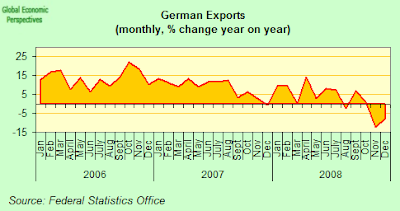
And if you have any doubt about the export connection, just look at the chart below, not an exact fit, but an obvious close correlation. Germany needs a demographic fix, simply going for longer shopping hours (and the like) won’t work in a case like this.
And as for labour market reforms, just look how many jobs Germany created this time round.

Words Of Wisdom On Krugman And Protectionism (Wonky)

Well I’m putting this piece from Claus Vistesen up here wholesale, since I think he advances some very important arguments that need a wider airing. Basically I started off agreeing with Paul here, but now Claus has convinced me: we cannot get out of this if we don’t address the global imbalances which produced the whole situation, and we can’t address the imbalances if we don’t start to think about the asymmetric demography which lies behind them (I wonder what the “visionary” Taleb set have to say about all this?). As Claus himself says:

First of all, I think that the Economist’s intuition is fundamentally right; the probability that short term protectionism would be anything but this is very large. I am not necessarily referring to the historical example with Reed Smoot and Willis Hawley, but rather to the point that since this crisis is going to be long lived the risk of using protectionism in what ever explicit form is too large.

Secondly, I think that global current imbalances are important to take into account here and if we want to allow economies to enjoy the ability to substitute consumption for saving (and vice versa) over time one fundamental pre-requisite is a commitment to openness. This does not mean that this will be the solution in and of itself. As I also pointed out above, this openess and the factors which may be deliberate in a political sense (e.g. pegging to the USD forming BW II) or more structural (demographic) are also one of the roots to why we are here. Yet, I think that we are still better off not considering protectionism for the simple reason that I believe whole economies (and not just small ones) would be devastated as a result.

Continue reading

Russian Debt And The Euro

Keynes’s genius – a very English one – was to insist we should approach an economic system not as a morality play but as a technical challenge.
Martin Wolf, Financial Times

The euro fell again yesterday, by 1.1 percent against the dollar (to $1.2860) and by 1.2 percent against the yen (to 117.52 yen). The change, even if quite large in a short space of time, is hardly dramatic, but what is of more interest is the why. Russian companies announced yesterday that they were thinking of opening negotiations to “restructure” their debt. Bloomberg:

The euro fell after a Russian bank official said the nation’s lenders asked the government to help moderate talks with foreign lenders on $400 billion of loans, adding to speculation financial turmoil in Europe is worsening.

The euro fell versus 13 of the 16 most-active currencies after Anatoly Aksakov, president of the Russian Association of Regional Banks, said in an interview with Bloomberg News that the group has written to the government after talking with foreign banks. He said $135 billion of the loans are due this year and the remainder of the $400 billion within four years.

The “report of rescheduling debt is driving the euro lower because European financial institutions have a bigger exposure to Russia than their counterparts in other countries,” said Takashi Kudo, Tokyo-based director of foreign-exchange sales at NTT SmartTrade Inc., a unit of Nippon Telegraph & Telephone Corp., Japan’s largest fixed-line phone company.

And then there is Kazakhstan to think about:

Kazakhstan’s banks may have their ratings cut as the devaluation of the nation’s currency makes it harder for them to repay foreign debt and “substantially increases” credit risk, Moody’s Investors Service said yesterday.

Continue reading

Latvia’s Economy Falls At A 10.5% Rate In Q4 2008

Well don’t come to this blog looking for good economic news at the moment, becuase quite frankly, at least as far as Europe is concerned, there isn’t any. Today we learn that Latvia’s economy is in freefall. The economy contracted 10.5 percent in the fourth quarter of last year, the sharpest fall in the entire European Union, as the credit crunch bit deep, consumer demand collapsed and manufacturing spiraled downdards.

The drop in gross domestic product, the largest since quarterly annual records began in 1995, compares with a revised 5.2 percent drop in the third quarter.

Quite frankly, such is the situation that I am fast running out of metaphors – freefall, abyss, precipice, meltdown – there is a growing danger of my having to repeat and repeat myself.

German Exports Drop Again In December

Exports from Germany fell back again in December after suffering a record fall in November. This only confirms the general impression that the German recession is steadily deepening. Sales abroad, adjusted for working days and seasonal changes, were 3.7 percent from November, (when they dropped 10.8 percent), and by 7.7% year on year, according to the Federal Statistics Office this morning.

The German government estimates that the was a 2% quarterly drop in GDP in the last quarter of 2008 (an 8% annual contraction rate of 8%) and expects the economy to contract 2.25 percent this year.

France Enters Recession

The French economy, which is Europe’s third largest, will slip into its first recession in 16 years in the first quarter of 2009 according to the Bank of France this morning. French gross domestic product will shrink 0.6 percent in the three months through March, following a 1.1 percent contraction in the final quarter 2008.

Basically France has steered clear of “technical” recession to date due to very slight growth (0.1%) acheived in Q3 2008. That being said, it is also the case that the French economy is certainly the “eurozone big 4” economy which is holding up best during the current crisis. Doubtless when all this is over we will spend a good deal of time talking about exactly why this is.

Russia’s Finances and Economy Look Nervously Towards The Abyss

“A significant amount, if not all, of the speculative attacks on the ruble are funded by the central bank itself,” said Vladimir Osakovsky, Moscow-based economist for UniCredit

The underlying dynamics of the current ruble devaluation are provoking more than a little consternation in Russia at the moment. In the forefront of the debate are data from Bank Rossii (the central bank) which show they lent 7.7 trillion rubles ($214 billion) in overnight and seven-day loans (secured with bonds or other collateral) in just 16 trading days last month – this was about double the 4.8 trillion rubles provided via so-called repurchase auctions in December. Over the same period the ruble lost 18 percent against the dollar. The question is, is there a connection here?

Russia’s banking authorities now certainly seem to think there is and Kommersant reported (Friday) that policy makers planned to reduce bank loans in an attempt to limit bets on the ongoing ruble devaluation. As a result the ruble remained safely within the target band all day Friday, and there was no need for any kind of intervention.

The decision follows several days of severe criticism over the way in which Russian banks appeared to be using the loans being made available to them. Oleg Vyugin, former deputy central banker and currently chairman of MDM Bank has suggested that Russia’s banks have now accumulated about $40bn in hard currency deposited for their clients on accounts with the central bank and another $40bn on accounts held with foreign banks.

Policy makers lifted the rate on overnight and seven-day loans obtained through the auctions by 1 percentage point to 11 percent this week, the highest since at least November 2007. Banks used “almost all” the money from loan auctions to bet against the ruble, Natalia Orlova chief economist at Alfa, Russia’s largest non-government bank, said. Policy makers “have basically fueled the speculation on the ruble themselves…..The market is intent on testing the central bank’s ability to spend reserves and they’re going to really have to tighten liquidity, or something, if they want to have a hope against that.”

Continue reading