About Edward Hugh

Edward 'the bonobo is a Catalan economist of British extraction. After being born, brought-up and educated in the United Kingdom, Edward subsequently settled in Barcelona where he has now lived for over 15 years. As a consequence Edward considers himself to be "Catalan by adoption". He has also to some extent been "adopted by Catalonia", since throughout the current economic crisis he has been a constant voice on TV, radio and in the press arguing in favor of the need for some kind of internal devaluation if Spain wants to stay inside the Euro. By inclination he is a macro economist, but his obsession with trying to understand the economic impact of demographic changes has often taken him far from home, off and away from the more tranquil and placid pastures of the dismal science, into the bracken and thicket of demography, anthropology, biology, sociology and systems theory. All of which has lead him to ask himself whether Thomas Wolfe was not in fact right when he asserted that the fact of the matter is "you can never go home again".

For Whom The Bailout Tolls

“On an optimistic view, that a deal was struck implies that neither side was ultimately willing to risk a Greek exit because they recognise that no one fully understands all the ramifications of such a decision. Under this scenario, when pressure again builds, the authorities will do the same: let Greece remain in the euro, even if it fails to keep to its adjustment programme. So, the reality of “bail-out II” means that, if the situation becomes critical, there will be a bail-out III”. Sushil Wadhwani, writing in the Financial Times

 So Greece has finally been awarded a second bailout. One may wish the country will live to tell the tale. Continue reading

Quick Reality Czech

The Czech Republic is the first economy in central and eastern Europe to slide back into a full technical recession during the current downturn (evidently it is unlikely to be the last), with a 0.3 per cent quarter-on-quarter GDP decline in the last three months of 2011, after a 0.1 per cent drop in the previous quarter.

Continue reading

Global Manufacturing Steadies As She Goes, Or Does She?

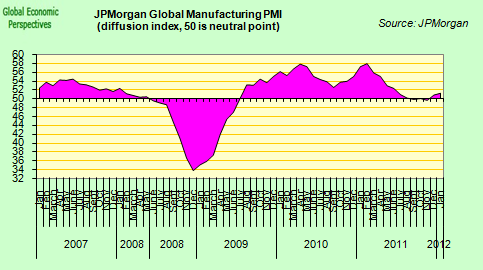
The year got off on a much better foot than might have been expected, at least as far as global manufacturing is concerned.  As the JP Morgan report puts it:

“The global manufacturing sector continued to record belowtrend growth at the start of 2012. At 51.2 in January, the JPMorgan Global Manufacturing PMIâ„¢ rose to a sevenmonth high, but remained below its long-run average (51.8). Manufacturing output expanded for the second successive month in January, as new orders rose for the first time since last August”.

“The cyclically sensitive new orders-to-inventory ratio also moved higher, reaching a ten-month peak. Although rates of expansion for both output and new orders were the fastest since last June, they were still only modest at best. Growth of production was recorded in the US, Japan, Germany, the UK, India, Eastern-Europe, the Netherlands, Austria, Canada, Switzerland, Turkey, Brazil, South Africa and Denmark”.

“International trade volumes improved for the first time in six months during January. Growth of new export orders was led by India, the US and Turkey. China, Japan and the UK all reported modest increases, in contrast to the declines seen in the Eurozone, Russia, Canada, South Korea, Taiwan and Brazil”.

A Month In Spain That Didn’t Shake The World

Journalists are undoubtedly  having hard time following official economic policy in Spain at the moment. The core of the problem they face is that we have a hydra headed government which speaks with many tongues. In some ways the lack of coordination can be put down to simple newness and inexperience, although it should be noted that all the principal actors were in action the last time the PP was in office, as part of  the Aznar government. Continue reading

Monti, The Full Version

The version in question is an interview with the Financial Times. A summary was available here, but now they have gone live with the whole interview. If you can raise it on Google or something then it is well worth a read. For one thing it will offer you a trip down memory lane. Anyone remember this?

“If you’ve got a bazooka, and people know you’ve got it, you may not have to take it out.” Continue reading

The Massendowngrade Effect

Well, that was the week that was, wasn’t it? It started with a cheerful, upbeat market response to both the impact of the ECB’s 3 year LTRO and the growing impression that Hungary was going to make some sort of “one-off” deal with the IMF, and ended near the depths of despair as S&P’s announced the downgrade of 9 Euro Area countries, while the EU Commission worked hard to reinforce the impression that it was about to launch legal proceedings that could even lead to the temporary suspension of Hungary from the EU. It was a time of bitter sweet experiences, which started with Tamás Fellegi (that’s him smiling in the photo below) heading off for his scheduled interview with Christine Lagarde. Then we learnt that the German economy had grown by a brisk 3% in 2011, only to have our hopes dashed by the clarification that most of the growth was in the first 9 months of the year, and in fact the country probably entered recession in the last quarter. Continue reading

Playing Chicken And Rooster With Hungary

Tension surrounding the application of a series of so-called “unorthodox policies” by Hungary’s Fidesz government has certainly been rising in recent days. While Washington has been reasonably quiet as govenment emissary Tamas Fellegi meets with top IMF officials, Brussels has seen a veritable avalance of official statements and policy initiatives. Despite constant rumours that an agreement with the IMF is near, I find it pretty implausible that any deal can be reached without some kind of EU assent.  At the present time this assent is unlikely to be forthcoming, and indeed the “ante” has been pushed up and up. The latest example here is the fact that Brussels has given the Hungarian administration till next Tuesday to do something about altering the country’s new constitution or face the prospect of legal action, and possible suspension from the EU under article 7 of the EU Treaty. Budapest on the other hand has been full of conciliating words, but the key point is we have yet to see anything meaningful in terms of action. Continue reading

From Here To Eternity, Hungarian Style

Hungary’s unofficial ambassador to the IMF,Tamás Fellegi, is reportedly facing a “terrible atmosphere” after his arrival in Washington on an exploratory mission whose objective is to open up communication about a new financial lifeline for the country. Frankly, given the recent record of relations between the two institions involved it isn’t hard to understand why. Leaving aside the long list of recent grievances, it was Hungary who decided to walk away from the IMF in the first place, suggesting it could manage quite well on its own, thank you very much, so the Washington based lender is now hardly likely to welcome the country back as some sort of long lost prodigal son. Continue reading

The Rain In Spain Falls Mainly On The Journalists, It Seems

Things in Spain are never exactly what they seem to be. This is a painful lesson that even Angela Merkel must have learnt in recent days, especially since she put her credibility so much on the line in backing the country’s deficit reduction efforts. “Spain has really done its homework and I think it is on the right track,” is the message she has been trying to sell to the world.

Naturally then she will not have been amused to learn last Friday that rather than the 6% promised under the Spanish stability programme, the country’s deficit in 2011 is going to be something like 8%. Some sort of overshoot was long being anticipated, but such an overshoot? Naturally it isn’t (quite) Greek proportions, but it is still hardly evidence for a credible and praiseworthy effort. This is the thing about Spain, it obviously isn’t Greece, but still all isn’t quite what it should be. Add to this deficit result the fact that the Bank of Spain is reported to be frantically pressuring banks into revising the valuation of their property asssets following the publication by ratings agency Fitch of a report which claims they are currently on average 43% overvalued. And, of course, any major downward revaluation of the repossesed assets will give an entirely new reading for the balance sheets of many of the institutions involved (the Caja de Ahorros del Mediterraneo went from having a 50 million euro profit at the end of 2010 to 1.7 billion euros in losses in June 2011 following the application of just such a mark-to-market procedure – and the savings bank was finally sold to Banc Sabadell for the princely sum of one euro). Put two and two together here, and it is clear that the country’s bond spread may once more be in for a bumpy ride when investors finally recover from their yuletide hangovers. Continue reading