Not so socialist Europe

In case you’re wondering why there’s such an rightwing dominance in the first place (and it’s pretty much always been that way in parliament elections): Some countries aren’t polarized between a leftwing block and a rightwing block, which has meant nonsocialist parties are dominant.

Some, like Benelux countries and Finland, have centrist supermajority coalitions and aren’t unusually rightwing in policy. Ireland and Poland and the Baltics are a different story.

Then there’s the Lib Dem’s, and various other left-liberal parties that belong to ALDE in the European Parliament.

The caucus groups are fairly important, and sometimes vote as a block. So even if from one perspective, the rightwing dominance is an illusion, it does give rightwingers a bit of a structural advantage in the Parliament.

The new parliament: A bit like the old one

By some wonderful magic, all media reports of an event tend to go with the same storyline, often kind of off. The storyline after the elections was “The right and anti-immigrant parties win big.”

Figuring out if it was accurate took some work, because some parties, for example the Tories and the Italian Democratic Party, plan to change caucuses and the official results site counts them as unattached. I had to do a lot of very tedious counting and adding up to make this post, the kind of thing journalists need us bloggers to do. I’ve assigned most nominally unattached parties to a group. This is based on known plans plus a few educated guesses, but the guesses mostly involve tiny parties.

As it turns out, PES+greens+commie parties will go from a combined 38, 3% of seats in 2004 to 36,2%.

If we count the liberals (reasonable-ish in the Parliament context), the present mainstream right went from a combined 55,0% of seats to 56,2%.

By my count, 2% of the old parliament’s non-inscrits were extreme nationalists, and 3,1% of the new parliament’s.

Results by group:

EPP-ED+UEN parties (including the Tories and ODS and Law) 44,2% of seats. (42,3% in the old parliament)

Counting them separately is pointless since they’re about to merge and split. This process of musical chairs tend to happen after every election.

* ALDE/ADLE: 10,9%. (12,6%).
They’re the liberal group (well, basically). The members parties mostly line up as center-right domestically, but some are center-left or just vaguely centrist.

* PES 25,2% (27, 6%)
Worse than it seems, because all parts of Italy’s Democratic Party, which didn’t exist in 04 is included in my count.

*Greens/EFA 7,1% (5,5%)
Impressive considering the many countries with no green representation

*GUE/NGL 4,5% (5,2%)
This is the far left

ID, the eurosceptic group went from 2, 8% to 2, 6%

So the storyline’s not flat wrong, but the changes aren’t very dramatic.

Throwing the bums out, in Iran

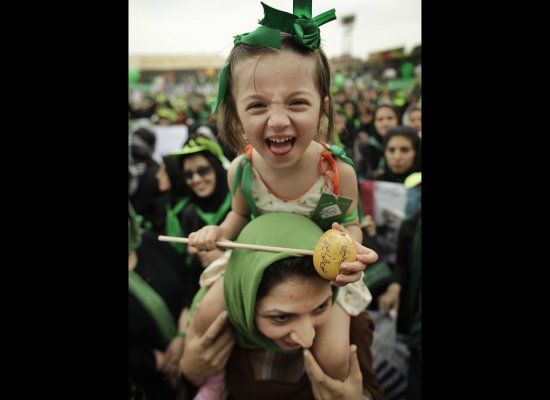
It’s polling day in Iran and a monster turnout is expected. Both leading candidates have been spotted appropriating bits and pieces of the style of the Obama campaign; incumbent president Mahmoud Ahmedinejad has been using the slogan “Yes We Can”, his main rival has been on a Web-enabled youth organising drive, and has been sending network-hammering numbers of text messages to get out the vote.

Oddly, US political comparisons are in the air. Laura Rozen asks if Ahmedinejad reminded anyone of Sarah Palin. I disagree – he reminds me most of all of George W. Bush.

An ambitious but limited regional politician who has spent time in the air force, he achieved election through a campaign for vague “reform” – whether with results or not is a good question – heavily tinged with religion or at least religiosity. In office, his term has been marked by a string of spectacular gaffes and crowd-pleasing rhetoric aimed at the hard right of the political spectrum, as well as a deliberately provocative foreign policy. Coming up to the election, Ahmedinejad leaves the Iranian economy in considerable trouble after over-spending on the belief that the boom would go on forever, and passing out considerable sums in favours to his clientele. Politically, he relies on low-information rural voters in parts of the country where the integrity of the ballot is frequently in doubt.

There’s also a certain Cheney- or Rove-esque quality to his campaigning; he regularly violates Godwin’s Law. For Ahmedinejad, everyone seems to be Hitler for fifteen minutes, just as they are for Jonah Goldberg. He would probably be Winston Churchill all the time as well, if Winston wasn’t chiefly remembered in Iran for nationalising the Anglo-Persian Oil Company and ordering the joint British-Soviet intervention of 1941. And he indulges in the partisan exploitation of supposed secret intelligence information, an odd reflection of the Plame affair.

Further, his election in 2004 was at a historic high point of Iranian influence, just as Bush was elected in a time when US power, wealth, and influence seemed beyond questioning; the US invasion of Iraq had begun to radically reconfigure the political balance between Sunni and Shia powers, whilst tying down the US military’s reserves and poisoning the US’s reputation. High oil prices made everything seem achievable. Unlike Bush, you can’t say he squandered it, but you can certainly question what, if anything, he achieved. As Marc Lynch points out, Iranian soft power would be instantly strengthened if the crazy guy failed to win re-election.

Yes, it sounds provocative, but it’s no more so than describing Iran as “totalitarian”. This is a country where the last two presidents were elected against the wishes of the establishment, in votes that came as a total surprise to the rest of the world. Here’s a wonderful quote:

But Rahnavard has been highly visible, especially after Ahmadinejad dragged her into the middle of the campaign by holding up what appeared to be an intelligence file about her during a debate with Mousavi and accusing her of skirting government rules in obtaining her degrees.

Rahnavard appeared to relish publicly defending herself, demanding that the president apologize.

“Either [Ahmadinejad] cannot tolerate highly educated women or he’s discouraging women from playing an active role in society,” she told reporters.

You might have thought this was the obvious statement of the year, but read the whole thing about women and the mobilisation for Mir Hussein Mousavi’s campaign.

Demonstration

What do his supporters want? Essentially, most things you do.

“Liberalization, a more forward thinking government, they want civil liberties — they want the whole gamut.”

Don’t, of course, imagine that a Mousavi government would immediately hand over the keys to the kingdom, or more to the point, the Natanz uranium enrichment plant. Talking in terms of “pro-Western” factions seems ridiculous in the context of someone like Mousavi, who was a revolutionary, a wartime prime minister, and is now a critic of the system. One thing that stands out is the intellectual flexibility and intellectualism of such people; you may not agree with the ideas presented here, but you can’t odds the commitment to ideas they represent.

It is nowhere near as surprising as it should be that Daniel Pipes says he would vote for Ahmedinejad.

Review: Alistair Crooke, “Resistance: the essence of the Islamist revolution”

I’ve been asked to crosspost this from my blog…

Resistance – The Essence of the Islamist Revolution is Alistair Crooke’s survey of modern Islamist thought. It would be clearer to say it is a couple of books occupying the same space; one would be a history of Islamist thought since the origins of the Iranian Revolution, with a polemic for greater understanding of such thought, and another would be a slightly eccentric, neo-Platonist rant with overtones of Ian Buruma’s notion of Occidentalism.

Well, that sounds fun, doesn’t it? Then you have to add in Crooke’s career; the book glosses him as an advisor to the European Commission on the Middle East, but makes absolutely no mention of his term as SIS station chief in Tel Aviv, in which role he negotiated a ceasefire between Israel and Hamas, which lasted until an unfortunate air raid resulted in the deaths of a round dozen civilians and not the Hamas man the Israelis were after. (The story is here.)

The war resumed, and Crooke was recalled; officially this was for “security reasons”, but if anything imperilled his security it was probably that after the event, the Israeli tabloids discovered his job title, identity, and photograph with un-mysterious suddenness. He eventually fetched up in Beirut, running a thinktank called the Conflicts Forum, devoted to contact between Western powers and Islamists. (Time was, it would have been a nightclub, but we live in fallen times.)

So, what upshot? Crooke makes a strong case for modern Islamism as a classical reaction to colonialism and modernisation, or rather an interwar vision of modernity. He relies on an impressive battery of reading ranging into cultural Marxism at one end and into hardcore conservatism at the other. More controversially, he tries to place Islamism since the 1950s in a context of rebellion against free-market economics drawn from Naomi Klein; but the Ba’athist and similar regimes hardly qualify as Friedmanites, with their nationalised oil companies, state military industries, and extensive Soviet influence in administration, secret policing, and military doctrine and structure.

He draws on a battery of confidential interviews, which are some of the most interesting things in the book, to illuminate current ideas and practice, specifically among Hezbollah thinkers. Notably, they argue, the Caliphate should now be seen as a world-wide network of loosely interconnected “communities of resistance”, rather than a state or any other kind of hierarchical organisation. The aim of these is to uphold the practice of an ideal, self-organising community of believers against a total onslaught by the forces of liberalism, which wishes us all to be atomised individuals.

In practice, this demands a sort of liberation theology/community-organising/vaguely anarchist drive to create base groups everywhere, drawn together by the practice of mutual aid and the study of critical texts, and if necessary to form the underground shadow-administration common to all good guerrilla armies.

Crooke is interesting on the military implications of this, but I think what he describes is less original than he suggests. Flat, highly networked command structures, with a high degree of autonomy down to the squad and the individual, are not characteristic of Islamic or Islamist warfare; what he is describing here sounds a lot like Auftragstaktik. Also, he describes the requirements of a Hezbollah leader as integrity, authenticity, reliability, personal charisma, and ability to mobilise others; would anyone at all disagree?

There is an interesting side-trip into Islamist economic ideas. He criticises Westeners who assume that the main aim of these is to find technical workarounds to make the normal course of business sharia-compliant; apparently the real thing is considerably better. However, a lot of it (as described here) consists of accepting a market economy but not letting money be the be-all and end-all of everything, etc, etc; in practice, this seems to mean a welfare state. No surprise, then, that one of the thinkers he quotes had to write an entire book to rebut the charge that his ideas were indistinguishable from European social democracy.

According to Crooke, the main distinction is in the field of monetary economics; but, in so far as his writing is a true misrepresentation of it, it seems to be distinct in a way which isn’t particularly original. Apparently, Islamist economists are very exercised about M3 broad money growth, on the grounds that this represents the growth of credit in a fractional-reserve banking system and that this is the root of the evils of capitalism. Instead, they are keen on…the gold standard, that most free-trade imperialist of economic institutions!

At this point you might want to halt briefly; Islamist Auftragstaktik applied to community organising? The Caliphate in terms suited to Clay Shirky? Dear God, Islamist monetarist gold bugs? Phew! And you could, perhaps, take comfort from the thought that however strange Iranian political thought may be, their economic thought is no stranger than Fraser Nelson’s or Jude Wanniski’s. Placing an upper bound on the strangeness, after all, is probably an important step towards international understanding.

Then we get into the second book. Crooke is always quoting Plato, specifically the apposition between the port and the city; he attacks Karl Popper, and uses a great deal of Horkheimer and John Gray. It is fair to say he accepts entirely the complex of critiques that argue that life is meaningless without a higher purpose usually decided by higher people, that the freedom offered by liberalism is no such thing, that trade (or commerce, or industry) is “mere”; it is harder to say whether he accepts this for the sake of argument, as much of the Islamist thinking he is discussing bases itself on these ideas.

And there is a valid argument that a lot of it claims to represent the up-side of such critiques – the need for a self-empowered, cohesive community, the problems of the free market – but might just as well be the downside. The economy should be directed, at a national level, towards certain “great concepts”; this could be post-war French indicative planning, and might well be, having been written in the 1950s – or it could be a Straussian exercise in National Greatness Conservatism. We should work and care for society; or is it, as one of Crooke’s interviewees says, that “life is not worth living without something worth dying for”?

None of this stuff about “false reconciliation” and “self-pacifying”, materialism, etc, etc, answers E. P. Thompson’s classic attack on “theories that assume that ordinary people are bloody silly“, either. Strangely enough, towards the end of the book, we have a sudden swerve back towards liberalism; freedom is not so bad after all, it turns out, compared with a neoconservatism informed by Leo Strauss.

Curiously, I left the book with a feeling that it had set out to make right-wing Americans feel closer to political Shi’ism.

Brad Setser Need Be Curious No Longer

Earlier this week Brad Setser was opining on his blog:

“Like everyone else, I am curious to see what China’s May trade data tells us. If China truly is going to lead the global recovery, China needs to import more – and not just import more commodities for its (growing) strategic stockpiles.”

Well Brad need restrain his curiosity no longer, since just this very morning we have learnt that:

China’s exports fell by a record in May as the global recession cut demand for goods produced by the world’s third-largest economy. Overseas sales dropped 26.4 percent in May from a year earlier. That compares with the median estimate for a decline of 23 percent in a Bloomberg News survey of 15 economists, and a 22.6 percent contraction in April.

Continue reading

These Guys Don’t Miss A Trick

This morning Bloomberg are reporting that:

Russia’s central bank may switch some of its reserves from U.S. Treasuries to International Monetary Fund bonds, the bank’s first deputy chairman, Alexei Ulyukayev, said in Moscow today. His comments were confirmed by a bank official who declined to be named, citing bank policy. Finance Minister Alexei Kudrin said last month that Russia planned to buy $10 billion of IMF bonds using money from its foreign reserves.

And then I recalled about a week ago reading this:

Russian Agricultural Bank, the state- owned lender to the farming industry, plans to sell dollar bonds in the first offering by a Russian lender to foreign investors this year. The issue by Rosselkhozbank, as the Moscow-based lender is also known, follows OAO Gazprom’s $2.25 billion sale in April, Russia’s only other dollar bond deal of 2009, according to data compiled by Bloomberg. Rosselkhozbank hasn’t set the maturity of its notes, according to a banker involved in the transaction, who declined to be identified before the deal is completed.

Rosselkhozbank hired Barclays Capital and Citigroup Inc. to organize the sale, said the banker. The lender is rated Baa1 by Moody’s Investors Service, the third-lowest investment-grade ranking, and one level lower at BBB by Fitch Ratings. Vnesheconombank, the nation’s state development bank, is planning a $2 billion sale of one-year notes tomorrow that will be privately placed with Russian commercial lenders and the central bank. The sale of 10-year notes by Gazprom, Russia’s gas export monopoly, was the country’s biggest-ever corporate bond offering and the first in dollars since July, Bloomberg data show.

So, if I understand things aright, you first borrow a lot of money in a given currency, and then you wind up a discourse which forces the currency you have borrowed the mony in on an ever downward path. I guess this is what they call “win-win” in Moscow.

Treasuries fell, pushing 10-year yields to the highest level since November, as the government prepared to sell $19 billion in the securities and Russia said it may switch some of its reserves from U.S. debt. Ten-year notes extended earlier losses after the first deputy chairman of Russia’s central bank said the nation may buy International Monetary Fund bonds. Today’s auction is the second of three sales this week that will raise $65 billion as part of the government’s record borrowing program.

More “Green Shoots” – Latvian Exports, German and Japanese Capital Goods Output

Well today there was plenty of fresh news for collectors of “green shoot” negatives. Starting in Latvia, where the Statistics Office announced that exports were down by 30.9% year on year in April (the fastest rate of decline to date), while imports dropped a massive 45.6%. It looks like the Latvian Parliament is set to pass another round of budget cuts today, in the hope that these will bring back growth (how is not clear). All I can say is “these poor people”, I do wish those who were advising them had a better idea what they were doing.

Continue reading

Green Shoots In Germany and Estonia?

Well, I am busying myself this morning scratching around looking for green shoots in Turkey. But even as I was digging for these I couldn’t help notice this coming in over the radar from Germany, courtesy of Bloomberg:

German exports fell more than economists forecast in April as the global crisis restrained demand, keeping Europe’s largest economy mired in a recession. Sales abroad, adjusted for working days and seasonal changes, fell 4.8 percent from March, when they rose a revised 0.3 percent, the Federal Statistics Office in Wiesbaden said today. Economists expected a 0.1 percent decline in April, according to the median of 10 estimates in a Bloomberg News survey.

So German exports have not touched bottom yet – they are still falling. Since the German economy is export dependent, then this implies the obvious, the German economy is still contracting. I don’t think anyone ever doubted this, but looking at the way some of the material has been presented recently, it wasn’t always clear.

Continue reading