Say What

“Only takes one tree, to make 1000 matches Only takes one match, to burn A thousand trees, A thousand trees” – Stereophonics

I have on occasion been turning to the lyrics of the English rock group Stereophonics when events in the economy and the market have eluded and essentially confused me. This time is no different and for the life of me I am unable to the see the rationale in the recent messages emanating from key European policy makers in the context of the ongoing crisis on the European continent and specifically the impending collapse of the East European economy. Continue reading

Slovakia’s 2009 presidential election

Well actually this post isn’t from me, but from my Global Economy Matters co blogger, and Election Resources On The Internet elections wonk, Manuel Alvarez-Rivera. Anyway, here we go:

Voters in Slovakia went to the polls today for a presidential election, but the outcome will almost certainly be decided in a runoff vote next April 4. Normally, a second round between the candidates arriving in first and second place would be held if no candidate won an absolute majority of valid votes in the first round of voting, but last February the Slovak Central Election Commission (UVK) ruled that an absolute majority of all eligible voters was required in order to secure a first round victory. Continue reading

The Almunia Syllogism

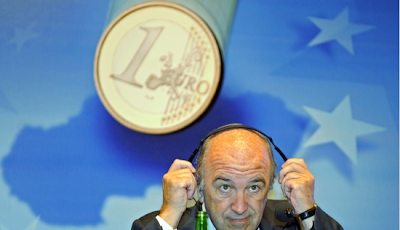
European Monetary Affairs Commissioner Joaquín Almunia recently, and possibly totally inadvertently, stumbled on a very interesting argument. Here it is:

“Who is crazy enough to leave the euro area? Nobody,” Almunia said. “The number of candidates to join the euro area increases. The number of candidates to leave the euro area is zero.”

Reductio Ad Absurdum

Now you don’t need a PhD in economics to understand what follows, although a little bit of basic logic would help. What we have here could be construed as a kind of syllogism (and from now on let’s christen this one “The Almunia Syllogism”). The Almunia Syllogism has the following form:

a) Anyone leaving (or aiding and abetting the departure of someone from) the Eurozone is crazy
b) The EU Commission, The ECB and The National Leaders are not crazy
c) Therefore no one will leave, or be allowed to leave, the eurozone (at least under current conditions)

Q.E.D. We Will Have A United States Of Europe.

Well, ok, I do need to add a lettle lemma here to the effect that the only way to enforce (c) is to build the necessary architecture, and there is room for debate about this, since this lemma is neither proven, nor is it self evident. You also need to accept that there is an excluded middle here, and we do not have a “now either the EU leaders are crazy ot they aren’t” fork which we can get diverted down.

As I say, the lemma is not self evident, although my own opinion is that in the weeks and months to come its validity will become extraordinarily clear even to the most reticent among us, but this still needs to be established. The thing about the lemma is that it focuses the debate. Those who do not agree with it need to be able to show how we can have (c) within the present architecture (since here there is a middle to exclude, either we can or we can’t). The results coming out from the “we can” camp are not entirely encouraging. For example, ECB Executive Board member Lorenzo Bini Smaghi’s recent attempt to argue that Krugman has it wrong, and that (we can manage with what we have) fails stupendously to convince, in my opinion, and especially the extract I reproduce below (which exemplifies precisely the point those who want new achitecture are making).

For instance, for the period 2009-10, discretionary measures adopted in Germany total 3.5% of GDP, compared with 3.8%in the United States. In some European countries, such as Italy, the size of such stimulus measures is relatively limited owing to the high levels of debt, but in other countries the total fiscal stimulus is larger than in the United States.

The whole issue is that we need a mechanism to average out the stimulus, is that so hard to understand? Is this obscurantism, or simply stupidity?

A Literary Trope Not A Syllogism

On the other hand, the formal validity of the following “utterance” from Almunia is rather more questionable.

“Don’t fear for this moment,” he said. “We are equipped intellectually, politically and economically to face this crisis scenario. But by definition these kinds of things should not be explained in public.”

The first phrase is an exhortation, one which I would agree with (but not for the same reasons), the second is an assertion whose truth content is, at least,questionable, while the third is an admission, one which would perhaps better not have been made, or a piece of advice, which the unfortunate Otto Bernhardt seems never to have received.

A senior German lawmaker said euro zone states stood ready to come to the aid of financially fragile members of the currency bloc, sparking furious denials from European leaders that a specific rescue plan existed. Otto Bernhardt, a leading lawmaker in Angela Merkel’s Christian Democrats (CDU), told Reuters in an interview late on Thursday: “There is a plan.”

and then Bloomberg let us know a bit more about the details of the plan.

The German Finance Ministry has no knowledge of a rescue fund organized by the European Central Bank for troubled euro-region members such as Ireland and Greece, spokeswoman Jeanette Schwamberger said.

Otto Bernhardt, finance spokesman for Chancellor Angela Merkel’s Christian Democratic Union, said in an interview with Reuters today that the ECB has a fund at its disposal to help troubled countries and can make money available at 24 hours’ notice.

Hungary Prime Minister Gyurcsany Resigns

Hungary’s Prime Minister, Ferenc Gyurcsany, announced this morning (Saturday) his intention to resign as Prime Minister. Gyurcsany informed a congress of the Socialist Party of his decision following a sharp fall in the popularity of his government.

Gyurcsany will now inform the Hungarian Parliament of his decision (probably on Monday), and attempt to initiate a “constructive” no confidence vote, by which means it is hoped that a new candidate for PM will emerge. Early elections are currently thought to be unlikely, although it is not clear at this point how the minority coalition partners will react.

Well, we now have a clear pattern being established following the recent IMF interventions in Iceland, Latvia, Hungary etc – the government collapses under the weight of the measures. Basically, and as I said during the week, what we have unfolding before us in Hungary is a tragedy, since the rigid enforcement of the deficit ceiling without external fiscal injections from the EU, simply means that the economic contraction feeds upon itself.

I hear that I am the obstacle to the co-operation required for changes, for a stable governing majority and the responsible behaviour of the opposition,” he was quoted as saying on Saturday by Reuters news agency. “I hope it is this way, that it is only me that is the obstacle, because if so, then I am eliminating this obstacle now. “I propose that we form a new government under a new prime minister.”

Irrespective of whether or not Gyurcsany was part of the problem rather than part of the solution, and despite the fact that Hungary may benefit from having a new leader, the issue is a much bigger one than the office of Prime Minister.

Amongst other matters, this is the principle “bottleneck”:

The source said talks with parliamentary parties would start next week to pick a new premier as soon as possible to pass much-needed budget measures with a stable majority.

OECD Forecast 4.1% Eurozone Contraction For 2009

According to this Reuters report, the Slovenian Minister of European Affairs and Development Mitja Gaspari informed a news conference in Ljubljana yesterday (Thursday) that the latest OECD 2009 forecast for the eurozone is for a contraction of 4.1 percent. He also stated that the OECD figures show Germany’s economy will contract by 5.1 percent and Italy’s by 4.2 percent. While these figures are completely unofficial – official publication of the updated OECD forecast is due on March 31 – they do not seem at all unreasonable, although they are of course shocking. At think at this stage talk of a recovery in the second half of the year is completely premature, and the only real issue is whether 2010 will simply be more of the same, or will be a bit better (a eurozone contraction of say 2%).

The previous OECD forecast, issued on November 25, showed euro zone 2009 GDP down 0.6 percent, Germany down 0.8 percent and Italy down 1 percent. I think the current numbers are now in the right order of magnitude, and the debate will obviously be about what to expect for next year.

The IMF yesterday published an “update” eurozone forecast of a 3.2% 2009 contraction, but also reported it was still “working on its projections”.

Advanced economies will suffer deep recessions in 2009, the assessment said. Leading economies in the Group of Seven are expected to experience the sharpest contraction for these countries as a group in the post-war period by a significant margin (see table). The IMF said that in the fourth quarter of 2008 global GDP contracted by 5 percent at an annualized rate. The IMF is still working on its projections and will announce numbers for countries around the world on April 22.

Three Things I Learned Tonight

You may have known them already:

The Russian word for train station, voksal, is related to the London neighborhood of Vauxhall.

It is considered bad luck in Georgia to take out the trash at night; it is a sign of throwing money away.

In Tbilisi, the Armenian ambassador’s official car was parked outside the residence of the Turkish ambassador.

Do They Have Parachutes In Bulgaria? (Updated)

With capital inflows to the CEE economies slowing to a trickle in Eastern Europe, a sharp correction is now underway in most countries’ external imbalances and in particular in their current-account deficits. For the CEE-6 (Poland, Czech Republic, Hungary, Romania, Bulgaria, Turkey), net private capital flows are forecast to slow to $59.5 billion in 2009, down from an estimated $161.9 billion in 2008, according to estimates from the Institute For International Finance. The basic concern is that those countries with significant external deficits are extremely vulnerable to foreign capital reversals, especially in the current environment of global credit tightening.

FDI flows (which are generally considered more stable and less susceptible to rapid outflows than other capital flows) have been the main form of financing for current-account deficits in recent years, but such inflows are set to slow sharply in 2009. The Economist estimates that between 2003 and 20007 FDI inflows (on average) covered almost 100% of the current-account deficit in the ten EU member states. In 2008, this coverage fell to an estimated 55%

As FDI has fallen back, debt – particularly intra-bank lending – has become the main financing vehicle for the current-account deficits. Nevertheless, intra-bank lending – that is, lending between foreign parent banks and their subsidiaries in the region – is falling back sharply in 2009, with nett bank lending to emerging Europe, excluding Russia, being projected at around $22 bn in 2009, down from $95 bn in 2008 (according to the Institute for International Finance)

Now the central issue is that such corrections in external imbalances can take pplace in one of two ways – either domestic demand drops sharply and/or the currencies weaken significantly. In the case of those countries with an exchange rate peg the second route is not open, hence what we are likely to see is a very sharp contraction. Such contractions are already evident in the Baltics, but what about Bulgaria. How sharp will the correction in Bulgaria be? Only today capital economics have come in with a forecast of 5% contraction over the year. But how realistic is this, let’s look at some data.

Well, we could start with this little deatil: retail sales down 25.7% month-on-month in January, according to the national statistics office. For an economy which has been driven by a consumer borrowing and lending boom, that looks like dramatic evidence of some kind. It looks like dramatic evidence, but it isn’t really quite so dramatic as it appears at first sight, and the first warning I would issue to anyone who wants to study the Bulgarian economy is never to believe anything you see at first sight.

The data came from a Bulgarian press source (see extract below), but they evidently had no idea what they were talking about, since they confused the basics of year on year and month on month, and obviously non seasonally adjusted sales are down massively January over December, every year. Actually according to Eurostat, seasonally corrected sales were down only 0.15% month on month, and were even still up 4.79% year on year, although this is still a very large drop from the 20% rate of increase registered earlier in the year. So the basic point would seem to hold, that Bulgaria’s economy is now in freefall, but I have learnt something: never, ever, cite material from direct Bulgarian sources without checking.

Retail sales revenue in Bulgaria declined by 25.7% in January from the same month of last year, the National Statistical Institute (wwwo.nsi.bg) said in a statement. The slump was attributed to a sharp decrease in retail sales of larger consumer goods, although a decline is normal for the beginning of each year. A major 31.5% drop was reported in sales of vehicles and technical maintenance. Revenue generated by non-food sales went up by 3.0% year-on-year, the data showed. Revenue from food, beverages and cigarettes sales showed a minor increase of 0.5%

Continue reading

Hungary, Watching A Tragedy Unfold

According to Secretary of State at the Hungarian Finance Ministry László Keller Hungary will post a public sector deficit of HUF 332.9 billion in the month of March, up from the preliminary forecast of HUF 329.8 bn made only a month ago. At the same time the Finance Ministry has left its full-year deficit projection of HUF 730.6 bn virtually unchanged from the one made a month ago of HUF 729.9 bn. (In fact the entire Q1 deficit is expected to run to HUF 581bn or 2.2% of annual GDP. This seems like a huge chunk of the whole years deficit spent already, but we should remember that there is a strong seasonal component here, and for comparative purposes we could note that the actual deficit for Q1 was HUF 508bn or 1.9% of GDP, so while the situation is not good, it may not be as bad as it seems at first sight).

However, as the months pass the ability of the government to live up to its budget objectives seems more and more remote, despite constant reassurances from Keller that “The cabinet is in control of the situation” and that “The government wants to keep the budget deficit under 3.0% (of GDP) at all costs”. Continue reading

“Macedonia’s Obama”?

Macedonia will hold Presidential elections this weekend. No news there. But here’s the interesting thing: recent polls suggest that an ethnic Albanian candidate, Imer Selmani, has a decent chance of making it past the first round. If so, he’d become the first ethnic Albanian to enter the runoff for Macedonia’s Presidency.

Why is this even possible? Well, to make a long story short, all the other major candidates have managed to make themselves look like idiots. They’ve traded stupid accusations and name-calling, while Selmani has managed to remain above the fray. It doesn’t hurt that he’s young, good-looking, and speaks perfect Macedonian.

Let’s be clear: even if Selmani makes it to the runoff round — unlikely, but possible — he’s not going to become President. That would require between a quarter and a third of Slav Macedonians to vote for an Albanian. This is not going to happen. Continue reading