Spain’s Unemployment Continues To Climb As The Economy Contracts

Spanish unemployment shot up again in February to 3.48 million in February, whilst consumer confidence took another knock amidst fears Spain’s jobless would now hit 4 million as early this summer, and maybe 4.5 million, or nearly 20% of the workforce. Right, this the latest in my monthly reports on Spain, but before I go further, a quick joke. How do you know when there is an economic crisis in a country? When everyone around you in the metro is busy reading the economics page in the newspaper.

The latest unemployment data released yestreday (Tuesday) show that the number of unemployment benefit claimants rose by 154,058 in February, down from last months increase of 198,838, but still nearly four times the 40,000 increase in Germany which has almost twice the population, and where the economy is apparently contracting at an even more rapid rate. Could we conclude that one stimulus package is working rather better than the other, at least in preserving employment.

Continue reading

How Not To Manage A Financial Crisis (Part 1)

“Saying that the situation is the same for all central and eastern European states, I don’t see that……you cannot compare the dire situation in Hungary with that of other countries.”
Angela Merkel, Brussels, Sunday

“Happy families are all alike; every unhappy family is unhappy in its own way”
Tolstoy

In Europe, leaders rejected pleas for a comprehensive rescue plan for troubled East European economies, promising instead to provide “case-by-case” support. That means a slow dribble of funds, with no chance of reversing the downward spiral.
Paul Krugman

Bank regulators from Bulgaria, the Czech Republic, Poland, Romania and Slovakia met today and issued a joint statement, ostensibly to reduce the some of the impact of what they term “alarmist comments” from the Austrian government about how the regional banking system is now in such a precarious state that it requires urgent action at EU level to prevent meltdown. The Austrian government are, of course, concerned about the impact of any meltdown on their own banking system. The result of this “reassuring statement” can be seen in the chart below (10 years, HUF vs Euro).
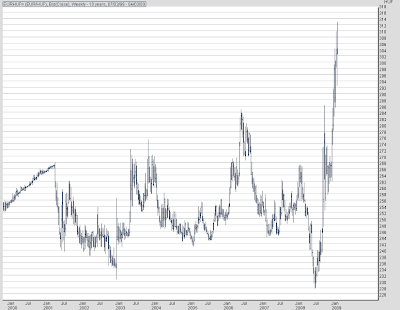
Within minutes of the joint statement Hungary’s currency plummeted to an all-time low against the euro and to a 6.5-yr low versus the US dollar. In fact the HUF rapidly depreciated to 312 per euro from 307.50 before climbing back in later trading to 310. And the reason for this swift reaction? Hungary was not invited to join the statement. As the forint plunged, Hungary ‘s banking regulator hurriedly signed up to the statement, blaming the original omission on a communications mess-up, but the damage was already done.

“Each of the CEE Member States has its own specific economic and financial situation and these countries do not constitute a homogenous region. It is thus important first to distinguish between the EU Member States and the non-EU countries and also to clarify issues specific to particular countries or particular banking groups.”

Well this just takes us back to Tolstoy, each of them have their own specific problems, but the underlying reality is that they all face problems, and are vulnerable, each in their own way.

Hungary’s economic fundamentals are clearly much weaker than those to be found in the Czech Republic and Poland as things stand, but what about Bulgaria and Romania? And the Czech Republic and Poland are about to have a pretty hard time of it as a result of their export dependence on the West, and Poland has the unwinding of the zloty options scandal still to hit the front pages. So there is plenty of food for thought here before throwing Hungary to the wolves. A default in Hungary could very easily lead to contagion elsewhere, and then the impact in the West is very hard to foresee. We should not be playing round with lighted matches right next to our fireworks stock. “Hey, it’s dark in here” and then “boom”.

Yesterday it was Latvia’s turn, and the cost of protecting against a Latvian default (Latvia is the first European Union member priced at so- called distressed levels) rose to a record following the announcement that the unemployement level rose from 8.3% in December to 9.5% in January, the highest level in nearly nine years. In fact credit-default swaps linked to Latvia increased nine basis points to an all-time high of 1,109 basis points, according to CMA Datavision in London. The cost is above the 1,000 level, breached last week, that investors consider distressed, and is now about 270 basis points above contracts linked to Lithuania, the next-highest EU member.

So two countries are being systematically detached here – Latvia and Hungary – and statements by EU leaders are unwittingly aiding and abetting the process. But we should all remember, after they have eaten Latvia and Hungary for breakfast, the financial markets will undoubtedly chew on other luckless countries over lunch (Romania’s Q4 GDP data was out today, and it was a shocker, and S&P have already said they are “closely monitoring” the situation), before perhaps moving on to bigger game for supper.

And we should remember here, no one is too big to fall, and I have already been warning about the gravity of Germany’s situation, with a rapidly ageing population, a hefty bank bailout of its own to swallow, and total export dependence for GDP growth. Final data from Markit economics out today showed that Germany’s composite PMI fell to 36.3 in February from 38.0 in January. That was the lowest level registered since the series began in January 1998. And it means that the German economy – which is highly interlocked with the whole of Eastern Europe (Austria holds the finance and Germany the industrial exposure) – is certainly contracting more rapidly in the first quarter of this year than it was in the last quarter of 2008, and may well contract in whole year 2009 by something in the order of 5%. Further evidence comes from the latest VDMA machine producers association report which shows that exports orders for German engineering companies were 47 per cent down on a year earlier in January. Overall industrial machinery orders were 42 per cent lower than in January 2008, with domestic orders down 31 per cent, while foreign orders fell 47 per cent. This is more or less Japan territory in its scale. So maybe someone over there in Germany should be reading the poem you will see below to “our Angela” right now, just so she doesn’t miss the point (Oh, and if you don’t speak German, you can find a translation here).

Als die Nazis die Kommunisten holten,
habe ich geschwiegen;
ich war ja kein Kommunist.
Als sie die Sozialdemokraten einsperrten,
habe ich geschwiegen;
ich war ja kein Sozialdemokrat.

Als sie die Gewerkschafter holten,
habe ich nicht protestiert;
ich war ja kein Gewerkschafter.

Als sie die Juden holten,
habe ich geschwiegen;
ich war ja kein Jude.

Als sie mich holten,
gab es keinen mehr, der protestieren konnte.

Russia, Iran, Obama and Some Missiles

Because it’s not like the rest of politics stops so that Europe can reach a consensus on the economic crisis.

President Obama sent a secret letter to Russia’s president last month suggesting that he would back off deploying a new missile defense system in Eastern Europe if Moscow would help stop Iran from developing long-range weapons, American officials said Monday [March 2] . …

The Obama letter was hand-delivered in Moscow by top administration officials three weeks ago. It said the United States would not need to proceed with the interceptor system, which has been vehemently opposed by Russia since it was proposed by the Bush administration, if Iran halted any efforts to build nuclear warheads and ballistic missiles.

The officials who described the contents of the message requested anonymity because it has not been made public. While they said it did not offer a direct quid pro quo, the letter was intended to give Moscow an incentive to join the United States in a common front against Iran. Russia’s military, diplomatic and commercial ties to Tehran give it some influence there, but it has often resisted Washington’s hard line against Iran.

Medvedev isn’t playing.

Russia’s president Dmitry Medvedev on Tuesday [March 3] rejected any suggestion that Moscow would “trade or exchange” in policies in order to dissuade the US from installing an anti-ballistic missile system near its borders in Eastern Europe.

Pulling Strobe Talbott’s book off the shelf, I recall that Russia-Iran consumed a surprising amount of presidential attention back in the day. Add in that Iran could be useful in Afghanistan, and the puzzle gets an extra layer of moving parts.

Euro 2012 to be funded by Arab states of the Gulf?

Has the global financial crisis crossed yet another threshold with indications that the financing of the Euro 2012 Championship could be imperilled?  The successful joint bid of Poland and Ukraine looked on one hand like a smart move to recognize the eastern European fan bases but on the other like a gamble given all the costs that the tournament brings, not least in stadium upgrades.   And with money tight for everything, money for football was perhaps going to be a tough sell.   Hence this interesting Polish courtship of Kuwait —

Continue reading

JP Morgan’s Global PMI Shows Another Substantial Contraction In February

The performance of the worldwide manufacturing sector remained very weak in February. Although the JPMorgan Global Manufacturing PMI rose further from December’s record low, at 35.8 it was still well below the critical no-change mark of 50.0. Rates of decline eased for production and new orders, but accelerated to reach a new survey record for employment.

“The PMI edged higher for a second successive month in February. The data are still pointing to marked declines in output and new orders, but the gains in these indexes indicate that the rate of contraction has begun to ease in global industry. Production cuts are likely to remain deep near-term while companies reduce inventory.” David Hensley, Director of Global Economics Coordination at JPMorgan

Continue reading

Orphan-who Is Advocating Quantitative Easing At The ECB?

Orphanides, Athanasios Orphanides, ECB governing council member, and current governor of Cyprus’s central bank. So the 16 country euro bloc is now being run from Cyprus. Ben Sils has the story:

A former Federal Reserve economist who made a name for himself telling his superiors they were wrong is now taking on European Central Bank President Jean-Claude Trichet.

Athanasios Orphanides, the governor of Cyprus’s central bank, was the first ECB official to argue in favor of zero interest rates, challenging Trichet’s position that cutting them so low would have “drawbacks” and should be avoided. Now, investors and economists are betting Orphanides, 46, is winning the argument as the euro region suffers its worst recession since World War II.

The ECB “can’t stand on the sidelines and use some weird voodoo economics,” said Erik Nielsen, chief European economist at Goldman Sachs Group Inc. in London. “Over time, the power of the right argument tends to win out over the wrong.”

At least seven members of the ECB’s 22-member Governing Council have lined up behind Trichet as they struggle to agree on new tools that would be needed with zero rates. Still, some have started to warm to the idea of deploying all the ECB’s rate ammunition and turning to unconventional methods, suggesting Orphanides may be securing support.

Bond markets expect Orphanides to prevail: Yields on two-year German bunds have fallen to their lowest level since at least 1990. All 55 economists surveyed by Bloomberg News predict the ECB will cut its main rate by a half-point to a record level of 1.5 percent on March 5.

Of course, the fact that Ben and I shared a very congenial cup of coffee last month in my favourite bar in Barcelona is entirely coincidental to all of this :).

Joaquin Almunia Is At It Again

Well if you want to set off a further wave of speculative contagion, here exactly is how to do it:

European Union Monetary Affairs Commissioner Joaquin Almunia said “there are risks in the banks” of eastern, southern and central Europe. “The assets of these subsidiaries of foreign banks are being impaired because of the crisis,” Almunia said at an event in Brussels today. Across the EU, “we need to have sound balance sheets in the banks to restore the credit channels.”
Bloomberg

Isn’t it time this guy was replaced, he is definitely on the liability rather than the asset side of the balance sheet? Helloo, anybody there?

Oh, and yesterday, according to Dow Jones News Wire we had this performance:

“Member States that have not done so should strive to meet the criteria for euro adoption,” Almunia said at a conference in Prague. The euro “provides a considerable shield from the worst effects of economic turbulence” and leads to better trade and financial integration and more competition, he added. Almunia said that an expanded euro area would have to go hand in hand with wider surveillance of national economies “in order to anchor stability and prevent the build up of macro-financial risks.”

What the hell is he going on about here? Is he suggesting that people haven’t been striving to join? What does he think they have been doing in Eastern Europe for the last 8 years. Or is he announcing a change in policy, that we will offer the carrot, and if they jump hard enough so they can bite it then in they will come, behind our defensive shield? Really the man is completely useless. As Krugman said yesterday, what IS the weather like on his planet, maybe we could all go for a visit.

Estonian Industrial Output Falls 26.8% In January

Well Estonia just set a new record (at least for the EU) this time round, for the sharpest year on year contraction in industrial output seen to date (although still below Ukraine’s 34.1% January year on year contraction, as Ron points out in comments). The Great Depression II is evidently now among us, and it is currently visiting Estonia.

Continue reading

Eurozone Inflation Expectations Fall As The Output Gap Rises

It’s a depressing spectacle: on both sides of the Atlantic, policy-makers just keep falling short — and the odds that this slump really will turn into Great Depression II keep rising.

In Europe, leaders rejected pleas for a comprehensive rescue plan for troubled East European economies, promising instead to provide “case-by-case” support. That means a slow dribble of funds, with no chance of reversing the downward spiral.

Oh, and Jean-Claude Trichet says that there is no deflation threat in Europe. What’s the weather like on his planet?
Paul Krugman, yesterday

What follows here are simply a few charts to illustrate further the argument I developed yesterday as regards the significance of the deflation threat which now exists in the eurozone. The argument is that the ECB is once again being far too cautious, and risks allowing the entire eurozone to entire a deflationary cycle which may prove to be a lot harder to get out of than it was to get into. In my view the ECB should bring the refinancing rate close to zero % at next Thursday’s rate setting meeting, and then explore what measures can be taken to introduce a zonewide version of US/Japan style Quantitative Easing as quickly as possible.

The key argument I am presenting is that it is a mistake to focus at this point on what is happening to energy, food and other commodity prices. The key issue is what is happening to core prices, and what will continue to happen to them as output contracts further. The other side of the coin are inflation expectations, and as we will see below these are now falling rapidly across Europe. It is very important at this point that these expectations do not get “locked in” to price fall expectations. Continue reading

Alternative history

Poland is proposing that the time that a Euro-aspiring country should spend in the exchange rate stability test of the Maastricht criteria be shortened i.e. that it not be as long as two years in the ERM-2 before becoming eligible for the euro.  Note that had such a relaxation been in effect from the start, the UK might already be in the Eurozone, since Black Wednesday hit during the ERM-2 phase of sterling, when the UK already was very close to the 2 year requirement.  Of course pre-Euro is different from post-Euro but one does wonder what the EU would look like with the UK as an ERM and then Eurozone country in the original group.