Crimea: Anschluss. Mostly wiling population, dissent shouted down or stamped out, stage-managed sham referendum. The main difference is that the troops of the larger, external power were already in Crimea, rather than just across the border in Bavaria.
Kharkiv, Donetsk: Sudetenland. Some real tension, mostly trumped up and stage-managed confrontations. Pleas for “protection” from some parts of a particular nationality to the outside power. Not fooling anyone. In contrast to then, Kiev would try to defend the frontier region militarily. (The great powers will not intervene, should it come to that.) Whether that defense would succeed is rather an important question. There’s not a major defensible barrier until the Dniepr. Speaking of which…
Dnepropetrovsk, Zaporizhia: Poland. The great powers would not be able to overlook the dismemberment of a major European state. They wouldn’t be able to stop it, either.
Here’s something interesting: the pro-Russian paramilitary leader in the Crimea is the son of the pro-Russian paramilitary leader in Transnistria.
As that empire was pushed out of Eastern Europe, Aksyonov’s father, Valery, became the leader of a group called the Russian Community of Northern Moldova, which campaigned for the rights of ethnic Russians in a country ruled by the Moldovan majority. In 1990, the ethnic tensions in that country erupted into war, and the Russian army came to the rescue of paramilitary groups fighting the forces of the Moldovan government. Two years later, the conflict ended with the de facto secession of a breakaway state called Transnistria, a sliver of land that runs along the Dniestr River.
Today, Transnistria is still a frozen conflict zone on the map of Europe – and a state that Aksyonov reveres. Its independence is not recognized by any member of the United Nations, including Russia. It is the only part of Europe that still uses the insignia of the Soviet Union, and its economy imposes Soviet-style subsistence living on the masses while the politically-connected elite benefit from its unique black market. As an unrecognized state unbound by international law, its customs points are a clearinghouse for contraband, including tobacco, guns and counterfeit liquor. But Aksyonov sees it as a place to be emulated. “Transnistria is a bastion of Russian culture inside Moldova,” he says. “They wanted to preserve their identity. And I fully support them, because I know what kind of pressures they faced.”
Who knew frozen conflicts could be a family business? Of course, “family” and “business” are usually very ordinary words that can take on a very different significance.
He remembers Aksyonov in the 1990s as a member of a criminal syndicate called Salem, which was named for the brand of contraband cigarettes they imported and dealt in bulk. (Other accounts claim the group was named for the cafe where they hung out.) “Aksyonov was a capo for them, an enforcer,” says Los. “He had a group of ten guys that would go around collecting money.” Aksyonov’s nickname in the local underworld, says Los, was the Goblin. “Every gangster had a nickname. I was called Horns because of my surname.” (Translated from Russian, the word los means moose or elk.)
In Crimea, it looks like he’s starting with the banks. Of course. Was ist ein Einbruch in eine Bank gegen die Gründung einer Bank? I do think this fits with my idea that this is about post-Soviets vs. pre-Europeans.
In the wake of the mysterious disappearance of Ballardian Malaysian Airlines Flight 370 to the East or possibly the West of the Malaysian peninsula, here's an interesting account of all the ways civilian airliners keep in touch with ground control in the various territories they cross over. It reveals that quite a lot of the time they're not actually in touch at all. Those reassuring blips on the screen are sometimes just flight path projections, as they appear to have been in this case.
It's shocking – and fascinating in a morbid way – that you can just lose an airliner full of people, as though it was a collective Amelia Earhart. But maybe its not so surprising. It's not just that ground coverage is incomplete. There are more flights than ever before, flying from and between places where perhaps the staff are not too well trained, funded or attentive, over vast expanses of ocean, desert, tundra, jungle and ice. Perhaps the surprising thing is that it doesn't happen more often. I speak as someone who has flown over the arctic with this on my mind. Anyway:
This incident (frankly, we’re not even 100 percent sure it is a crash) is different. So far, no debris field has been found, the Pentagon reports that it detected no midair explosions in the area, and Malaysian authorities have issued contradictory statements about what primary-radar tracks they may or may not have observed. Based on the vast search area, it appears that authorities believe that the plane may have been deliberately flown far from its original heading. If that’s the case, then whoever redirected the plane might well have timed its abduction to coincide with the period when it would have slipped out of sight of the air traffic control system anyway.
The search for flight 370 is also hampered by the fact that the relevant sea lanes are literally full of crap. The almost certain bet is catastrophe in the air compounded by incompetence on the ground, but the resonances of the case are so strange that you wouldn't be surprised to discover that, 20 years on, some mad visionary pilot had taken his passengers to - say – sojourn among the Wa for urgent but incomprehensible reasons. After all, if the pilot was just intent on suicide/murder, why wait until he was out of contact?
A question: did the so-called “revolution consultants” do any work with the Ukrainian military, or did Colonel Mamchuk come up with the idea independentantly?
This piece of Galrahn’s has a great title: US Soft Power in Ukraine is Missing Hard Power’s Escalation Control. It then wanders off into generic stuff about how Obama is lacking resolve and a succession of supposed military options, all of which would lead to war with Russia.
But if we were to stick with the title, we might learn something. “Soft power” – influence, the EU as a magnet, that stuff – is very hard to “calibrate” precisely because it deals in influence over people rather than physical force. People may not be impressed for years, but then change their minds and hugely over-deliver. The participation that makes it important also makes it very difficult to use as an instrument of policy. Classical theories of innovation diffusion tell us that “reinvention”, the degree to which users make innovations their own, is a critical factor in whether this or that idea reaches enough early adopters to hit the inflection point into mass adoption. As a result, not only does it work far better than anyone expects when it works, it also goes to new and unpredictable places nobody expects.
Fair enough. It is obviously true that US and European soft power played a role in Euromaidan. They called it Euromaidan, after all. But I have been writing so far in the voice of someone who imagines they controlled the situation, explaining why they failed to control it. Saying that soft power lacks escalation control is another way of saying that you underestimated the agency of Ukrainians. This theme runs through the whole story.
Vladimir Putin, famously, doesn’t believe it’s a nation and openly treats it as a colonial entity. The US imagines that some National Endowment for Democracy money and advice will solve everything in the way they would like it to be solved. The EU sees it as a fairly cynical bargaining process between Yanukovych and Yulia Tymoshenko and wouldn’t have minded Yanukovych sticking around even after all the shooting. Yanukovych, for his part, clearly didn’t think of Ukraine as a nation; he thought he owned it.
Operationally, this was meant to work like so. The conflict could be presented as a divide between (ex-Polish) western Ukrainians and (ex-Soviet) eastern ones. Experts differ. This would permit people to see it as not a proper nation, a conflict that had to be managed, or alternatively a Soviet survival that needed protecting from the IMF. At street level, this would show up as a pro-Yanuk movement big enough to be a potential political majority. But Yanuk was let down by the failure of the supposed “pro-Russian East” to show up. He was counting on it and he may have reassured Vladislav Surkov, Putin’s very influential PR expert, that it was coming when Surkov came to see him.
The problem was, though, that the “pro-Russian east” had already been a disappointment in 2004, and it was even weaker this time. Research on the ground suggests that the idea of a geographical split is misleading – the political divide is generational, and eastern Ukrainian identity does not signal support for Russia and still less for Yanuk. There is even some evidence that the linguistic picture has changed since 2004, with more people, especially young people, opting to speak Ukrainian and to adopt such an identity. This could be described as the transition from a post-Soviet to a pre-European identity. We might make a little leap of faith and argue that the EU missed this too, and the evidence is that Tymoshenko’s polls are horrible.
If the pro-Russian east didn’t show up, who did? There was a big surprise about Ukraine, and there was a big non-surprise. The surprise was the appeal of the European Union as an ideal – who expected that? – and the non-surprise was the emotional force of nationalism. This brings me to Tuesday’s standoff at Belbek airfield, Sevastopol, where Ukrainian Colonel Yuri Mamchuk led an unarmed march of the 204th Aviation Brigade’s ground crew to assert their right to access the runway and maintain the 40 or so MiG-29 aircraft there. You can watch the confrontation, with subtitles, below:
But I prefer this photo, which reminds me of Ilya Repin, perhaps a painting entitled Colonel Mamchuk Defies the Rascally Cossacks:
Face off between Ukraine base commander Col. Yuli Manchur and Russian officer at occupied Belbek airbase pic.twitter.com/6N10wuezef
The imagery here is very important – the red banner is the colours of the Soviet unit whose traditions the 204th inherited, which had no fewer than six Heroes of the Soviet Union. The Ukrainians have both appropriated the Second World War heritage, and also posed the question as to who looks like the Germans here. It’s also crucial to note that the people Mamchuk led up to the Russian sentries will have been the cooks and clerks and avionics technicians you need to make an air force work, not some sort of commando elite. This is, I think, what nationhood looks like.
And as a piece of strategic nonviolence, it came close to scuppering the whole Russian plan or non-plan in the Crimea. If the Ukrainians got to use the airfield, they could resupply and indeed relieve their garrisons there. If they could fly their planes, they would evidently discredit any Russian claim to control the air. Starving them out would no longer be an option. Having both Russian and Ukrainian forces present would be very much like the Crimea pre-revolution, and therefore something close to the status quo. The degree to which Russian and Ukrainian forces coexisted there until this month is shown by the fact the 204th is a counter-air wing with the dogfighter variant of the MiG-29, and the Russian air wing up the road is a strike force with the Su-24 bomber. The Ukrainians essentially provided the Black Sea Fleet’s air defence. (SO AWKWARD.)
The upshot was a compromise – the Ukrainians didn’t get to reoccupy the airfield, but they did get to station people there. But this is progress towards the status quo. And today, this Daily Mirror piece mentions that the Ukrainian navy’s helicopters are active in Crimea and that the Mirror journalist saw one resupply the garrison he visited. If this is true, the Ukrainians can hold out a long time.
On Tuesday, both Putin’s odd self-contradictory statement and Kerry’s words in Kyiv were united in tone; they both seemed huffy, calling for OSCE monitors to check on the kids-on-lawn situation. Two old men who found they controlled the situation much less than they thought. It is worth pointing out that historically, Crimeans have usually demanded autonomy or even independence, not integration in Russia.
Sources I used beyond the ones linked in the text:
As the expression has been put back in the news, here’s the text of what became known as the Chicken Kiev* speech of President George HW Bush (the elder) in 1991. The title speaks to the changed times: Remarks to the Supreme Soviet of the Republic of the Ukraine in Kiev, Soviet Union. The speech takes as a guiding frame that the USSR will continue in some form and is sceptical about the ongoing process of USSR disintegration, especially economic disintegration. The paragraph that caused Bush 41 trouble back home (a reaction that no doubt had some influence on Bush 43) was this one:
Yet freedom is not the same as independence. Americans will not support those who seek independence in order to replace a far-off tyranny with a local despotism. They will not aid those who promote a suicidal nationalism based upon ethnic hatred.
For US domestic politics, too deferential to the Soviet status quo. But he did manage to avoid accusations that he was stirring things up and a few months later, Ukraine had voted for independence. Anyway, read the whole thing.
A nice piece on the re-emergent Julia Tymoshenko which gives us a clue as to why Yanukyovich became unsupportable:
Vyacheslav Konovalov, a criminology researcher, explains that “the initial idea behind ‘Dear Friends’ was a transparent system for monitoring public finance in place of the Soviet model. To do so, a system of tenders and a tender chamber were set up. Specially “favored” people with Western degrees were appointed to control the system. Soon enough the initiative produced many thirty year old ministers and deputy ministers, dubbed at the time ‘Kinder Surprises.’” They are an “untouchable tender mafia” presiding over a system where brokers enjoy kickbacks of thirty, fifty, up to seventy percent.
The tenders made it easy for Yulia and her allies to enjoy luxurious lifestyles without actually owning anything on paper. According to court documents, by the end of her trial, the only property they could confiscate from Yulia was a modest apartment in Dnepropetrovsk. But Yulia, as many others political elites in Ukraine spent much of her time in police-protected, luxurious villas.
"Untouchable tender mafia" is such an excellent phrase, even if the sense is just 'contracts'. Amusingly, Y and his people couldnt get her on any of these things because they were too involved themselves, so they had to semi-fabricate charges against her, which in turn helped the gas queen reinvent herself as a martyr. Anyway, Yanukyovich:
The Yanukovych family has gone even further on a larger, more grotesque scale. According to the PEP Watch anti-corruption center, the net-worth of Yanukovych’s son Oleksandr has gone from 7 to 510 million UAH since 2010. His dacha in Mezhyhirya, showed off to the public on February 22nd, was a rude awakening. Luxury cars, gilded toilets, a lakeside galleon, and a private zoo were found. Acres and acres of tasteless, overpriced junk that cost millions of dollars.
So under Yanukyovich, the system reverted in Mancur Olson style terms from stationary to mobile banditry. He stole with both hands and spent money which had actually passed through his own mucky paws on his absurd country retreat. Apparently he also robbed his own support base blind, which is why backing for him from that sector and from across the general apparatus of state seemed remarkeably soft. The downside of that is that it allowed fascist street muscle to play an overly prominent part in his ouster. Still, at least the crowds at the Maidan seem to have caught on to Tymoshenko
According to wikipedia, “overdetermination is a phenomenon whereby a single observed effect is determined by multiple causes at once, any one of which alone might be enough to account for (“determine”) the effect.That is, there are more causes present than are necessary to generate the effect”. In this strictly technical sense Japan’s deflation problem is overdetermined – there are multiple causes at work, any one of which could account for the observed phenomenon. Those who have been following the debate can simply choose their favourite – balance sheet recession, liquidity trap, fertility trap – each one, taken alone, could be sufficient as a cause. The problem this situation presents is simply epistemological – in a scientific environment the conundrum could be resolved by devising the requisite, consensually grounded, tests. Continue reading →
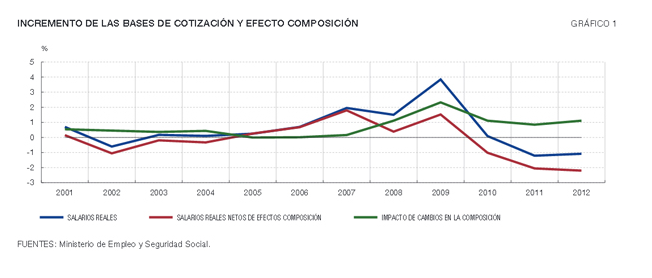
Here’s one simple chart which illustrates why I think Japan style deflation is now more or less inevitable in Spain. Curiously it comes from the Ministry of Employment and illustrates the relation between the movement in average wages caused by actual movements in the real wage and those caused by what is known as the “compositional effect”. This latter is known by this name because it is the result of movements in the composition of the workforce, whether this be in terms of the average skill level or the average level of experience (or seniority premium, if you prefer). Seniority has historically played a very important part in the Spanish wage structure – ie the longer you have worked the more you are likely to earn.
Now if you look at the data superficially, you find that in the first years of the crisis average real salaries went up sharply (the blue line). This surge in average salaries was not due to salaries actually rising to this extent, rather it was the result of the composition of the workforce having changed (the average skill level went up) as unskilled workers in construction lost their jobs. Hence the 2009 spike in the composition effect.
According to Bank of Spain data in 2008 skilled workers represented 23.55% of the total while by 2012 the proportion had risen to 28.2%. On the other hand, over the same time period unskilled workers fell from 14.8% to 10.2% of the total.This naturally had an impact on average wage levels.
Now, however, the labour market has stabilised, and unskilled workers are no longer losing their jobs (at least not in net terms). According to the Spanish newspaper Expansion the Spanish statistics office estimate average hourly labour costs (not unit labour costs, note) fell in Spain by 2.9% en 2012, 1.9% in 2013 and they are expected to fall another 1.7% this year.
Again, looking at the chart you can see that the green (compositional effect) line which surged in 2009 has now flattened. It has flattened but the impact is still there and has stabilised at a more or less constant rate. Subsequently it is quite possible that the compositional effect will even turn negative due to the impact of the 2012 labour market reform: average salaries are no longer falling due to labour shedding producing a changing skill composition but due to AGE CHURN. Older workers with long term contracts and lots of seniority are being steadily replaced by younger ones on less well paid contracts, thus dragging down the average wage. The line is flat and extends out in to the future. This can go on for years now, and indeed the compositional effect can even turn negative.This is exactly what has been happening over the years in Japan, and is the principal reason why Abenomics isn’t working.
Incidentally, here I have been talking about average hourly labour costs NOT those famous unit labour costs. These, as we all know, fell significantly in Spain after the onset of the crisis. What isn’t so well understood is that this fall wasn’t due to falling hourly wage costs (these didn’t really start falling till mid 2010, see blue line in chart) but due to massive labour shedding. Spain’s GDP has fallen by something like 7% while employment is down by around 20%.
On the surface this shows a large gain in productivity. Where this gain is actually coming from hasn’t been sufficiently analysed yet, but part surely comes from a compositional shift in the labour force. One thing is, however, reasonably clear and that is that it hasn’t come from industrial productivity, since industrial output is down by some 30% since the pre-crisis peak, even more than the reduction in employment.(I’m afraid you’ll have to stare very hard at the industrial output chart if you want to see signs of the much proclaimed recovery – you’ll have to stare very hard since there is so little sign of it).
So why do I think this suggests deflation may become endemic in Spain? Well, with average real wages falling, real pensions falling, and credit still shrinking by around 6% a year it is hard to see where the demand is going to come from, especially with very little happening in the way of new employment – the shortfall is becoming structurally implanted.
For more argument on all this (in Spanish) see my book which is being published by Ediciones Deusto next week. You can find a list of chapter headings here.



+Y-o-Y.png)
