
Legendary hedge fund supremo Ray Dalio is in ebullient mood. Following a series of moves by Mario Draghi to underpin European government financing Dalio told Bloomberg that, in his opinion, the euro will now “likely” stay together because existing growth-constraining austerity measures will henceforth be balanced by money printing over at the European Central Bank. His statement was, of course, a response to ECB President Draghi’s save the Euro pledge. Continue reading
FROB is not NAMA
The post’s title acts as a self-selection device, since if your interest is piqued by the mention of Spain’s Fondo de Reestructuración Ordenada Bancaria (FROB) or Ireland’s National Asset Management Agency (NAMA), you’re already in the world of Eurozone “bad banks” and perhaps willing to read on. The issue at hand is how the respective bad banks interact with the ECB.
Every unhappy peripheral is unhappy in its own way
 From the IMF’s Global Financial Stability Report. There’s a recurring controversy in Ireland as to whether the country was somehow bounced into a bailout by the European Central Bank in November 2010. The ECB’s reluctance to release all its communications with the Irish Department of Finance in that month has fed the suspicions, but the chart above should lay to rest to notion that Ireland was singled out by the ECB for special treatment. Ireland singled out itself. Exposure to the central bank system (ECB + Central Bank of Ireland) was rocketing from late summer 2010, as the 2 year blanket guarantee of September 2008 expired and Irish banks could find nowhere else but central banks to refinance their bond cliff of September 2010. Add to that the inability to convincingly upper bound the Anglo losses, and you had seemingly open-ended central bank exposures unlike other peripheral then or since. Incidentally, if spikes in this variable (central bank borrowing as share of GDP) are a leading indicator, the dashboard is flashing for Spain now.
Some pleasant monetarist arithmetic
Speech by Benoît Cœuré, Member of the Executive Board of the ECB, at the Institut d’études politiques in Paris yesterday —
… from an institutional design perspective, central bank independence and a clear focus on price stability are necessary but not sufficient to ensure that the central bank can provide a regime of low and stable inflation under all circumstances – in the economic jargon, ensuring “monetary dominance”. Maintaining price stability also requires appropriate fiscal policy. To borrow from Leeper’s terminology, this means that an “active” monetary policy – namely a monetary policy that actively engages in the setting of its policy interest rate instrument independently and in the exclusive pursuit of its objective of price stability – must be accompanied by “passive” fiscal policy. A passive fiscal policy means that the fiscal authority must be ready and willing to adjust its policy stance (revenues and primary spending) in such a way as to stabilise its debt at any level of the interest rate that the central bank may choose. … The creation of the EFSF/ESM in charge of providing support to euro area Member States in difficulties and enforcing appropriate conditionality has filled this gap. It provides the euro area with a means to restore “Ricardianess”, thereby minimising the risk of “fiscal dominance”.
Although this section of the speech is steeped in references to technical literature, it puts at least one major question up for debate: is what ails the Eurozone a need to reassert monetary dominance? The now seemingly widely accepted diagnosis of Professor Paul de Grauwe was that the Eurozone had excessive monetary dominance: precisely because the ECB was not a national central bank, none of the fiscal authorities within it had the ultimate backstop of monetary financing of debt, and therefore some face punishingly high yields or complete lock out from bond markets.
So although what M. Cœuré describes may be pleasing to Bundesbank ears, the underlying interpretation is somewhat different. What’s happening now is not a switch back from fiscal dominance to monetary dominance. It’s a kinder, gentler monetary dominance where the discipline comes not from a binge and purge fiscal cycle, but more active support to keep the would-be fiscal dominators from finding out the hard way what happens at the end of the alternative path. In so doing, it also makes old style Bundesbank monetarism easier: tight money now doesn’t force countries to the point where inflation is eventually the only option.
The Eurozone designs a halfway house
Setting out the framework for the ECB’s Outright Monetary Transactions (OMT) on Thursday, the ECB said —
They may also be considered for Member States currently under a macroeconomic adjustment programme when they will be regaining bond market access.
Certainly helpful for Ireland and Portugal to have that backstop. What’s not quite so clear is how the conditionality would be applied. The countries would be selling bonds as a path to exit from their existing Troika programme and the programme would presumably expire as the final disbursements were made and the original programme conditions met. So what is the Post-Program Monitoring (as the IMF might say) for those countries?
Il Calcio explains the Eurozone crisis
 From Gazzetta dello Sport’s Serie A scores page on Sunday evening.
Unlocked handcuffs

The above figure, from a fascinating new IMF Working Paper* on sovereign debt restructuring, shows the breakdown of recent EU country public bond issuance by the governing law of the bond contract. Economics has various concepts of the usefulness of tying one’s hands to gain credibility, such as for example by committing to a single currency following a history of high inflation and devaluations. So perhaps the most interesting thing about this chart is that it shows despite the presumed sanctity of sovereign bonds above all other forms of debt, European countries have generally not chained themselves to the (external) mast in terms of governing law. Most countries issue government debt under their own law, meaning that changing the terms of the debt could be accomplished legislatively at any time. This is in contrast to commercial bonds: note that one of Ireland’s rationale’s for servicing unsecured debt in insolvent banks was that the bonds were issued under English law.
Now, as the chart shows, it’s not always true that European Union countries issue public bonds governed by domestic law. If there’s a rough trend in the data, it’s for small and mostly non-Eurozone countries to issue under English law, perhaps in search of the credibility or good signal of such a framework. But for the rest of them, its sovereign debt and we’re not even supposed to discuss default and they’ve pinky-promised that they’ll pay it back. But legally, they could rewrite the terms in the morning.
*Sovereign Debt Restructurings 1950 – 2010: Literature Survey, Data, and Stylized Facts. Das, Papaioannou, & Trebesch, IMF WP 12/203, 2012.
In Search Of Lost Demand
So here’s the 5 trillion dollar trick question. In an interesting article on the limitations of central bank monetary policy in the current environment, Reuter’s Alan Wheatly made the following statement which caught my attention. “Central banks are rummaging through their toolkits because, despite slashing interest rates and buying vast quantities of bonds, they have signally failed to revive a global economy hamstrung by heavy debts and weak banks”. But thinking about it for a couple of minutes, you could ask yourself why is this so? Continue reading
The Owl Of Minerva
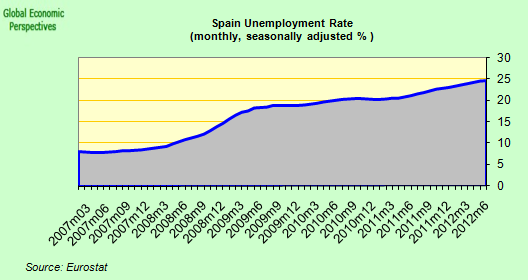
Last week was the fifth anniversary of the outbreak of the global financial crisis. Not uncoincidentally it was also the fifth anniversary of continually rising unemployment in Spain , since it was in early summer 2007 that seasonally adjusted Spanish unemployment embarked on its steady upward path. And after it started climbing, naturally it hasn’t stopped since. Indeed we seem to have at least another year of growing unemployment before us, maybe more.
Is The Italian Elephant About To Break Loose Again?
Market nervousness about Italy has been growing in recent weeks, with the Moody’s credit downgrade of the country being only one of the reasons. A bailout is clearly in the offing, with the only real questions being how and when. While the situation inside his country appears to be deteriorating, Mario Monti has been doing the rounds of European capitals in an attempt to drum up support. While in Helsinki he raised an eyebrow or two when he warned that without a serious plan to bring down interest rates disaffection with the euro in his country could easily grow to dangerous proportions. Crying wolf, or a piece of insider information? Probably a bit of both. Continue reading