One Chart To Rule Them All, One Chart To Find Them (Out)

Look, if there is one simple chart which sums up everything that is wrong with current thinking at the International Monetary Fund, then it is this one.

Basically, I spent much of the day yesterday scratching my head, trying to work out how the hell the IMF could be forecasting Spanish GDP growth of 1.7% in 2012, of 1.9% in both 2013 and 2014 and 1.8% in 2015. And now it has dawned on me how and why they can. Quite simply they are forecasting current account deficits for Spain of 5.3% of GDP in 2010, 5.1% in 2011, 5.0% in 2012, 5.0 in 2013, 5.0% in 2014%, and 5.0% again in 2015. In other words, the assumption is that nothing fundamental is going to change in the post 2008 world, when compared with the years that preceded it. And this is clear when you come to look at the whole structure of current account balances revealed in the chart above, which are based on the IMF forcasts through 2015 as set out in the April 2010 World Economic Outlook. It is a case of plus ça change. Continue reading

Too Soon To Cry Victory?

Confidence Has Returned To Europe’s Financial Markets, But Lasting Economic Growth May Not Be So Easy To Achieve

ECB president Jean-Claude Trichet was in rather optimistic, one might even say jovial, mood at the press conference which followed this week’s central bank rate-setting meeting. Second-quarter GDP growth in the 16-nation euro zone would prove “really exceptional,” he stated, while the July bank stress tests marked “an important step forward in restoring market confidence.”

And it wasn’t only that pre-holiday bonhomie – as Ralph Atkins also reports M. Trichet was about to head off for some well earned rest in the Brittany seaport of Saint-Malo – which was lifting M. Trichet’s spirits, recent data – especially from France and Germany – has been reasonably encouraging. Indeed, M. Trichet’s comments came just hours after Germany reported a stronger-than-expected 3.2 per cent rise in industrial orders in June, which came hot on the heels of some pretty strong PMI readings and a further rise in confidence among those living in the Euro Area about the immediate economic outlook, which hit its highest level in more than two years in July according to the EU economic sentiment indicator. Nevertheless, as the EU Commission itself points out, a substantial part of the most recent improvement is due to the improved mood in Germany.

Continue reading

Just What Is The Economist Up To In It’s Seeming Crusade Against Catalunya?

Well, this is certainly not the first time I have had cause to complain about the quality of the journalism and economic reporting served up over at the Economist, and I’m damn sure it won’t be the last. But this latest example of shoddy (I would almost even go so far as to use the word “gutter”) journalism certainly takes the biscuit. Catalunya, the august magazine informs its readers is the “Land of the Ban” – “First the burqa, now the bullfight. What will Catalonia outlaw next?” Evidently the author of the article is entitled to his opinion, but could it be that the long-standing practice of incorporating unsigned opinion pieces may now have lost its earlier justification, and may it not somehow have inadvertently converted itself into a rather cowardly way of expressing otherwise hard to justify opinions behind the safe shield of anonymity. Or would our author really like to show us that valour is, at least in this case, the better part of discretion, and enter the arena in persona in order to face the wrath of the Catalan bull?

“The bullfight is not a sport in the Anglo-Saxon sense of the word,” wrote Hemingway in his classic treatise Death in the Afternoon, “that is, it is not an equal contest, or an attempt at an equal contest between a bull and a man. Rather, it is a tragedy; the death of the bull, which is played, more or less well, by the bull and the man involved, and in which there is danger for the man, but certain death for the animal.”

Continue reading

Hidden away in a sunlit mountain valley …

The Wall Street Journal carries a review by Trevor Butterworth of The Enlightened Economy by Joel Mokyr, former editor of the Oxford Encyclopedia of Economic History. This is a book which aims to explain why the industrial revolution happened in Britain before it happened anywhere else. Thoughts on the book itself will follow, perhaps. Right now, I’m more worried about the review:

The reason for Britain’s exceptionalism, Mr. Mokyr says, lies in the increasing hostility to rent-seeking—the use of political power to redistribute rather than create wealth—among the country’s most important intellectuals in the second half of the 18th century. Indeed, a host of liberal ideas, in the classic sense, took hold: the rejection of mercantilism’s closed markets, the weakening of guilds and the expansion of internal free trade, and robust physical and intellectual property rights all put Britain far ahead of France, where violent revolution was needed to disrupt the privileges of the old regime.

This is the first time I’ve seen ‘rent-seeking’ defined as ‘the use of political power to redistribute rather than create wealth’. It’s a bad definition, since we naturally tend to think of ‘political power’ as something wielded by government; this particular definition, then, will lead us to think of ‘rent-seeking’ as primarily an activity of government. Which it ain’t. Things like ‘robust physical and intellectual property rights’ may privilege any suitably placed individual or private company: Sky TV, for example. But let’s take the main point as given: at one time, Britain was comparatively liberal, France was comparatively regressive. And France did indeed experience revolution. Of course, you’d think that revolution might allow France a bit of a catch-up opportunity. Apparently not:

Such political upheaval in Europe, notes Mr. Mokyr, disrupted trade, fostered uncertainty, and may well have created all kinds of knock-on social disincentives for technological and scientific innovation and collaboration with business. Much as we might deplore too many of our brightest students going into law rather than chemistry or engineering, it is not unreasonable to think that many of France’s brightest thinkers were diverted by brute events into political rather than scientific activism (or chastened by poor Lavoisier’s beheading during the Revolution).

Admit it, people, the real thesis here is: heads the Anglos win, tails the Euro-weenies lose. I note also that ‘France’ and ‘Europe’ are treated as synonyms, but hey.

I suppose it’s mostly fairly difficult to untangle the prejudices of the reviewer from the subject, where the subject itself is a representation in writing of someone’s thoughts, but I suspect this particular review gets close to the limiting case: i.e. the case where everything you see is the prejudice of the reviewer. Stock tropes only; nothing substantial or falsifiable to be given away.

Incidentally, I think there’s a way to understand the Murdoch publications paywall: it’s journalism going Galt. They’ll come out as they went in; how else could it be? I think it’s a shame Rand had the first-handers hide themselves away in the Rockies, though; I’m imagining a South American tepui, Conan Doyle Lost World style.

Update: I’ve realised that there is a reading of ‘the use of political power …’ which brings it more into line with how rent-seeking is usually understood. This is the reading in which political power (of government) is held ready for someone outside government to make use of: government as a utility, if you like. Even on this reading, I still think it’s a poor definition. It’s understood that it costs a petitioner something to engage with government – hence there’s an efficiency argument to be made in connection with rent-seeking – but terms like ‘use’ and ‘manipulate’ suggest that policy can be flipped on and off like a light. So, how would I define ‘rent-seeking’, you might ask. Perhaps like this: rent-seeking is the attempt to influence public policy in search of policy privilege.

And a welcome to readers from University of North Carolina at Chapel Hill, also.

Do The Latest European Bank Lending Numbers Reveal A Major Headache Looming For The ECB?

According to Ralph Atkins, writing in the Financial Times:

“Eurozone mortgage borrowing grew last month at the fastest pace in almost two years in a sign that bank lending across the 16-country region may be flickering back to life. Lending for house purchases rose at an annual rate of 3.4 per cent in June – the fastest since September 2008, according to European Central Bank data published on Tuesday. The acceleration pointed to a revival in consumer confidence and an increased willingness by banks to fuel the economic recovery with loans to the private sector.”

So is this really the good news it seems to be? Well the answer is (as usual) yes and no. The problem is that behind the positive aggregate data lie the individual national details (you know, the place where the devil is usually to be found), and when we dig down to this level, then we find the position is much more complicated than it seems. Nor should this surprise us, since if a one size fits all interest rate policy didn’t work in the pre 2008 world (just look what happened to Spain and Ireland for heavens sake), is there any good reason to assume that it will in a post 2010 one? Continue reading

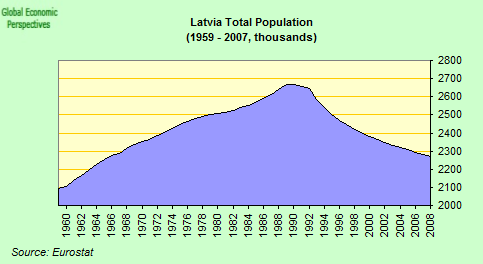
Latvia: The Demographic Price Of Procrastination

One of the things I think we can safely say about the impact of the current economic crisis is that the face of Macro Economic theory will never be the same again. Quite what the macro economics of the future will look like is too early to say, but what is clear enough is that the existing corpus has been tested and found wanting: it’s predictive capacity is very, very limited, and this is obviously a far from satisfactory situation.

At the same time, new ideas, and new perspectives are emerging. I have already spoken earlier this morning about the key issue of “non linearities” in the context of Jordi Molins’ discussion of the weaknesses of the stress test methodology. Claus has spoken about some of the issues raised by the attempt to put macro theory on micro foundations, and now I would like to present an important, if little known, piece of research coming from Latvia – one of the canaries in the coal-mine on the whole Eurozone sovereign debt issue. Eliana Marino’s work is both extremely interesting and extraordinarily important, since what it illustrates is the negative feedback mechanism that can be activated by having an “L” shaped non-recovery in a rapidly ageing society with extremely low underlying fertility. What Eliana did was something macro economists seldom consider doing, she carried out some qualitative research, rather than running a computer model, to find out just what was happening on the ground.

The resulting survey, which she personally conducted in Riga from September to December 2009 and which involved some of the leading Latvian experts on migration issues, lead her to estimate that around 30,000 people may well have left Latvia in 2009 and the same number are likely to follow them in 2010. These numbers are considerably greater than the official register shows. As she argues these large emigration flows from Latvia will have a significant effect on the future demographic and economic path of the country, creating serious problems of labour shortage, unsustanability of the pension system and accelerating the already significant population decline.

And just why may Latvia be a canary down the coal-mine in this context? Well think about Spain, where the housing boom attracted in the best part of 6 million people – in a country where the rate of natural change in the population was stagnant. Now imagine that with 20% unemployment as the continuing outlook for the country over the best part of the next decade, what might happen there. People could vote with their feet, and the population could contract just as rapidly as it grew, leaving that 1.5 million currently unsellable housing units even more unsellable than ever. The warning signs are there. The number of those contributing to the social security system continues to stagnate, even as unemployment remains unchanged, so where are the people? Some have obviously found their way into the growing informal economy, but others have surely left, and there is plenty of anecdotal evidence to support this idea. In addition, the rate of new household formation turned negative in the first quarter, for the first time in the series history.

At the end of the day, the truth of the matter is that we really don’t know what is happening in Spain, so would the Spanish Eliana Marino please kindly step forward? Continue reading

Macroeconomics, Representative Agents and Demographics (wonkish)

Upon first reading what I am, more or less, pasting below, my thesis councillor opinioned that this particular piece of text was a malignant tumor that had to be surgically removed if the patient (in this case, my master’s thesis) were to make it alive. I agreed with him back then and I still do, but I thought that the section was too interesting to be devoted entirely to the dustbin. Moreover, the debate on the state of macroeconomics has gotten new life on the back of the financial and economic crisis with a lot of interesting contributions in the past 2 years [1] and I wanted to add my own spin on, at least, part of the issues involved. Continue reading

Interpreting The Stress Tests

Evidently there is now a considerable debate out there about the famous (or should that be infamous) CEBS stress tests. Methodologically all sorts of weaknesses have been identified, but in many cases these are decidedly beside the point. It is important to be aware what the tests were (and weren’t) designed to show. They were, it seems to me, essentially designed to free up lending in the short term European interbank market, nothing more, nothing less. This would be useful since it would enable the ECB to step out of playing this particular role. And it may well happen, since if everyone can agree that no European bank is going to fail tomorrow, or be allowed to fail tomorrow, then there should be no difficulty for one bank to lend to another for 24 hours, and so on.

But this issue is a quite separate one from the longer term funding needs of the Spanish banking system, for example, or from the longer term solvency of Greek sovereign debt, where a large quantity of asset backed securities of one kind or another need to be re-financed in the months and years to come. This is a much more complicated issue, since no one has a really very clear idea of the longer term value of the securities which back the pieces of paper, either in the Spanish or the Greek cases, and the stress tests have done nothing to resolve this issue. And that is not surprising, since they were never intended to serve that purpose.

What the tests have I think made reasonably clear is that no EU bank or sovereign will be allowed to fail between now and the end of 2011. They will not be allowed to fail, quite simply because the ECB and the European Financial Stability Facility are there to guarantee that they don’t. So something is something. The Eurozone was created without due care and attention being paid to the kind of institutional backdrop which would be required to support it if things went wrong. Now things certainly have gone wrong – in ways which I think were perfectly forseeable, but let’s not push that one too hard right now – and we are in the process of putting some of the institutional support in place. Like Gaudi’s famous Sagrada Familia, what we have is a work in progress, with no evident end-date in sight, and no detailed blueprint of what the thing will finally look like. Debate about the future is, as they say, “ongoing”, and the situation is “fluid”.

At the same time issues about the per se usefulness of the kinds of tests the CEBS have just carried out remain, and continue to be legitimate areas of discussion. Some people have spoken about the likelihood of tail risk events (not forseen in the stress tests). But to some extent even this argument misses the point, since I am not sure that what we are talking about are “tail risks” in a situation like the Spanish or Greek one. The kind of cascading scenario (debt snowball, for example) we could see actually forms part of what anyone with a solid grasp of the underlying macro should actually expect to happen if no one does something to ensure it doesn’t, for the simple reason that all the various economic agents are effectively “inter-linked”, so when one part of the system goes down, then the rest can come crashing down behind it. And this is what will almost inevitably happen if someone, somewhere doesn’t find a way to revert the Spanish and Greek economies to a sustainable growth path.

With this in mind, and with due regard to the fact that most of the models conventional economists and financial analysts work with make all kinds of “linearity” assumptions when in fact many of the processes involved are decidedly non-linear, and subject to various kinds of interconnectedness issues and feedback loops, I though it might be useful to reproduce here an argument to this effect recently made by my friend, the Catalan economist Jordi Molins. So without more fuss or flourish, here its is. Continue reading

Well, we’re all good at something

Chris says he doesn’t like hierarchies:

For as long as I can remember, I’ve hated hierarchies. I didn’t like school, for example, until I entered the less hierarchical sixth-form. One reason I wouldn’t want to be an academic or a civil servant is that I’d be uncomfortable with their endless gradations of status.

Discussion follows, in which a fair few people have a go at Chris for wanting to differentiate himself as an inventive blogger: i.e., he’s just as status-seeking as anyone else.

Chris’s original intent, though, was to get a bit of traction on an argument that’s come out both against The Spirit Level and against the leftish commentary that’s gone along with it. This is the argument that status differentiation is inevitable; it’s a natural extension of our heterogeneity. We are diverse to begin with – each of us is a different mix – and status is built on that, in various corresponding ways. This isn’t a particularly new story. Howard Roark isn’t the only hero of The Fountainhead; there are others, themselves to be admired for what they do. The hotelier Kent Lansing, for instance:

I want a good hotel, and I have certain standards of what is good, and they’re my own, and you’re the one who can give me what I want. And when I fight for you, I’m doing – on my side of it – just what you’re doing when you design a building. Do you think integrity is the monopoly of the artist? And what, incidentally, do you think integrity is? … Integrity is the ability to stand by an idea.

Ian Fleming extends the range of ideas somewhat:

Man has climbed Mount Everest, gone to the bottom of the ocean. He’s fired rockets at the Moon, split the atom, achieved miracles in every field of human endeavour … except crime!

Auric Goldfinger strives non-virtuously and revels in it, hence the humour. But the each-to-his-own-field-of-excellence sentiment – as diffused into contemporary society – takes a where’s the harm? tack. It goes: so what if some people are wealthy? There are some really cool skateboard kids in Pasadena; you might envy my wealth, but money just happens to be what I do. Actually, I envy the skateboarders. It’s self-consciously and defensively earnest, and I reckon it owes quite a bit to the Rand version.

Anyway, the distinction I want to remind everyone of is that between hierarchies with consequence and hierarchies without consequence. It’s not an absolute distinction, but it’s there.

For example, when it comes to golf, I’m at the bottom of the heap and I know it. Almost everyone is better than me. I hate golf, come to that, and never play. But the cause of my hatred isn’t that my options in golf (or in anything else, more or less) are constrained by other golfers (as golfers). In fact my options are almost wholly unconstrained by other golfers. Perhaps I couldn’t enter any tournament I wanted to, but I still get to have a go at just about anything else golf-related that I might fancy. It’s ‘no skin off my nose’ that other golfers are better than me.

Contrast with the hierarchy of wealth. Not the same. Your wealth – as part and parcel of our social arrangements generally – is made a condition of many, many activities. Including access to golf courses, as you may have muttered to yourself when reading the paragraph above. It’s a commonplace that other wealth-holders do tend to constrain your options; typically, they constrain you in that they outbid you in seeking something scarce. The hierarchy of wealth is a hierarchy with consequence; it is skin off your nose, it’s a hierarchy that often matters, and this is why it’ll tend to get brought into any discussion of social inequality. And perhaps this is only something odd about me, but I tend to think that if a person is constrained almost every which way he or she turns, then that person will start to feel just a little bit beaten down.

As a part-aside; apparently Nero’s palace in Rome got to be so big that other Romans had to take huge detours in order to get from one side of the city to the other. In the end, the lawful resident of the Domus Aurea pissed off other Romans so much that they did him in. Just saying.

Woerth/Bettencourt: efforts to cap the well fail, storm approaches

This week’s Canard Enchainé has a cartoon likening the Woerth/Bettencourt scandal to the Deepwater Horizon oil spill. This annoys me, as I’ve been making the same joke to anyone who will listen for weeks. So what happened? Well, just to run up to speed…

So there’s the heiress to L’Oreal, Liliane Bettencourt, the richest woman in France. (Among other things, she is the second biggest taxpayer and receives a reputed €34m in dividends a month.) She’s in her eighties, and she has a daughter. She also has a faintly boho circle of friends and a crack team of accountants. Now, she fell out with her daughter about the amounts of money she spends on her mates. The daughter sued, trying to get rid of her mother’s accountant and have mamma placed under a power of attorney. Mamma doesn’t agree, and the fact that she manages to pay the same marginal tax rate as someone on a salary of €3,000 monthly would tend to support the notion that she can well look after herself.

Then it turned out that her servants had been secretly taping conversations between her, her accountants, and various others. Sensation; one of the people involved is Eric Woerth, the former Budget Minister and now Minister of Labour. Eric Woerth’s wife, Florence, is an accountant employed by the Bettencourt family office. Further sensation.

But what were they talking about? One of the plaintiffs in the original lawsuit now gets her own back, by telling the newspapers, specifically the former Le Monde editor Edwy Plenel’s subscription-only website Mediapart. She says that Mme Bettencourt was in the habit of inviting key right-wing politicians for dinner and distributing yer actual brown envelopes stuffed with raw cash. Names include Woerth, Prime Minister Francois Fillon, and…Nicolas Sarkozy. El presidente himself.

Suddenly, no-one was talking about the family dispute any more, and a certain Macondo quality took hold. A string of efforts to cap the leaking well began.

Activating the giant shears

First of all, the UMP’s underwater robots tried to cut off the information source, encouraging legal efforts to suppress the documents of the case. That didn’t work; they were clearly “d’intéret génerale” and anyway, bits were washing up everywhere. Including in Switzerland, where it was alleged that €100,000 of the campaign money had come from. This would be highly illegal.

Top Hat

Then they tried to place a steel cap over the leak. The ex-accountant was quizzed by the police, and suddenly decided that Sarkozy hadn’t received the money and that the dates were wrong. What was wrong about them wasn’t clear, but it was certain who was at fault. Le Figaro somehow got what purported to be an extract from the transcript of the police interview, which said that Mediapart had “romanced”, perhaps a careful choice of words. (Remember that bit – it’ll come up later.)

There was only one problem; the police had already seized the bank statements, and large sums of cash had been withdrawn on each of the dates in Mediapart’s original report. Bubbles of hot air were building up beneath the cap, rendering it dangerously unstable.

A string of new leaks began to appear; a rather well connected racing stable, which had turned up just in time for its owners to benefit from a special tax break, for example. The tax break allowed those subject to France’s wealth tax to shield some of their assets by investing in small businesses. It had probably not been foreseen that such a small business might include buying horseflesh. Who changed the rules? M. Woerth, while his wife was one of the shareholders.

Actually, the affair has a curious horsey scent. Woerth is also accused of having sold a publicly owned racecourse, at mates’ rates, in his capacity as mayor of Compiégne…

There was more serious stuff, too. Bettencourt’s tax file, as one of the biggest in France, should have been audited every 3 years at least. Somehow, this had not happened since 1995 (significantly, since the end of the Mitterand presidency). The internal inquiry denied that Woerth had anything to do with it, but not many people believed this.

In the light of all this, containment efforts broke down. The accountant changed her mind again. The new line of defence was that the large cash withdrawals represented the Bettencourts’ pocket money. Even Le Figaro noted the curious coincidence that this requirement spiked by a factor of eight immediately before elections.

Top Kill

Clearly something more powerful than the underwater robot was required, and it was decided that a shot of Presidential authority might do it. Nicolas Sarkozy appeared on national television, in an awkward cross between an interview and a formal address, during which he talked a great deal about pensions. Afterwards, the semi-interviewer was accused by the France 2 journalists’ union of having done the government a favour.

Then came a new shocker – the discovery of the “microparties”. In France, it is illegal for a party to accept more than €7,500 a year from any one person or organisation. There is, however, no restriction on how many parties one candidate may be a member of. Also, someone who is a member of a party may give it as much as they like, and an association (as opposed to a party) can do as it likes and can also turn into a party at any moment. As a result, France has over 300 active political parties, many of which have no members. Inevitably, Woerth turns out to have such a personal party. The President himself has two. Valérie Pecresse has three. Laurent Wauquiez took the opportunity of an official trip to London to solicit money for his pocket party from French businessmen here.

Thick, sticky cash kept spilling from the damaged well. It turned out that Bettencourt had received €100 million in refunds over four years under a Sarkozy-initiated tax cut. Woerth was discovered to have pulled strings with the Bettencourts for his wife. The ex-accountant had been paid by both Bettencourt and her daughter. And there was that thing with the island in the Seychelles of unknown ownership.

This week’s Canard has an informative article on the Bettencourts’ tax affairs; thanks to a neat structure, the dividends from L’Oreal (a sort of feudal tribute imposed on every artificial blonde) flow into a shell company and sit there. Having been taxed as income at source, they are not then subject to further taxation. The lady draws on this company’s funds as required, and therefore manages to pay income tax only on what she spends.

Junk Shot

The situation, therefore, is grim. Sarkozy has been quoted as complaining that Woerth is “un poids, pas un atout” (a burden, not an asset) that it was “impossible de se délester” (impossible to jettison). Which begs the question, why is it impossible to get rid of him? It probably has something to do with the time he spent as the UMP’s treasurer. The president has some experience of these things – as Edouard Balladur’s campaign director in 1995, he was responsible for banking 10 million francs of campaign contributions. Ostensibly collected at campaign rallies, the only unusual feature of this transaction was that it consisted entirely of 500 franc notes. As Arthur Goldhammer says, one way of looking at Sarkozy is in terms of a swap of elites – the electorate turning to the private-sector rich rather than the civil service/industrial technocracy. “I call you…my base!”, indeed, but surely that took it a little too far.

So, what to do? Fortunately, there’s always the option of abasing yourself in a binge on racist demagoguery. So the police shot a gypsy, which started a riot.

Ce matin, au cours du Conseil des ministres, Sarkozy a donc annoncé qu’il organiserait une réunion, le 28 juillet, à l’Elysée sur « les problèmes que posent les comportements de certains parmi les Gens du voyage et les Roms » et qu’on y déciderait « l’expulsion de tous les campements en situation irrégulière ».

One of his own senators wouldn’t agree, but we’re in “don’t confuse me with the facts!” territory. After all, they also want to pass a flag-burning law, despite the fact there already is one. But sometimes, the best solution is a million gallons of old rope, balls, and toxic mud.

I mentioned that the Figaro story would come up again. Look at it closely; you’ll notice that there is no byline attached. This week’s Canard has a news-in-brief item mentioning a protest by the paper’s journalists about a story that was dubious and “part of the presidency’s communications strategy”, in connection with an unsigned article.