Has Spanish Unemployment Really Been Falling Recently?

In this post I would just like to ask a very simple question. What is the real rate of growth of unemployment in Spain? Are things improving, getting worse, or simply staying the same? Now, before you jump to too many conclusions on this it is important to remember that in the world of economic analysis there are lies, damn lies, and then there are press releases.

So if you read in the headlines in your paper recently that the number of jobless in Spain fell by 20,794 in July after a 55,250 decline in June (cutting the total number of unemployment benefit claimants to 3.54 million), you might like – bearing in mind what I have just said – to ask yourself what else could lie behind such statistics?

Continue reading

Are Spain’s Banks Really As Good As They Look?

Well, Variant Perception’s Jonathan Tepper certainly doesn’t think so, and since his latest report on the Spanish banking sector cites me extensively and explicitly, I guess I don’t either.

Spain had the mother of all housing bubbles. To put things in perspective, Spain now has as many unsold homes as the US, even though the US is about six times bigger. Spain is roughly 10% of the EU GDP, yet it accounted for 30% of all new homes built since 2000 in the EU. Most of the new homes were financed with capital from abroad, so Spain’s housing crisis is closely tied in with a financing crisis.

The impact on the banking sector will be severe. Consider this: the value of outstanding loans to Spanish developers has gone from just €33.5 billion in 2000 to €318 billion in 2008, a rise of 850% in 8 years. If you add in construction sector debts, the overall value of outstanding loans to developers and construction companies rises to €470 billion. That’s almost 50% of Spanish GDP. Most of these loans will go bad.

Spanish banks, in our view, are now facing a very bleak outlook. Spain’s unemployment rate reached over 17%; there are now four million unemployed Spaniards and over one million families with not a single person employed in the family.

We argue and will document anecdotally in this report that:

• The real estate crash in Spain is worse than is widely believed, much as the subprime problem was much worse than people believed
• Spanish banks are hiding their losses and rolling over debt to zombie companies, much as Japan did in the last decade
• Investors are deluding themselves if they believe that Spanish banks are among the strongest in the world. (This is a new theme. See Forbes’s latest “Spanish Banks In Top Form” for an example of the new fawning articles on Spanish banks.)

If we are right, Spain will soon have zombie banks like Japan and it will face a prolonged period of deflation. However, Spain will be much worse.

The report is getting extensive coverage in the UK and Spanish press:

Financial Times – Are Spanish banks hiding their losses?

Expansión – El informe más catastrófico: “España sufre la madre de todas las burbujas inmobiliarias y su banca será zombie”

Cinco Dias – Una casa de análisis predice que España se enfrentará a una tasa de paro superior al 25%

Cotizalia – ¿Están los bancos españoles escondiendo sus pérdidas?

For those of you whose first language is Catalan I’ve organised a translation on my Catalan blog here.

Is Germany’s Economy Really Powering Ahead?

Well, euphoria in Germany is certainly on the rebound, with a sudden surge in the ZEW investor confidence index and newspaper articles all over the place predicting the imminent renaissance of European economic growth, despite the fact that in 3 of the 5 big European economies – the UK, Italy and Spain – there is little in the way of evidence to back this view up.

The French economy is certainly holding up reasonably well, but the situation in Germany still remains deeply problematic due to the complete dependence of the economy on exports. Despite this we have a shower of articles (Below I present an extract from Frank Atkins writing in the Financial Times) explaining how “Europe’s Economic Recovery is Gaining Steam” and the “German economic recovery powers ahead”. I have already written up a an extensive summary of the actual state of play in the German economy, which is largely supported by a strong government stimulus programme, and a recovery in industrial output for export to levels which are more in line with the actual current level of demand than were the extremely low levels seen at the turn of the year (which were the product of demand being met from inventory run downs). Continue reading

Raising Taxes In Spain Is Not A Solution!

Victor Mallet had a piece on public works minister José Blanco’s Thursday speech in the FT yesterday. My feeling is that the Spain of Zapatero looks more and more like the Hungary of Gyurcsany with every passing day, and I say this more from the point of view of the twin deficit problem, and the impression the administration gives of things being totally out of control and no one knowing what to do, than anything else.

I am not at all party political, and my observation should in no way be read in that sense. The situation has only deteriorated since Solbes and Vergara were ousted, and the only mystery for me is why exactly they were replaced with a team who have no understanding of macro economics whatsoever. For the record, I predict the IMF will have a permanent delegation in Madrid before 2011 is out.

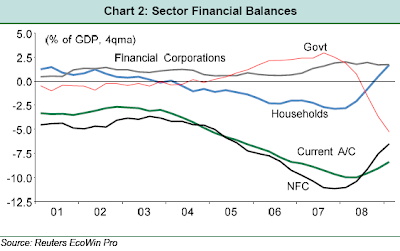
As the following chart – from Dominic Bryant at PNB Paribas – makes clear, while Spain’s households and corporates are busily deleveraging, government finances are deteriorating in a totally unsustainable fashion.
On the details of Blanco’s statement, I would simply make three points.

Firstly, it is far from clear that this is a serious proposal. There must be a battle royal going on inside the PSOE even as I write, and this proposal may well have more to do with internal party debates than anything more substantial. Economy Minister Elena Salgado has been notably silent, so one possibility is that Blanco made the speech simply to “test the ground”.

Basically, the current Spanish administration want to hear nothing of internal devaluation, and will try anything to avoid that going down road. The biggest issue they have is growing deflation, and falling revenue as prices drop. This has been a common picture across Eastern Europe, it is just that the states in the South of Europe are rather richer, so there was more flesh on the bone when the crisis broke. They have a salary increase for public servants pencilled in for next year, and this, of course, is a commitment which it will be impossible to honour in the present climate.

Secondly, the biggest unspoken issue we are seeing in one economy after another is the retreat of a lot of activity back into the informal sector. So called economic “greying”. Just look what is happening to revenue in Italy. Again, we have seen this happening throughout the East. The contractions in the Baltics are nowhere near 20% in my view (although they are, of course, very large), people simply are declaring less and less. This is a problem the IMF are struggling with day in and day out in Latvia. But this whole process makes things very difficult for government finances, as we are seeing. More tax increases on the very rich and professional middle classes will be entirely unproductive as they will only accelerate this process.

Lastly, increases in VAT. These are again very counterproductive, since they hit consumption directly, at a time when consumption is declining anyway. All such increases do is accelerate the contraction (IMHO the IMF is wrong to be advocating this in the East, but undoubtedly they feel they have little alternative if they wish to preserve some minimal semblance of social services, which they need to do to get the population to agree to their packages in the first place). I wouldn’t even mind betting that a VAT hike would be nearly revenue negative, for the consumption drop it would produce and the retreat into the informal economy it would accelerate.

Twenty Percent of Spanish Mortgages Now Considered To Be High Risk

According to an article which appeared in the Spanish newspaper Expansion this morning, one in five Spanish mortgages is now considered as being high risk and liable to become “non performing”.

The mortgages at greatest risk are naturally those contracted after 2005 where the loan to valuation was over 80% of the total. In 2006 and 2007, according to data from the bank of Spain, LtVs were over 80% in 17.7% of the mortgages granted, since prices are now heading back towards the 2005 level, we can easily conclude that something in the region of one in five Spanish mortgages are now high risk. Continue reading

A Eurovision story

Ex Caucasus semper aliquid novo:

Rovshan Nasirli, a young Eurovision fan living in the Azerbaijani capital Baku, says he was summoned this week to the country’s National Security Ministry — to explain why he had voted for Armenia during this year’s competition in May.

“They wanted an explanation for why I voted for Armenia. They said it was a matter of national security,” Nasirli said. “They were trying to put psychological pressure on me, saying things like, ‘You have no sense of ethnic pride. How come you voted for Armenia?’ They made me write out an explanation, and then they let me go.”

A total of 43 Azeris voted for the Armenian duo Inga and Anush, and their song, “Jan-Jan.”

Nasirli, like others, used his mobile phone to send a text message expressing his preference, little imagining his vote would eventually result in a summons from national security officials. (By contrast, 1,065 Armenians voted for the Azerbaijani team, apparently without consequence.)

— That’s actually a fairly good index of the relative freedoms of the two countries. Armenia is a managed democracy, where the opposition is kept pretty toothless. Last year, when the government got tired of peaceful protests over a stolen election, they gunned down a bunch of protesters in the street. (And then blamed the opposition, of course.) Continue reading

From Original Sin To The Eternal Triangle – Lessons From Central Europe

The non-biblical concept of original sin, as Claus Vistesen notes in this post, when propounded in its standard Obstfeld & Krugman textbook version refers to the situation where many developing economies who are not able to borrow in their own currencies feel forced to denominate large parts of their sovereign and private sector debt in non-domestic currencies in order to attract capital from foreign investors – as evidenced most recently in the countries of Central and Eastern Europe. Well, piling insult upon injury, I’d like to take Claus’s point a little further, and do so by drawing on another well tried and tested weapon from the Krugman armoury, the idea of the “eternal triangle”. Continue reading

Germany’s Economy Returns To (Timid) Growth In Q2

The German economy, Europe’s largest, unexpectedly returned to growth in the second quarter, technically bringing an end to its worst recession since World War II. The euro climbed 0.2 percent to $1.4248 on release of the report.

But don’t get carried away just yet, since while gross domestic product rose a seasonally adjusted 0.3 percent from the first quarter, when it plunged 3.5 percent, the most since quarterly data were first compiled in 1970, compared with Q1 2008 Compared with the second quarter of 2008, the price-adjusted GDP product was down 7.1%, while after adjustment for calendar variations, economic performance decreased 5.9% on a year earlier as the quarter had three working days less than the same period of the previous year.

Continue reading

No law beyond the twelve mile limit

This morning the BBC had news that the MV Arctic Sea may have been hijacked in the Baltic and sailed through the Straits of Dover before vanishing. There is probably less to this than meets the eye – for all the speculation of pirates and illegal arms transfers, this looks like a commercial dispute being solved using Russian traditional law and custom. But it raises a more general point.

Continue reading

Alain de Botton on ‘success’

Just a small post to direct you to an interesting and entertaining lecture by Alain de Botton on career crises and the psychology and sociology behind ‘success’ (hat tip BNET):
One quote: “It is not the material goods we want, it is the rewards. (…) The next time you see someone driving a Ferrari, don’t think this is someone who is greedy, think this is someone who is incredibly vulnerable and in need of love.” I suppose this could be another way to look at the bonuses in modern banking…