About Alex Harrowell

Alex Harrowell is a research analyst for a really large consulting firm on AI and semiconductors. His age is immaterial, especially as he can't be bothered to update this bio regularly. He's from Yorkshire, now an economic migrant in London. His specialist subjects are military history, Germany, the telecommunications industry, and networks of all kinds. He would like to point out that it's nothing personal. Writes the Yorkshire Ranter.

Post No. 10000

(Because it is!) I should probably do more French politics blogging, I think. A couple of themes lately:

Cahuzac x Sarkozy.

There’s been a major scandal around the budget minister Jérome Cahuzac, spearhead of a campaign against tax-evasion, who turned out to have hidden his own multi-million euro fortune in Switzerland and had to resign. As a result, the president announced a campaign to “moralise politics” and legislation to force politicians to declare their financial interests. Ministers were ordered to go first and set an example.

Cahuzac is a weird character, a cardiologist who turned expert in cosmetic hair transplants to make money, and whose wealth was managed by a veteran of the extreme-right student movement, a long-standing member of Cahuzac’s circle of friends, a group of men with a surprising tilt to the far Right. Marine Le Pen’s spokesman was strangely calm about the whole affair, describing it as “anodyne”. This may suggest that the FN’s tax affairs are not entirely in order. Allegedly, some of his patients paid in cash so he could ship the money straight to Reyl & Cie of Geneva.

This even overshadowed the news that the former president, Nicolas Sarkozy, is under police investigation over his campaign finances. The story goes back to the great Bettencourt affair; at the time, certain daring voices (like this blog) suggested that Liliane Bettencourt’s envelopes of cash had reached the president himself. It’s probably most interesting that the issue has been officially recognised – it’s no longer something for intrepid journalists and radical bloggers. It’s also interesting, though, that the investigators are treating the case as one in which Sarkozy manipulated the old lady into handing over her money, rather than, say, the richest person in France and owner of one of its biggest companies pouring untraceable cash into the political system. Clearly, there is a limit to how far anyone is willing to recognise the issue.

That said, Cahuzac’s bank is going to be the object of more inquiries, and it apparently served many other politicians, so you should certainly look out for more revelations.

Salon de thé

Is that a tea party in French? Here’s an interesting blog post on the French conservatives. You may recall that they couldn’t elect a leader after losing the elections, and fell to fighting among themselves. They eventually agreed to try again in a year’s time, which is coming up fast. Lately, would-be leader Jean-Francois Copé, the man once voted the most annoying politician in France, has been suggesting that perhaps they could forget about the election and it’s all better now. Unsurprisingly, would-be leader 2, Francois Fillon, isn’t having that.

And then the government began passing the gay marriage legislation, and the Right put aside the row in order to mobilise against it. Or, as the link argues, they mobilised against it in order to put off the row until later, in a more-or-less conscious imitation of US Republican tactics. They didn’t have the votes to stop it, and it’s popular, but they could agree on putting down 700 amendments to the text, staging demonstrations, and generally going to the mattresses, and so that’s what they did.

Everyone was surprised about the capacity for mobilisation of the rightist and Catholic network, and the whole thing took on its own momentum, ending up with members of parliament coming to blows and thugs attacking gay bars. Now, the law is on the statute book, and although another demo is planned for the 26th of May, you wonder what the point is…other than putting off the evil day when they have to pick a leader.

Also, if you think Cahuzac is a slightly unlikely figure what with the hair transplants and the fascist mates and the socialism, check out the anti-gay marriage campaign’s leader.

In general…

Bernard G.‘s comment here is recommended.

Margaret Thatcher: European.

The French Socialists’ internal policy machinery has been activated to express increasing frustration and anger at the constraints of the Eurozone, in the context of rising unemployment and basically no sign of anything improving. Specifically, they’re trying to start a row with the Germans, and somewhat less obviously, Britain. The key quote is here:

“Le projet communautaire est aujourd’hui meurtri par une alliance de circonstance entre les accents thatchériens de l’actuel premier ministre britannique – qui ne conçoit l’Europe qu’à la carte et au rabais – et l’intransigeance égoïste de la chancelière Merkel – qui ne songe à rien d’autre qu’à l’épargne des déposants outre-Rhin, à la balance commerciale enregistrée par Berlin et à son avenir électoral”, écrivent également les dirigeants socialistes pour qui “la France possède aujourd’hui le seul gouvernement sincèrement européen parmi les grands pays de l’Union”.

So, they accuse Angela Merkel of thinking of nothing but German creditors, the German trade surplus, and her party’s prospects, and describe this as intransigent egoism. Well, perhaps they have a point. They blame all this on David Cameron for having a “Thatcherite tone” and only thinking of “Europe a la carte and with a rebate”. And apparently, the French government is the only sincerely European one.

Now I had no idea Merkel was such a poor weak insignificant figure that her policy was dictated by Britain. You may be surprised to learn that this diplomatic triumph is insufficiently publicised in the UK. Further, I clearly remember that the reason for austerity in the UK was meant to be that things were bad in the eurozone and we were going to be like Greece. Don’t just ask the prime minister, ask Sir Mervyn King. It’s as if British politicians tend to blame everything on the EU and French politicians tend to blame everything on the Brits, or something.

However, not only are they right on the actual issues, they have a point about Thatcherite Europe.

Margaret Thatcher was underrated as a European politician. As prime minister, she was very much in favour and deeply engaged in the creation of the Single European Act and therefore of the single market. It is a cliche to say that the Brits only think of the European Union as a single market, but this is ahistorical – in the mid-80s, single market completion was the absolute top priority on the European agenda. If Europe is a project under construction, the single market was the phase that was completed in the 80s. The notion of catching up with Europe, competing with Europe, trading across Europe – all of this was ingrained in Thatcherite style, tone, and rhetoric.

British macro-economic policy in the Thatcher years was also driven by European integration. After giving up on monetarism, the UK government decided to establish a fixed exchange rate with the D-Mark, and later formalised this by joining the Exchange Rate Mechanism. In fact, the UK spent as much time under Thatcher tracking the D-Mark as it did targeting the money supply. The notions of “importing credibility” that were used to promote the Euro in the 90s and 00s had an earlier run-out in the UK in the 1980s.

With an open capital account and a currency pegged to the D-Mark at a dramatically high parity, the UK in the late 1980s looks rather like a peripheral European economy of the mid-2000s, with inflows of capital chasing yield, a growing financial sector, a trade deficit, a housing bubble, and a political elite frantically clapping themselves on the back, before the crash.

The UK’s broader foreign and defence policy could have been reduced to the word “NATO”, which is another way of saying that it was focused on Europe. In the early 1980s, UK defence plans were all about the BAOR operational area in Germany and the NATO Northern Flank. In fact, if it hadn’t been for the accident of the Falklands, they would have been much more so, sharply reducing the Navy at the expense of the Army and RAF and the nuclear world. Similarly, Thatcher really didn’t care about the Commonwealth or anything much outside, yes, Europe or the North Atlantic.

I can hear a storm of whataboutery building by now. What about the rebate? What about “give me my money back”?

Well, what about it? A lot of European politicians spent the 1980s ripping into each other over narrowly national interests. (They did in the 70s and 90s and 00s, too.) Were any of the various ferocious defenders of the CAP as it applied to them un-Europeans? Was Helmut Kohl un-European for insisting on reunification, to head right for the reductio ad absurdum? Germany was obviously pretty keen on exporting cars – was Hans-Dietrich Genscher a Eurosceptic, then? This is simply hypocrisy, with a dash of sexism chucked in. (Do we have to quote Mitterrand fancying her again?)

I also think it’s important to distinguish Thatcher, prime minister, from Thatcher, post-prime-ministerial pontificator. Her swing to Euroscepticism was post-1990, post-power, rather like her swing towards the climate-change deniers. It’s worth noting that the Eurosceptics were not passive, either – they deliberately sought to claim the Thatcher myth as a source of legitimacy for their efforts to topple John Major. She also, I think, adopted Euroscepticism as a way of projecting influence in the Tory Party after leaving office. That said, we should surely consider action before 1990 as weightier than words after 1990. And her foundation was very much involved in the Central European transition to a certain idea of democracy – in the EU, in NATO, in the stability pact, eventually in the Euro.

So why isn’t this more obvious? I think the answer is that the European Union has not turned out to be the nice alternative to Thatcherism it was sold as in the 1990s. Ask a Spaniard. No, go ahead.

The policies it delivers – open trade, austeritarian macro-economics, open capital flows, no real redistributive budget, and a permanent war on inflation – are basically nothing Margaret Thatcher would not have welcomed. Even the way she thought tact was something sailing-ships did would fit right in with German newspapers claiming Cyprus is a richer country than Germany. And the EU’s generally sane approach to things like environmental regulation would work for the post-1987, Montreal Protocol and IPCC-championing, “first scientist prime minister” version of Thatcher. It did at the time.

I wonder, in conclusion, if Thatcher can be understood from a European point of view as an ordoliberal politician, rather than a libertarian or just a conservative? Britain has always been more like Germany than it lets on. Thatcher was a European; it’s Europe that’s the problem.

A right to be forgotten?

So we’re talking about the “right to be forgotten”. I am profoundly unconvinced about this. For a start, I can’t see how you can have an ethics of responsibility and at the same time a right to be forgotten. I am very interested in the past track record of people who want to exert power over me. That Boris Johnson used to claim that renationalising Railtrack was as bad as Robert Mugabe is, I think, relevant information to anyone who might have to vote for or against him. Similarly, the public memory of archives is enormously important, especially to anyone who intends to commit journalism.

That said, we should take petty tyranny, the abuse of private power, seriously too. We should take it seriously, among other things, because it is so common and it tends to be exercised in the same direction as all the other privileges in society. Having posted an embarrassing photo on Facebook should not actually be a bar to employment. Obviously, we’re living in a transitional era here – in the future, everyone will have an embarrassing Internet past, and therefore it will be unremarkable. The trouble is what happens in the meantime.

These two points are obviously in tension, if not contradiction. What I would like would be not so much a right to be forgotten, as a duty of tolerance, a right to be different or perhaps more importantly, a right to be wrong. Wrongness comes to us all. If you are never wrong, it suggests that you’re in denial, or that your ideas are simply uninteresting. And very often, being wrong is confused with just being unpopular.

But then, Harrowell, you’ve been very harsh on all sorts of people yourself. This is true, but I would claim that I’ve picked issues that are important and targets who can look after themselves.

To sum up, I would say that the notion of a right to be forgotten is worrying because we want it. This implies that we are scared of private bullying, and policed by elite consensus.

Beyond that, I am much more interested in the private use of public information, the deep-web stockpiles of ad-targeting metadata, which are worrying precisely because they are not directly observable. Then again, you have as much right to demand that you disappear from my notebook as from my mind.

Völkischkeit

I’ve recently been reading Peter Longerich’s biography of Heinrich Himmler (disclosure: I was Longerich’s student) and one thing that stuck out was that his translator seems to have solved a longstanding problem in Nazi-era translations, but not to have noticed. The problem is this: what do you do with völkisch?

This adjective was widely used as a self-identification by Nazis, and also by all sorts of people in the wider extreme-right movement in the German-speaking world from the late 19th century onwards. It’s sometimes translated as “nationalist”, but this is widely considered inadequate. Consider the main Nazi newspaper: Nationalist Observer is both clunky and also too harmless. It sounds like it might be a paper in provincial Ireland, competing with the famous Impartial Reporter of Enniskillen.

The problem is that the adjective is derived from das Volk, the people or the nation or the race or even the tribe or host, depending on context. The Warsaw Pact countries tended to describe themselves as People’s Republics, which translates as Volksrepublik. A Völkische Republik would have been a very different animal. Bees, in German, live in Bienenvölker – bee nations or bee tribes.

But this only expresses the incoherence of the content behind the name. To be völkisch is not the same as being nationalist. It wasn’t bound to a state or a government, or to a particular physical territory. Although it rejected civic nationalism, it excluded some members of the nation on the ground that they disagreed with it purely in terms of political opinion. It also included some foreigners, and never quite decided whether it wanted to include people who adopted German culture and served German interests, or to exclude them on essentialist grounds of race.

When the Nazis took over Alsace-Lorraine, they decided early on to reintegrate the provinces into Germany-proper, but they got hugely confused dealing with the people. If you were a blonde, German-looking, person with a German surname, but you opted to remain a French citizen, racial examiners might classify you as especially German precisely because of the stubbornness and determination you exhibited in insisting on Frenchness. Depending on who was politically in charge at that moment, they might either decide that you must be denied to the French enemy and reintegrated into the German nation, or else that you were racially German but politically probably a communist, and therefore you should be sent to a concentration camp. On the other hand, if you weren’t blonde enough but you insisted on Germanness you might be deported to France, which all things considered might have been the best thing that could have happened to you, while heaven help you if you were an unblonde who opted for France, and therefore both racially unworthy and a traitor to boot. But sometimes these last options were swapped, depending on power politics in Germany.

It wasn’t equivalent to “fascist” either. Unlike Italian fascism, a lot of völkisch people despised modernity. Unlike Spanish, Latin American, or Austrian versions of fascism, they tended to consider Catholicism the enemy. And it wasn’t even equivalent to “Nazi”. Albert Speer or Hermann Göring didn’t really fit with it, especially when the bit about hating modernity came around.

But Longerich’s translator briefly hit it out of the park by translating it as “racist”. The leading Nazi newspaper Racist Observer sounds just right to me. Although völkischkeit wanders about all over the place, race is always central to it. The varying worldviews on history, culture, policy, etc. are all organised around race and racism. An important point about völkischkeit is that it always had pretensions to the status of science, and the source of this pretended authority was the concept of race. It was racist in the sense that it demanded discrimination, apartheid, slavery, and eventually genocide. It was racist in that it claimed inspiration from other regimes it considered racist.

Of course, the notion of race is itself incoherent and pseudo-scientific. Völkischkeit incorporated poorly understood concepts from genetics, physiology, and statistics. The genetics was usually pre-Mendelian, the statistics pre-Fisherian (even if RA Fisher himself was more than a little racist), and the physiology already overtaken by genetics. Himmler, for one, had started looking for an escape-hatch by 1942 or thereabouts through vague notions of recessive genes and spontaneously emerging leaders among the subhumans. In many ways, this reminds me of bad science-fiction.

Völkischkeit might well be considered a genre fiction more than anything else. It consisted of poorly understood, not-quite cutting edge scientific concepts, plus a variety of myths and aesthetic tropes, organised into narratives by wishful thinking. This may remind you of H.P. Lovecraft, and it probably should as he was a prize racist. It should come as no surprise that, according to Longerich, Himmler was addicted not just to pseudo-science of every sort, but also to crappy genre fiction, consuming vast quantities of both.

Thing Versus Blob!

Here’s an example of the great floppy weight of conventional wisdom. And it’s about Francois Hollande, so I guess it’s Epic Blob vs. The Thing, a fine B-movie title. Andrew Rawnsley notes that Hollande doesn’t seem to be doing so well, and Ed Miliband should learn from this.

Astonishingly, though, his conclusion is that Miliband should set out a plan to “deal with the deficit”, i.e. to double-down on failure and join George Osborne hunkering down in the bunker. This is exactly the policy Hollande has adopted!

The French government has pivoted, as they say, to reducing the deficit as the top priority above all else. They have chosen to do so by taxing the rich, which is probably better, but this is a marginal distinction. Hollande’s popularity is slipping precisely because unemployment is up and the economy is going nowhere. It is going nowhere because the European economy is going nowhere.

And Hollande’s options are minimal. He can’t do anything with monetary policy, trade policy, or the exchange rate because he doesn’t control them. He can’t do much with the budget because, thanks to the six pack (aka “I can’t believe it’s not a balanced budget amendment!”) he doesn’t really control that any more.

Of course, this isn’t true of a hypothetical Miliband government.

Fortunately, nobody’s expecting anything from expansionary contraction or internal devaluation any more. But that just leaves what I call sad donkey economics – muddling through and hoping something turns up. The problem here is that it might not. Further, if it doesn’t matter who the hell you vote for, you may as well not, or you may as well vote extremist.

The ultimate development of elite consensus is politics with the politics taken out, the notion that it shouldn’t matter who is in charge. This is of course very close to the vision of the European project as defined by the elite. The Thing beats the Blob, but by then the two are indistinguishable.

Probably the best blog post you’ll read this year

Eli Rabett publishes a translation of Stefan Rahmstorf’s superb German-language discussion of what climate scientists expected from a world with unusually low spring maximum sea-ice cover, what their computer models forecast, and just how closely the forecasts correspond to the weather North-West Europe is putting up with.

That’s what you get if you plug the expected results for surface pressure into a weather forecasting model. Red is unusually hot, blue is unusually cold. And here are the observed temperatures:

Bloody freezing.

The End of the Automatic Stabilisers

An extremely radical and dangerous policy is embedded in the UK’s otherwise no-change budget. It has serious implications.

To understand it, let’s pull up this post from Sky News economics editor Edmund Conway. Government spending in the UK is broken into two major categories for management purposes – departmental expenditure limits (DEL) and annually managed expenditure (AME). DEL is determined by the regular, inter-agency Comprehensive Spending Review process and includes things that can be planned in advance, although it can be adjusted via the annual budget.

AME includes the other stuff, like the costs of the social security system, which can’t be planned in advance as they fluctuate with the behaviour of the macroeconomy, and the operational costs of defence, which can’t be planned in advance as they are driven by events, dear boy. The austerity budgets since June 2010 have mostly affected DEL, for the excellent reason that DEL is the stuff the government has discretionary control over. As a result, they have fallen very heavily on capital investmnt and construction, which I believe to explain why it’s gone so bad so quickly.

On the other hand, people like Fraser Nelson went through a phase of denying that any cuts had happened because AME went up in cash terms. “In cash terms” is a tell, of course, as part of this was just inflation, but the real point was that the UK has been experiencing the austerity trap – the budget consolidation didn’t work because it hammered the real economy, reducing tax revenues and increasing payouts to the unemployed.

Inevitably, George Osborne has drawn precisely the wrong lesson from this. AF447 economics strikes again. It’s impossible to arrive at the right treatment if your diagnosis is itself pathologically crazy. Starting in a few years’ time, he wants to get rid of AME, or rather to create a new management framework that permits of setting a cash limit on it, and Ed Conway, as a good Very Serious Person and News International employee*, has already started with the talking points – note the title of his blog post. “Uncontrolled spending” anyone?

But it is precisely the fact that AME floats that makes it worthwhile. Another way of describing the AME/DEL distinction is to say that it is the distinction between the automatic stabilisers and discretionary fiscal policy. Mike Konczal covers just how much the relatively weak stabilisers in the United States helped to relieve the recession in 2009 and how much they are now helping to restore the public finances in the recovery.

If you decide to impose cash flow controls on AME, though, how can the automatic stabiliser possibly work?

*This is relevant; during the Leveson inquiry, it became known that George Osborne recommended Andy Coulson, on Rebekah Brooks’ suggestion, to the prime minister. Osborne had previously been in trouble and had been spared the full fury of the tabloid press for some reason.

The Case for Balls

First, something amusing:

OK, break’s over. Come, muse, let us sing of Balls! I cannot agree too strongly with Mehdi Hasan when he says that sacking Shadow Chancellor Ed Balls would be madness. Ed Balls is one of a tiny number of people close enough to the Euro-Atlantic policy elite to matter who is not completely wrong about every issue of importance at the moment. Better, he is also in the tinier subset of this group who are trying to win politically, rather than writing letters to the editor or, yes, blogging.

But What About The Crisis?

The first key point in the anti-Balls case is that he bears some special responsibility for the financial crisis of 2007. In so far as anyone articulates this in detail, the idea is that he argued for Bank of England independence in 1997 and the transfer of its regulatory mission to the Financial Services Authority, and the corollary is that the FSA “failed” and that the crisis is all down to that.

The problem here is that the financial crisis was not just a problem of bank regulation in the usual meaning of the term. The financial product that did most of the damage was a bog standard mortgage. There was, as Dean Baker would say, a housing bubble! The number of Balls critics who believe that the UK should have, say, imposed quotas on mortgage lending, massively increased property taxes, changed its exchange rate policy to reduce the inflow of capital, or restricted the growth of the property-lending activities of the City in some other way is vanishingly tiny. In fact, many of the loudest anti-Balls voices, often the very same individuals, spent the mid-2000s yelling that stamp duty was too high and this-or-that Labour initiative was “a menace to property prices” or “a risk to our financial services industry”.

Most of these policies, further, were simply politically impossible in the UK in 2002, say. It is just about thinkable that Gordon Brown might have been convinced that the property boom was getting out of hand. But it is absolutely unbelievable that Tony Blair, the most electoral of prime ministers, would ever have consented to restraining the bubble that was making his key support base so rich. Really.

Of Course, Nobody Else Had Anything To Do With It, Not Me Sir

If letting the Bank of England be an independent central bank with a monetary-policy-only mandate was such a crazy notion, surely its Governor must have had something to say about it? And the broader economics profession? Well, the latter can be dealt with quickly. It’s a broken reed, but I remember 1997 and they lapped it up to a man, and they were still doing so in 2007.

But here’s the Financial Times‘s Chris Giles, profiling Mervyn King, who turns out to be an authoritarian workplace bully who was determined to have nothing to do with bank regulation and to make the Bank’s remaining responsibilities in that line a Siberia assignment for people who fell out with him. I discussed this with two Bank employees who at various times worked for him and worked in bank regulation and they approved every last word.

And the notion of the independent, monetary-policy-only central bank? Well, here’s Brad DeLong on just what a massively hegemonic chunk of global conventional wisdom it was.

But, But, But! What About the Broader UK Economy?

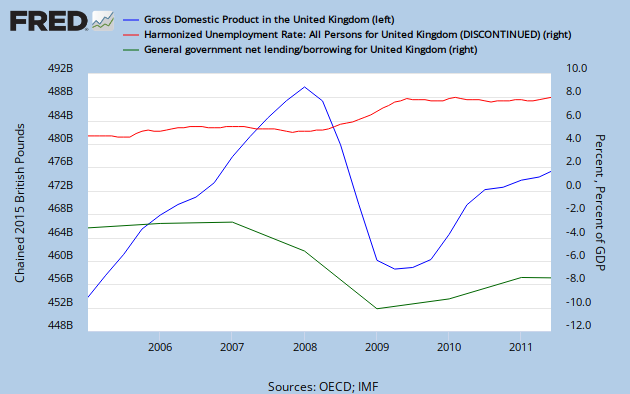
Didn’t the UK go into the crisis with its government debt already spiralling out of control? This is a point which is supported by Iraq-style Very Serious People of all parties and none. As such, it is of course nonsense, but it is nonsense that must be repeatedly cleaned up. Rust never sleeps, so here I am on the middle watch down at frame 73K with the intellectual angle grinder. The UK government net debt did not increase as a percentage of GDP between the .com boom/crash and the great financial crisis.

Here’s a chart of the annual surplus/deficit:

Here’s one of the stock of debt:

Further, the UK government’s debt in 2012-as-forecast broke down as follows: 47% the impact of the crisis, including 4% discretionary stimulus, 37% existing stock, and 16% for the “structural deficit” up to 2010. One lesson from the UK post-2010 is that the structural deficit is whatever you say it is, being deeply assumptions-dependent. But either way, 47 is lots more than 16.

(Source: Lib Dem economist Giles Wilkes and the IMF)

This is important, because it is literally impossible to get to a sane economic policy from pretending that the national debt hurtled upwards in 2005 and the economic event of 2007-2008 was a massive sell-off in government bonds. Similarly, you couldn’t get a sane foreign policy in 2005 from pretending that things in Iraq would be OK in a couple of Friedman units or perhaps a Chote.

But, But, But, But! Wasn’t It All An Illusory Consumer Binge?

The answer is no. As John van Reenen and others at the LSE pointed out (monster PDF), Labour productivity in the UK grew at an annualised rate of 2.8% from 1997 to 2010, even counting in the crisis. Productivity growth in the UK was better than France or Germany and as good as the United States during the so-called productivity miracle. About 0.4% of this was accounted for by finance, and the definition of the metric excludes changes in the value of real estate.

In fact, if there was a problem, a large part of it was that the growth in productivity didn’t make it into wages and therefore didn’t get near the consumer economy. Ex-housing, consumption didn’t grow faster than productivity.

Correct Actions on the Stall Warning

Also, the UK’s policy response to the crisis was, it now becomes blindingly obvious, a huge success. Here’s the flight-data recorder tape that shows the real economy hitting the crisis, and importantly, when:

The blue line, on the left-scale, is unemployment, the green line, also on the left-scale, is youth unemployment, and the red line on the right scale is the employment-population ratio. Watch it plunge in 2008! I use this metric because it was precisely what David Blanchflower was watching that year on the Bank of England’s monetary policy committee, while he repeatedly argued for interest rate cuts and Mervyn King thought everything would be cool in a Friedman unit or two.

In the winter of 2008, Gordon Brown, Alistair Darling, and Ed Balls reacted correctly to the stall warning – they dealt with the banks, allowed the automatic stabilisers to kick in, let the pound devalue, got King to act, and also chucked in a (relatively small) fiscal stimulus. Darling and Brown also did something else which is undervalued in all this, which is that they changed the composition of public expenditure as well as its quantity, by bringing forward capital investment and especially construction projects.
null

The economy was growing again by the end of 2009, and strongly. It was creating jobs. The public finances were improving, and repeatedly surprised on the upside. Too much recent British politics is explained by the fact that the forecasts of 2009-2010 were based on the horrible month of December, 2008, the depths of the recession and structurally usually a weak month for UK tax receipts.

And now, well:

It’s snowing; I presume that’s going to be the explanation for something in due course.

The Man Who Was Wrong vs AF447 Economics

Ed Balls was wrong to think the British economy of the mid-2000s was fine. As we have seen, there was plenty to be said for it. However, there were serious problems, notably the housing bubble, the dangerously big banks, and problems of regional and class inequality. But at least Balls believes that he was wrong. The continent of Europe is crawling with economists who know they are right.

This is where the Iraq-style Very Serious Person phenomenon kicks in. The best way of spotting a VSP is to look for the man whose policy advice never changes in substance from the average of other VSPs, whatever has happened in the false world of reality. So we have people like ex-Labour spin doctor Hopi Sen.

I’ve repeatedly crossed swords with him on precisely this issue, and here I go again. Back in 2010 he believed Labour shouldn’t risk disagreeing with George Osborne on economic policy, and certainly shouldn’t let Ed Balls near it, because Osborne was right and Balls had spent all the money before the crisis. Later, he believed Labour shouldn’t risk disagreeing with Osborne because there was a chance it might turn out OK in a Chote or two and that would be tactically embarrassing. Now, he argues that the OBR’s forecasts are so menacing that Labour shouldn’t risk disagreeing with Osborne’s policy because there is no alternative.

Of course, the OBR’s forecasts are based precisely on the continuation of current policy. Further, the OBR’s forecasts have repeatedly turned out to be worthless, but that is a secondary issue. The key point here is that the VSP never wavers from the elite consensus in terms of the final net-net output, whatever the input. (It will surprise no-one that he was wrong about Iraq.)

The upshot is what I called AF447 economics; the crew of Air France flight 447 were a highly specialised group of experts, respected and trusted by society, who blew it so comprehensively it took years to gather enough evidence to prove that they blew it and the aeroplane was entirely functional at the moment of hitting the sea.

Specifically, they failed to diagnose the original problem, and the worse things got, the more they clung to their original failure to diagnose it, which led them to make everything worse. We will never know what they were thinking as they kept the stick fully back all the way down in a stable stall, but I think it is a fair guess that they had a lot of arguments why they were right and it was going to work any second now.

Very serious people, if you will.

Everything Will Be Fine In Just One Chote Unit

So I said that the European economic situation is basically like the Iraq War. Here’s an example from noted dissident David “Danny” Blanchflower:

Even this OBR [the UK Office for Budget Responsibility – ed] forecast is not credible because it suggests growth will be 1.8 per cent in 2014 and 2.3 per cent in 2015. There is no evidence that consumption, net investment or net trade – which are the main components of growth – will grow any time soon; they aren’t.

The OBR’s belief that all will be well in two years is the same assumption they have made in every forecast – so called “mean reversion” – but this hasn’t happened and isn’t going to.

I hadn’t been aware of that, but it is astonishing. The OBR’s core forecasting assumption is that everything will just revert to trend, and therefore everything is OK. The problem here is that things revert to the mean if, and only if, if there is a trend and some evenly-distributed noise around it. That is to say, they literally think nothing has changed, even though things have changed, and policy has changed. It is very important to identify the moments when the trend has changed, and if you’re the government, to reflect on whether or not you might be the trend.

Further, they have even formulated a well-defined timeframe within which everything will be OK. For the OBR, it’s two years. For Thomas Friedman, everything in Iraq was going to be OK within six months, aka one Friedman Unit, and then you pesky kids with your computer diaries were going to be sorry. In honour of OBR director Robert Chote, I therefore give you the Chote Unit. The economy will be fine by 2012, and failing that, in two years’ time.

Some of my readers will protest and say that Robert Chote is a man worthy of respect, a genuine expert. But one of the readers who is most likely to do that has already answered his own objection.

Yes. This government has a terrible record of co-opting genuine experts, using them like fools, and leaving them weeping by the roadside. As well as a Chote unit it could also be a Budd unit, after the founding OBR director Sir Alan Budd, who also thought everything would be fine by 2012, and who quit the OBR after its first intervention in politics, when it made up the numbers to suit the politicians (don’t ask me, ask me the first, me the second, and me the third). But I’m sticking with the Chote unit, because Chote was warned, and he’s stuck with it much longer than Budd.

The Iraq examples are legion, but the most telling one was the fate of the Iraq Study Group, led by none other than the enduring statesman and personal friend of Georges Bush 1.0 and 2.0, James Baker, which went to Iraq in 2006, and reported back that it was a terrible disaster and the best thing to do was to patch up local arrangements like the Marines did in Anbar and then get out as quickly as possible. This was ignored, and passed to the attack dogs to be denounced as treason. Eventually they ended up following the recommendations, after time and blood had passed under the bridge and the military had worked out the same ideas themselves.

Meanwhile, the high panjandrum of expansionary contraction, Alberto Alesina, has noted that the US stock market is up, and concluded this is down to the as-yet-undelivered golden prospects of sequestration. This is genuinely ridiculous. As the Washington Post points out, actual fiscal contraction in the US didn’t bring about a boom, and neither did much greater contraction anywhere else, yet he claims to believe that the mere prospect of it is firing up the old animal spirits.

(Of course, it can’t be those because animal spirits are thoughtcrime and we say expectations which are somehow different and nothing at all to do with Keynes although nobody really knows how.)

So, you can have contraction without expansion, expansion without contraction, and expansion with only future promises of contraction. Further, looking at the British experience, you can also have contraction that starts with future promises of contraction. In what way is this any better than astrology?