About Alex Harrowell

Alex Harrowell is a research analyst for a really large consulting firm on AI and semiconductors. His age is immaterial, especially as he can't be bothered to update this bio regularly. He's from Yorkshire, now an economic migrant in London. His specialist subjects are military history, Germany, the telecommunications industry, and networks of all kinds. He would like to point out that it's nothing personal. Writes the Yorkshire Ranter.

Even more German election…

A quick rundown of German election news. Handelsblatt says the result is awaited with great tension, which perhaps tells you more about Handelsblatt than anything else. They also have a discussion of the coalition position.

In fact, in a sense, the coalition talks have already begun; the Ministry of the Interior has essentially made its opening bid, by issuing a list of demands for more surveillance and anti-terrorist powers. As the CDU is hoping to go into coalition with the FDP, this is probably best understood as setting a position from which they can bargain down. The FDP is predictably unimpressed.

There’s a row in Nordrhein-Westfalen, where the CDU prime minister is accused of spying on the SPD (he’s the one who was quoted as saying that Romanians couldn’t possibly assemble mobile phones). This is mostly important for his future career in the party; he’s standing for re-election in May and is a possible successor to Angela Merkel, if he doesn’t blow up.

Merkel, meanwhile, finished the election campaign by firing up the CDU activists with a speech about how Germany needs stability before anything else. Did anyone find this campaign a little dull? In fact, it’s not quite as bleak as that – she was referring to Adenauer’s 1957 campaign. The last polls, meanwhile, put the CDU/CSU on 33, the SPD on 25, the FDP on 14, the Left on 12 and the Greens on 10.

Both the “traffic light” and the Left/Left/Green option are level with or ahead of the CDU/FDP option; even if the FDP officially doesn’t want to talk, this may alter their calculations somewhat.

Der Standard has a look at the flashmobs that have been following the chancellor’s campaign, cheering at odd intervals and shouting out randomly selected words. (In the UK, it’s the other way around – the candidates shout nonsense at the public.)

In general, the conservative side is much less certain of success than it was a few weeks ago, rather as we predicted.

Al-Qa’ida’s opinion of the elections has been made known through a video; among other things, they threatened the terrors of the earth if a majority of Germans don’t vote for withdrawal from Afghanistan. A majority of Germans appears, going by the polls, to be unimpressed. Several foreign governments took him more seriously and issued warnings to travellers.

There’s a rundown of alternative options for your vote here; why not vote Violet for a spiritual politics?

German election roundup

The last lot of German polls are out, showing a modest recovery for the SPD but nothing strategically epic. However, some polls have shown enough recovery to put some pressure on the FDP’s calculations. We’re in the realm of statistical noise here.

It’s quite surprising just how dull the campaign has been – the main parties essentially arguing that they won’t drop the ball, although they’d be happy with some more votes for their faintly more radical partners. I’m sticking with my prediction that the SPD will pick up a bit more and that then we’ll go into Klausur with the other parties; whatever happens, don’t bet against Angela Merkel as a committee politician. This is despite the economic crisis, and more recently, the Kunduz air raid, which even induced the chancellor to refer to “war”.

It’s not as if nothing is happening; a senior Green resigns over sensational videos of the party’s co-leader. Sensational videos of Renate Künast fishing, that is. This is a resigning matter, but not for her.

As far as the German engagement in Afghanistan goes, there is a row going on about the idea of paying for the training and deployment of 2,500 extra Afghan soldiers in the German sector. This has resulted in a very unusual outbreak of harmony between the CSU and the Greens, both of whom think it’s a good idea; but the government much less so. This wraps into the row between the US and Germany about the Kunduz incident, which seems to be on hold until after the election, just as any decisions about strategy or tactics are.

In fact, all the decisions are. It feels like the current European way; elections without decisions.

What’s more fun than staying away from carnival writing about the German elections?

It’s a tall order…but surely writing about German elections with statistics must beat it?

But there’s a German election coming up, although, as Der Spiegel points out, you might not have noticed, as both major parties are secretly quite pleased with the current situation. Polling data is here. Angela Merkel has spent the period since her triumph of 2005 governing well to the left of her party and being a quietly effective foreign-policy chancellor, just as we predicted; the Social Democrats have been struggling, as a result, to retain an independent profile, but (from their point of view) at least they’re in government, and paradoxically the main gainers from the economic crisis have been the FDP, the spokesmen for classical liberalism.

Their leader – still Guido Westerwelle after all these years – is behaving a little strangely in public, saying very frequently that he doesn’t believe there is any chance of the so-called traffic light coalition with the Social Democrats and Greens, but not saying that he rules it out. If the polls stay as they are, this would be the only chance of the Left taking power; but, of course, this is a huge assumption, especially in the light of their surge during the 2005 campaign. With the CDU on 37%, it’s essentially assumed that they are running up against demographic limits – a typically AFOE point, but a good one.

The all-time record conservative share of the vote is 39.7%, achieved in 1957, but more to the point, even another point-and-a-half would be more than one standard deviation from the long-run average, that is to say about a 3 in 10 chance. Theoretically, there is a 5% chance of getting to 42%, but if Konrad Adenauer couldn’t get over 40% in booming 1957 it’s probably even more unlikely that Merkel will in 2009. In fact, one thing that this little statistical exercise shows is that German party vote shares are very stable indeed – the SPD’s share of the vote has greater variance, but not that much.

So there is not much space for the rightwing vote to grow; and the Left Party is apparently stuck just under 10%. The strong Liberal showing – 15% in the current polls – suggests that the right could hope to form a new coalition without the Social Democrats, which would hold 50% of the vote. At the moment the only way the Social Democrats could checkmate this would be to get the Liberals and Greens into a coalition – the Left Party and the Greens wouldn’t be enough. This all assumes that nothing else changes, however; if the Left-Left-Green option was possible, all the coalition calculations would be altered, as the Liberals would face a serious risk of being left out in the cold. So what would it take to make it happen?

At the moment, the LLG coalition adds up to 46%, the “bourgeois” (i.e. CDU/FDP) option to 50%; so they need four percentage points to cross this strategic threshold. In fact, in so far as they are fighting a zero sum game, they might need fewer. The SPD’s share of vote in the current polls is on 23% – a shockingly low figure. In fact, based on the SPD’s historical vote shares, this would in itself be approaching a 1 in 100 event. Even taking account of the Left Party breakaway, the party polled just under the historical average last time out; and the 95% probability level corresponds to a vote share of 27.3%, which would put them back in the game. Actually, there doesn’t appear to be much covariance at all between the Left Party and SPD shares; this fits the explanation that the Left is still mostly the ex-PDS.

So I’m going to forecast that, even if the SPD looks down and out now, there’s an excellent chance of them being in with a chance on the night.

action: (I)D-day, 8th July

OK, it’s coming down to the wire. Next week, on Wednesday, 8th July, the Government is going to put three regulations before the House of Commons. These are the crucial executive orders that put the guts of the Identity Cards Act in place; specifically, they are the ones that make it possible to force anyone who wants a passport (or any other official document not yet specified) to be fingerprinted, recorded, and loaded into the National Identity Register, to force the same people to pay for the dubious privilege unless they work at Manchester or London City Airports and have an airside security pass, and to pass any and all information from the Register to a variety of authorities including private credit-reference agencies and anyone who those authorities want to give it to.

At the current time of asking, this would appear to include the Uzbek secret police, so long as a police officer above the rank of inspector (!) acting on orders from a more senior officer, or the authorised agent of either secret service, GCHQ, SOCA, or the Inland Revenue says so. There is a clear hierarchy of priorities here; the fee is no problem so long as the compulsion doesn’t get in, and although obviously evil, the data-trafficking is considerably less problematic if the compulsion doesn’t get in.

So, time to write to them; remember that the scheme will be compulsory for anyone who ever wants to leave the country, which is another way of saying there is no choice; remember that the system is wildly insecure, that the biometrics have been hacked repeatedly, and that the Government wants to use the Chip-and-PIN infrastructure as a major part of it, and some Chip-and-PIN terminals mysteriously contain GSM radios that call numbers in Pakistan; remember that it will cost a fortune; and remember that many of the supposed “allied” intelligence services who will be able to ask for data from it have demonstrated that they cannot be trusted not to torture British citizens.

If you’re scared of the whips, vote for the fees regulation and maybe the data sharing one if you’re desperate and they’ve shown you the photos; but whatever you do, vote down the Information and Code of Practice on Penalties Order. It’s secondary legislation, so it just takes one loss in the Commons to kill it.

The texts are here, here, and here.

Iranian elections, with SCIENCE

Georg Hoffmann of PrimaKlima has turned away from climatology for a moment to carry out an interesting statistical analysis of the Iranian election results. Bizarrely, the percentage split between the incumbent and the closest rival remained entirely stable throughout the count – an R2 value of 0.999. But even more bizarrely, the lead for Ahmadinejad doesn’t correlate with anything – as if the uniform national swing beloved of psephologists was real, or for that matter, as if someone had simply shifted the numbers across the board. For comparison, he ran the same exercise for the 2005 German elections, which shows a wide scatter of points with a concentration of big CDU leads in the south.

Then, however, comes the genuinely scientific bit. What would Benford’s law, the principle that in most data sets there is a large excess of numbers that begin with low digits, and that therefore fake data can be identified by its divergence from this, make of it? (The data, by the way, is available here.) Well…it turns out that the results pass the Benford test, which may mean that they are honest or possibly that the Iranian Ministry of the Interior reads blogs, too.

Throwing the bums out, in Iran

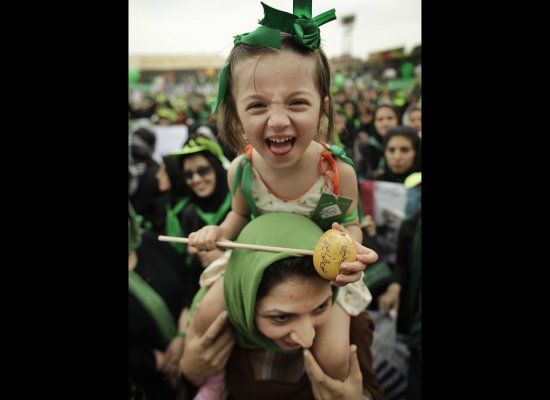
It’s polling day in Iran and a monster turnout is expected. Both leading candidates have been spotted appropriating bits and pieces of the style of the Obama campaign; incumbent president Mahmoud Ahmedinejad has been using the slogan “Yes We Can”, his main rival has been on a Web-enabled youth organising drive, and has been sending network-hammering numbers of text messages to get out the vote.

Oddly, US political comparisons are in the air. Laura Rozen asks if Ahmedinejad reminded anyone of Sarah Palin. I disagree – he reminds me most of all of George W. Bush.

An ambitious but limited regional politician who has spent time in the air force, he achieved election through a campaign for vague “reform” – whether with results or not is a good question – heavily tinged with religion or at least religiosity. In office, his term has been marked by a string of spectacular gaffes and crowd-pleasing rhetoric aimed at the hard right of the political spectrum, as well as a deliberately provocative foreign policy. Coming up to the election, Ahmedinejad leaves the Iranian economy in considerable trouble after over-spending on the belief that the boom would go on forever, and passing out considerable sums in favours to his clientele. Politically, he relies on low-information rural voters in parts of the country where the integrity of the ballot is frequently in doubt.

There’s also a certain Cheney- or Rove-esque quality to his campaigning; he regularly violates Godwin’s Law. For Ahmedinejad, everyone seems to be Hitler for fifteen minutes, just as they are for Jonah Goldberg. He would probably be Winston Churchill all the time as well, if Winston wasn’t chiefly remembered in Iran for nationalising the Anglo-Persian Oil Company and ordering the joint British-Soviet intervention of 1941. And he indulges in the partisan exploitation of supposed secret intelligence information, an odd reflection of the Plame affair.

Further, his election in 2004 was at a historic high point of Iranian influence, just as Bush was elected in a time when US power, wealth, and influence seemed beyond questioning; the US invasion of Iraq had begun to radically reconfigure the political balance between Sunni and Shia powers, whilst tying down the US military’s reserves and poisoning the US’s reputation. High oil prices made everything seem achievable. Unlike Bush, you can’t say he squandered it, but you can certainly question what, if anything, he achieved. As Marc Lynch points out, Iranian soft power would be instantly strengthened if the crazy guy failed to win re-election.

Yes, it sounds provocative, but it’s no more so than describing Iran as “totalitarian”. This is a country where the last two presidents were elected against the wishes of the establishment, in votes that came as a total surprise to the rest of the world. Here’s a wonderful quote:

But Rahnavard has been highly visible, especially after Ahmadinejad dragged her into the middle of the campaign by holding up what appeared to be an intelligence file about her during a debate with Mousavi and accusing her of skirting government rules in obtaining her degrees.

Rahnavard appeared to relish publicly defending herself, demanding that the president apologize.

“Either [Ahmadinejad] cannot tolerate highly educated women or he’s discouraging women from playing an active role in society,” she told reporters.

You might have thought this was the obvious statement of the year, but read the whole thing about women and the mobilisation for Mir Hussein Mousavi’s campaign.

Demonstration

What do his supporters want? Essentially, most things you do.

“Liberalization, a more forward thinking government, they want civil liberties — they want the whole gamut.”

Don’t, of course, imagine that a Mousavi government would immediately hand over the keys to the kingdom, or more to the point, the Natanz uranium enrichment plant. Talking in terms of “pro-Western” factions seems ridiculous in the context of someone like Mousavi, who was a revolutionary, a wartime prime minister, and is now a critic of the system. One thing that stands out is the intellectual flexibility and intellectualism of such people; you may not agree with the ideas presented here, but you can’t odds the commitment to ideas they represent.

It is nowhere near as surprising as it should be that Daniel Pipes says he would vote for Ahmedinejad.

Review: Alistair Crooke, “Resistance: the essence of the Islamist revolution”

I’ve been asked to crosspost this from my blog…

Resistance – The Essence of the Islamist Revolution is Alistair Crooke’s survey of modern Islamist thought. It would be clearer to say it is a couple of books occupying the same space; one would be a history of Islamist thought since the origins of the Iranian Revolution, with a polemic for greater understanding of such thought, and another would be a slightly eccentric, neo-Platonist rant with overtones of Ian Buruma’s notion of Occidentalism.

Well, that sounds fun, doesn’t it? Then you have to add in Crooke’s career; the book glosses him as an advisor to the European Commission on the Middle East, but makes absolutely no mention of his term as SIS station chief in Tel Aviv, in which role he negotiated a ceasefire between Israel and Hamas, which lasted until an unfortunate air raid resulted in the deaths of a round dozen civilians and not the Hamas man the Israelis were after. (The story is here.)

The war resumed, and Crooke was recalled; officially this was for “security reasons”, but if anything imperilled his security it was probably that after the event, the Israeli tabloids discovered his job title, identity, and photograph with un-mysterious suddenness. He eventually fetched up in Beirut, running a thinktank called the Conflicts Forum, devoted to contact between Western powers and Islamists. (Time was, it would have been a nightclub, but we live in fallen times.)

So, what upshot? Crooke makes a strong case for modern Islamism as a classical reaction to colonialism and modernisation, or rather an interwar vision of modernity. He relies on an impressive battery of reading ranging into cultural Marxism at one end and into hardcore conservatism at the other. More controversially, he tries to place Islamism since the 1950s in a context of rebellion against free-market economics drawn from Naomi Klein; but the Ba’athist and similar regimes hardly qualify as Friedmanites, with their nationalised oil companies, state military industries, and extensive Soviet influence in administration, secret policing, and military doctrine and structure.

He draws on a battery of confidential interviews, which are some of the most interesting things in the book, to illuminate current ideas and practice, specifically among Hezbollah thinkers. Notably, they argue, the Caliphate should now be seen as a world-wide network of loosely interconnected “communities of resistance”, rather than a state or any other kind of hierarchical organisation. The aim of these is to uphold the practice of an ideal, self-organising community of believers against a total onslaught by the forces of liberalism, which wishes us all to be atomised individuals.

In practice, this demands a sort of liberation theology/community-organising/vaguely anarchist drive to create base groups everywhere, drawn together by the practice of mutual aid and the study of critical texts, and if necessary to form the underground shadow-administration common to all good guerrilla armies.

Crooke is interesting on the military implications of this, but I think what he describes is less original than he suggests. Flat, highly networked command structures, with a high degree of autonomy down to the squad and the individual, are not characteristic of Islamic or Islamist warfare; what he is describing here sounds a lot like Auftragstaktik. Also, he describes the requirements of a Hezbollah leader as integrity, authenticity, reliability, personal charisma, and ability to mobilise others; would anyone at all disagree?

There is an interesting side-trip into Islamist economic ideas. He criticises Westeners who assume that the main aim of these is to find technical workarounds to make the normal course of business sharia-compliant; apparently the real thing is considerably better. However, a lot of it (as described here) consists of accepting a market economy but not letting money be the be-all and end-all of everything, etc, etc; in practice, this seems to mean a welfare state. No surprise, then, that one of the thinkers he quotes had to write an entire book to rebut the charge that his ideas were indistinguishable from European social democracy.

According to Crooke, the main distinction is in the field of monetary economics; but, in so far as his writing is a true misrepresentation of it, it seems to be distinct in a way which isn’t particularly original. Apparently, Islamist economists are very exercised about M3 broad money growth, on the grounds that this represents the growth of credit in a fractional-reserve banking system and that this is the root of the evils of capitalism. Instead, they are keen on…the gold standard, that most free-trade imperialist of economic institutions!

At this point you might want to halt briefly; Islamist Auftragstaktik applied to community organising? The Caliphate in terms suited to Clay Shirky? Dear God, Islamist monetarist gold bugs? Phew! And you could, perhaps, take comfort from the thought that however strange Iranian political thought may be, their economic thought is no stranger than Fraser Nelson’s or Jude Wanniski’s. Placing an upper bound on the strangeness, after all, is probably an important step towards international understanding.

Then we get into the second book. Crooke is always quoting Plato, specifically the apposition between the port and the city; he attacks Karl Popper, and uses a great deal of Horkheimer and John Gray. It is fair to say he accepts entirely the complex of critiques that argue that life is meaningless without a higher purpose usually decided by higher people, that the freedom offered by liberalism is no such thing, that trade (or commerce, or industry) is “mere”; it is harder to say whether he accepts this for the sake of argument, as much of the Islamist thinking he is discussing bases itself on these ideas.

And there is a valid argument that a lot of it claims to represent the up-side of such critiques – the need for a self-empowered, cohesive community, the problems of the free market – but might just as well be the downside. The economy should be directed, at a national level, towards certain “great concepts”; this could be post-war French indicative planning, and might well be, having been written in the 1950s – or it could be a Straussian exercise in National Greatness Conservatism. We should work and care for society; or is it, as one of Crooke’s interviewees says, that “life is not worth living without something worth dying for”?

None of this stuff about “false reconciliation” and “self-pacifying”, materialism, etc, etc, answers E. P. Thompson’s classic attack on “theories that assume that ordinary people are bloody silly“, either. Strangely enough, towards the end of the book, we have a sudden swerve back towards liberalism; freedom is not so bad after all, it turns out, compared with a neoconservatism informed by Leo Strauss.

Curiously, I left the book with a feeling that it had set out to make right-wing Americans feel closer to political Shi’ism.

Election Night

The antiliberal collective have a good data thread going on; it’s been interesting listening to the BBC Radio feed on one brain interface and reading actual data on another, an experience that reminds just how conventionalised the news experience is. Based on the numbers, it looks like the EPP-ED parties have held their own and gained a little (this is “a triumph” in mediaspeak), some of the social democrats have suffered – notably the French and British – and the Greens and some extreme-rightists have done well.

But the UK Tory blowout hasn’t happened yet. The Tory speakers on the BBC were trying to make out that their results from places like Norfolk, West Dorset, Elmbridge, and Richmond were spectacular, which sounds good until you realise that all of these are areas which have never had any statistically significant Labour support in the history of democracy. Labour has had one stinging experience, the election of a BNP member in Yorkshire.

I’m sorry.

Well, like most BNPers in office, he’ll probably crash in flames in months. Knowing how some of them managed to fail as local councillors, I really wonder what he’ll do with the financial possibilities of being an MEP. He is giving a truly bizarre speech about the D’Hondt system as we speak.

In France, meanwhile, the Socialists’ ego wars have had their impact, and as expected, the Bayrou wave was a flash in the pan. The PS is down as far as 17%, and the Greens had a blowout night, especially in Paris. This suggests that the wing of the party that supported Dominique Strauss-Kahn has swung Green, an interesting result; he did say back in 2007 that “il faut preparer l’apres-petrole”, I suppose. On the comedy wing, one seat has moved from the FN to the Hunting, Fishing and Traditions Party.

Hungary really has seen a disquieting burst of hard-right voters; the quite ugly Jobbik got almost 14%. And Sweden saw both a Socialist majority and a seat for the Pirate Party, which won hugely in the youth vote. The organised hackers/sinister nazi copythieves, depending on media version, are planning to align with the Greens.

The really weird story, though? The British Tories have won big in Wales, where they have no history or support and whose autonomy they opposed. They’ve shut up about that bit lately.

Update: The Scottish Nationalists are claiming to have won heavily.

Update 2: The BNP MEP: not the disaffected ordinary man they would like, but a long-term neo-nazi maniac.

Update 3: German results: CDU 20 points ahead of the SPD, who are down 3 points. That group is equally split between the Left, the Greens, and minors.

Update 4: Oh dear, yer man from the BNP is on the radio. Apparently he thinks that the test of Britishness is “anthropological”, and specifically “like the population after the war”. Fucking idiot. He mentions the voluntary repatriation clause in the 1971 Immigration Act. Ha. Some people used to request voluntary repatriation under the Act, take their air ticket to Jamaica, and take a holiday – because the Act’s drafters set up that any such action was without prejudice to one’s immigration status. He doesn’t seem to know that.

Update 5: Suggested UK figures – Tories 20-odd, UKIP 17, Labour 16, Liberals 15.

Update 6: Results for London. 2 Tories, 2 Labour, 1 Liberal, 1 UKIP, 1 Green. ‘Kippers in fifth place. A good point from Liberal London chairman Simon Hughes – BNP in Yorkshire has only gained 2%, Greens have doubled their share in the UK.

Update 7: UKIP aristocrat babbling on the BBC about Marta Andreesen. “Wouldn’t sign the EU’s fraudulent accounts”. The UK’s national accounts aren’t externally audited, but then, it was never about that. It looks like she beat Tim Worstall though.

Update 8: Jesus wept, Griffin’s in. Can’t wait to see how often he shows up, how much money goes missing, and what happens when he has to shake hands with Danny Cohn-Bendit.

A Dirty Europeanism from Beneath

I have just been reading Misha Glenny’s McMafia. It is excellent; an intelligent tour through the criminal landscape that emerged since the late 1980s, driven by a combination of globalisation, un-globalisation, technical change, and the usual things that fertilise big crime. We hear about the early history of the modern Russian mafia, how the UN Security Council created one of the world’s most effective criminal networks by trying to deny the former Yugoslavia cigarettes, and much more.

Some points that stand out:

1 – Networks

A common trend in all the criminal systems Glenny covers is a shift from hierarchical structures to decentralised ones; the four dons who controlled the Bombay underworld up to the late 1980s are replaced by a shifting confederation, mostly independent, vaguely loyal to Dawood Ibrahim in his Dubai fastness. The traditional prison gang hierarchies of Russia and South Africa are replaced by flat networks of crooks. The multi-criminal smuggling route through the Balkans, once authorised and taxed by the Bulgarian secret police, warps into a complicated weave of different ones open to every thug in southeastern Europe.

2 – The Great Shift

Everywhere Glenny went, both cops and thieves always said the same thing in the same way; in the early 1990s, they were in control and then “something odd happened”. New forms of crime; new actors; new communities; new drugs. Similarly, traditions and habits that kept things roughly in limits and facilitated both illicit and licit business were suddenly torn apart. Grand old yakuza chiefs were murdered in their beds; the harbour suddenly filled with shiny speed boats with unusually deep and thoroughly reinforced cockpits. And wham! Nothing was normal ever again.

3 – Fake Police and Police Fakes

So much of this proliferating mayhem was driven by the people who were meant to oppose it. In Russia and Eastern Europe, a major force was the sheer number of spooks and wrestlers looking for a job, and for that matter, the existing smuggling systems set up by people like East German STASI Colonel Alexander von Schalck-Golodkowski to raise hard currency. But even more important were the strategic decisions taken by world powers, which often created the legal barriers around which criminal profit grew. The economic blockade on the former Yugoslavia was one; the drugs war another.

4 – Complicity

The great spree would never have been possible if so many people hadn’t been customers, to say nothing of direct corruption. Japanese banks, during the great bubble, were delighted to cooperate with yakuza thugs; the tobacco industry saw nothing at all unusual in shipping absurd quantities of cigarettes to tiny Swiss cantons, from where they were re-exported on ex-Soviet cargo aircraft that invariably needed to make refuelling stops in Montenegro, during which the ciggies and the export papers vanished. The cigarettes crossed the Adriatic in wild-arsed powerboats into the hands of the newest Italian mafia, the Sacra Corona Unita of Puglia, and went from there to everywhere in Europe. The aircraft went on to the ex-Soviet Union, to Slovakia’s ZTS-Osos and Bulgaria’s KINTEX arsenals, and brought back arms for the Balkan wars, bought with the government’s share of the profits.

Similarly, the iconic European industrial achievement, GSM, used huge quantities of rare minerals from central Africa and the ex-Soviet Union, which arrived on some of the same aircraft, backloaded from further arms shipments after the Balkan wars were over and the region became an arms exporter again. It’s worth remembering that the secret police of Yugoslavia were well aware of arms dealing, having been a big exporter before the Balkan wars. And, more broadly, millions used prostitutes, smoked dodgy cigarettes, and took cocaine.

5 – The Boss Fallacy

So many cops Glenny quotes had the same experience; they finally caught the Big Boss, but everything got worse afterwards. Once the old sheikh was nailed, they expected the crime rate to fall, but instead something odd happened; all hell broke loose. It wasn’t just that the crooks fought among themselves, which the cops usually welcomed. It was that they competed harder, and that the rules and traditions and habits that usually constrained them were torn away with the traditional hierarchy. Suddenly there were no rules, or rather, there was a savage fight to set the new ones.

And killing the hierarchy changed things more subtly. The structure of the underworld changed; it became decentralised, federal, anarchist. The old hierarchies were repurposed to legitimise the new gangs, which meant that their mythos of leadership and of terror could be extended to anyone whose outfit joined the confederation. Arguably, the new structures were not just more survivable but more efficient and more scalable than the old ones.
On the other hand…

Looking across this shady landscape, though, there are some bright spots. There is something inspiring about the vigour of it all, the refusal to listen to the government, the company, the Big Don, or any other authority. The European Union was very keen to talk revolution in the East, much less to open the doors. But long before they were opened in 2004, unofficial Europe was working hard. And, in fact, it had been at it for years; Ameisenhändler at the Bahnhof Zoo, gastarbeiter from Yugoslavia working all over the continent, InterRailers, university system administrators hooking up X.25 and IP links. I remember that one day in 1995, cheap smokes and Czech lager and high-powered German fireworks suddenly arrived in our valley in the Yorkshire Dales, sold weekly in one of our local pubs. The bus route from Leeds to Osnabrück, a subsidised liberty-bus for BAOR soldiers, was also a clubber-transfer link before the arrival of EasyJet.

Practical Europe, of a sort. Crime is nothing if not practical. One of the telling things about McMafia, as it applies to Europe, is just what a society Europe could have been in the last 15 years with a little more courage early on. And we did pretty well anyway.

How the USSR missed European integration

An interesting post on the reaction from the late-Stalinist Soviet Union towards what was about to become the ECSC/EEC-and-beyond. It seems that the Soviet leadership was much more concerned about the European Defence Community proposal, an eventual failure, than the economic, social, and administrative/political version. But then, this was Europe ten years after the war; who would imagine that the main story there would roughly be “peace, and prosperity” for the foreseeable future.

It’s also telling that it was exactly the forces of economics and of culture that the Soviet Union structurally underestimated in Europe. Curiously, the Soviets missed the significance of economic union even as they shifted from the swagger of the late 40s to the status-quo power of the 1950s – you might think that, if you were going to order your allies in Europe not to make any trouble, and pursue a policy of peaceful competition, you would be very concerned indeed with the other side’s economic integration. This is, of course, 20/20 hindsight.