About Alex Harrowell

Alex Harrowell is a research analyst for a really large consulting firm on AI and semiconductors. His age is immaterial, especially as he can't be bothered to update this bio regularly. He's from Yorkshire, now an economic migrant in London. His specialist subjects are military history, Germany, the telecommunications industry, and networks of all kinds. He would like to point out that it's nothing personal. Writes the Yorkshire Ranter.

So what is it with Tory MEPs and the Internet?

Those horrible surveillance proposals came up again in the European Parliament, and got shot down again. Even though their co-author Syed Kamall did come out against some forms of mass surveillance, I promised I’d look into the two British Conservative MEPs who keep doing this. Anyway, so we’ve got Syed Kamall and Malcolm Harbour, and we’ve also got the great new Web site for spying on MEPs, Votewatch.eu, as well as a gaggle of other things.

Harbour is easy enough to deal with; as his Wikipedia article explains, he was involved with a highly transparent lobby for software patents which sent unsolicited bulk e-mail from his address, supposedly without his knowledge. More about the “Campaign for Creativity” – in reality, Microsoft – is here. He’s now a “political member” and member of the board of governors of the European Internet Foundation, whose “business members” include several firms involved with the CFC and which was itself party to the software-patent campaign. Conveniently, according to the EIF’s Web site, only the business members have to pay a membership fee.

Kamall, who is leading the Tory list for the London region at next month’s election, is slightly different. His primary outside interest is something called the “Global Business Research Institute”, a supposed think-tank arguing for the benefits of globalisation which has a rather second-rate Web site and not very much else. In fact, it doesn’t seem to do anything much but collect links and accept donations – a figure of $500 is mentioned. At some point it seems to have been associated with Alex Singleton’s Globalisation Institute. What interests me about this is why, if he wants to blog, he doesn’t just get a blog – why does he need an Institute?
Apparently the institute is a British company limited by guarantee, that is to say, a non-profit entity (so donations are tax-deductible) – its entry in the register of companies is here.

However, it can hardly explain his commitment to total surveillance; its total expenditure for 2008 was £15, the fee for filing its accounts.

Bad Russian Radar

An unexpected consequence of the North Korean attempted satellite launch was that it has demonstrated that Russian early-warning radar coverage is poor. Specifically, the Russians didn’t detect the North Korean launch at all; they picked up the object during its suborbital flight, but not during its ascent. This is worrying, because it suggests two things – first of all, that the Russians would only get warning of a missile launched from that direction when it was already about to re-enter the atmosphere, giving them very little time to analyse the situation, and secondly, that the US Groundbased Midcourse Defense interceptors based on the Pacific coast could, if launched to intercept a North Korean missile, appear on the Russian radars flying up over the edge of the Earth, as if they were incoming North Korean, Chinese, or US submarine-launched missiles.

This obviously involves some pretty awful risks, and it is another good reason to be sceptical of GMD; in a real crisis, would it actually be wise to fire it? If not, of course, it’s useless and the potential enemy can be expected to take account of that. Worse, however, is that the Russians are bound to consider a radar contact from that direction more threatening than one from over the Pole, from the West, or from the South, directions in which they have much better coverage. Therefore, the very fact of the weakness is destabilising; it increases the perceived importance of quick reaction, and therefore the coupling between Russian and other missile/radar complexes. With the increasing numbers of ballistic missiles in Asia – Indian as well as Chinese, North Korean, or submarine-based – this is not good news.

It’s been suggested that one solution would be a Joint Data Exchange Centre, a headquarters in Moscow in which US and Russian staff would swap information from their warning systems. This has a serious problem; if one party is willing to launch a first nuclear strike, they are surely also willing to feed fake data to the JDEC and to accept the imminent death of their representatives there. Unfortunately, it is unlikely to be credible. Hence another plan, RAMOS (Russian-American Missile Observation Satellite). This foresaw that the US would finance and help build a constellation of satellites similar to its own Defense Support Program birds, which detect rocket launches worldwide using infrared cameras, which would broadcast their data in the clear so that both powers (and anyone else) could receive it and use it independently. Both parties would participate in their development, and would be able to do anything they liked to verify the satellite before launching it on one of their own rockets. (Perhaps now we could publish the design under the GPL.)

This Clinton administration idea, however, failed to get funding back in 1999 and was promptly canned by the Bush administration as far too sane. Perhaps it could be resurrected. Or alternatively, whatever the Americans think, why shouldn’t the European Union do it? The radar position is not as bad in our direction, but the Russians have their own missile-defence interceptors that do fly out our way, and there was that horrible business with the Norwegian research rocket. We have a serious space industry, and the French would be wholly delighted; they consider space power to be a major national priority anyway. It’s better than relying on another Stanislas Petrov.

gaseous Goodhart

China’s top climate change negotiator wants the Chinese export sector to be excluded from their targets, and “consumers to pay” instead. This is not good news.

For a start, the tactics. It means accepting the principle of letting some special interests off. We know, after all, that there will be the mother of all lobbying wars about this, all wanting their pet interest group to be left out. Therefore it’s best to hold a firm line as long as possible, minimising the damage. Also, even if this isn’t just special pleading, the output (no CO2 target for much of Chinese industry) is identical to the effects of special pleading. So it’s worth treating it as such until proven otherwise.

After all, if it proved to be honest, you can always make a gracious concession later; but you can’t take back concessions you made earlier so easily.

Secondly, there is no end to this argument. If they claim a right to export all they like and bill the customer for the CO2, then for this right to be effective, they must also have a right to import capital goods – machine tools, Siemens power stations, that kind of stuff. Wham, half the German engineering sector wants a note from mum too. What about the primary exporters? And come to think of it, if it’s the consumer’s fault, some of that responsibility must rest with the people who lent them the money…which for the dollar zone was the People’s Bank of China, State Administration of Foreign Exchange.

More seriously, it’s a really bad idea on the substance. The mechanism of action is something like this – imports containing a lot of embodied CO2 would be taxed and would cost more, so people would buy less carbony ones, and Chinese exporters would stop producing so much CO2. But it’s a very long set of tongs; too many moving parts. Unless the energy used in the product is a hell of a lot, the tax component won’t be that great compared to the range of prices for that kind of product. The exporter might not notice, or might attribute the drop in sales to something else.

Just taxing fossil fuel at the point of sale, already, has the huge advantage that it falls directly on the user, who has the most control over how much gets used, and it’s explicitly and unmistakably down to the fuel.

Further, how many SKUs (Stock-Keeping Units – individual products) does the Chinese export sector produce? It’s got to be in the tens of thousands at the least. Under this proposal, each one would have to be carbon-audited accurately and regularly and assessed for taxation on that basis. It is far from clear whether the importing state or the exporting state would do this. Just taxing fossil fuel, already, involves less than a dozen SKUs, which happen to be bulky, smelly, heavy, or black and dusty, and therefore difficult to hide on a big scale.

And every manufacturer would have a fine incentive to lie about the CO2 emissions associated with their product; if you can bring yourself to put melamine in the milk, you can surely lie about your electricity bill. It’s the worst Goodhart’s Law violation I’ve seen for a long time.

But here’s the really weird bit. Whether the CO2 tax is applied at source as a fuel tax or a cap-and-trade system, on crossing the border like a tariff, or at the point of final sale like VAT, the economic upshot is essentially the same; goods subject to it would cost more than goods not subject to it, and goods subject to it that contained more CO2 would cost more than ones with less.

Either yer man is hoping that the importing states wouldn’t bother to impose the tax, or else his argument is actually indistinguishable from the one he’s trying to shoot down – that there should be a tariff on goods from states that don’t implement a CO2 tax.

Alternatively, he’s just talking his book, setting a negotiating marker in a cost-free fashion. In which case, time to pick it up and run it back.

If this leaves you in need of an optimism fix, have a look at this GSFC feature. The “shorter”: ozone depletion would have made it unsafe to go out in the sun for as long as five minutes essentially everywhere by 2065, but we, ah, fixed it. (Via German ScienceBlogs; if you speak German there’s also a fascinating interview with Paul Crutzen here.)

giant centrifuge arm for whole ships considered cool

The French government is moving its ministry of defence, pulling a whole gaggle of institutions together into a “French Pentagon” to be built on an old Navy site in the suburbs of Paris. Obviously there are the usual complaints, but this is interesting. Jean-Dominique Merchet’s Sécret Défense reports that they are going to knock down a giant circular water tank with a huge rotating arm. Eh?

Well, the site was the R&D centre for French naval shipbuilding, and the installation was used to test the hull design of new ships. A scale model (“scale model” here means something that weighs about as much as an articulated truck) would be built and spun through the water at high speed on the end of the arm, driven by huge electric motors, so the engineers could observe the turbulence it created in the water. The thing is 60 metres in radius, 5.5 metres deep, and the arm moves at 17 degrees a second

These days, we can solve fluid dynamics problems with a Really Big Computer instead, so the thing is losing some of its relevance. But it seems a shame to flatten it and build offices; someone really ought to get some photos taken before the bulldozers move in. A few are here and they are suitably science-fictional.

Anything that thinks logically can be fooled by anything that thinks at least as logically

On Monday, I saw Paolo Sorrentino’s film about Giulio Andreotti, Il Divo at the ICA. It’s a scorching brilliant sensation, full value for its Prix du Jury, and I strongly recommend you see it at once.

The first thing you need to know is that this is a movie; a lot of directors, faced with a heavy political biography and a crisis that needs explaining, would have ended up with a hell of a lot of people talking a lot in moodily lit offices or speechifying in parliament. But the historic genius of Italian cinema is that it’s always been able to deal in serious subjects by looking good, and Sorrentino’s direction makes the whole thing look fantastic and practically thrum with energy.
There is one of the best depictions of the sport of politics anywhere, as Andreotti attempts to be elected President of the Republic and the camera tracks with his finance minister, (Paolo Cirino Pomicino, played by Carlo Buccirosso) for an unfeasible period of time as he schmoozes, threatens, and argues his way around MP after MP.

A string of mafia assassinations are shocking and hyper-real; there is a lot of really bad violence in films, the sort of ketchup-CGI-unfeasible car wreck fluff where it is not clear whether it is more boring or more desensitising, and only a few manage to get the shock and horror of it. My reference point for this is the fist-fighting in Once Were Warriors, which is far more shocking than any amount of car-off-viaduct; this is similarly classy. Note that Sorrentino has to deal with the most hackneyed piece of “action” available, an actual car blowing up, in the Mafia murder of Giovanni Falcone, and handles it well.

The look-and-feel gives us some important clues; Andreotti, played superbly by Toni Servillo, is sinisterly out of place in parliament or in the streets, surrounded by his escort of hochglanzed Fiats and whipsmart security agents in sharp suits and sharper machine pistols, but perfectly at home in the sick, stuffed baroque corridors of power, where his colleagues never quite fit in either. They would rather be in public, in the 20th century; when one of them appears for a meeting with both a Motorola NMT brick of a mobile phone and a VHF radio, he might as well have brought a sharpened flint to a genetics lab. But you could overdo this – by the time Andreotti is facing trial, he can be spotted briefly speaking on one of the new GSM phones, just as the reporters type in unison on a gaggle of laptops.

Servillo’s performance is a wonder; he plays Andreotti as an entirely physical being, an odd idea for an old politico who is barely seen outside the corridors of power, and who answers his doctor’s suggestion that he exercise by saying that everyone he knew who did was dead. But the only signs he gives of inner life or emotion are physical – rather than feelings, he has migraines. He’s a classic hysteric, so deeply repressed that his emotions are only expressed as psychosomatic, not to say diplomatic illnesses.

In fact, his whole family are like that; there is a scene of the whole clan taking pills together before eating, as if to relieve a common headache brought on by ignoring common secrets. Interestingly, Carlo Buccirosso’s character nods to this unphysical physicality early on – in a party scene, he motionlessly listens to Andreotti holding court, until Livia Andreotti announces that it’s her husband’s bedtime. Demonstrating a proper submission to his wife, Andreotti departs. No longer on his best behaviour, the Minister of the Budget dances wildly and very unlike any finance minister is meant to as the camera frantically tracks him.

Time, and secrets; the depths of history are as important to the film as the depths of space and time to, say, Lovecraft. There are unimaginable, mind-wrecking horrors lurking in there, in the files in Andreotti’s private archives (he significantly remarks that an imagination is one thing, but an archive is much better), and he’s one of them. Charlie Stross used the toolkit of horror to write about the Cold War, and of course Andreotti is a product of the same conflict, having spent his life keeping the Communists out of government and Italy in NATO, whatever it took.

There is a theory that the sudden wave of honesty that ripped through several great European political parties in the 90s – the Christian Democrats in Italy, the network around Mitterand in France, the British Conservatives, Kohl’s CDU – was a reaction to the end of the Cold War. Suddenly, it was no longer true that any deceit, any crime would be better than the worst-case scenario to end all worst-case scenarios, and up it all came. The eruption was most powerful and most sensational in Italy, and one of its consequences was that Andreotti’s calculations were no longer valid, perhaps precisely because it was fundamentally psychological; he couldn’t feel it.

The closest character in the rest of the cinema to Servillo’s Andreotti is undoubtedly HAL, the computer in 2001: A Space Odyssey. And come to think of it, HAL is another Cold War product, eventually brought down by the duplicity inherent in its need-to-know protocols. This science-fictional reading is explicitly hinted at during the trial towards the end of the film, when a journalist describes Andreotti as an extra-terrestrial. That is precisely what he isn’t, of course – in fact, he’s a formidable artificial intelligence, hyper-rational, inscrutable, amoral, realistic, terrifying.

Intelligent he is, but artificial? Certainly. There is a sense in which self-control, self-discipline, and pathological repression aren’t that far apart. Andreotti’s constant psychosomatic disorders are the manifestations of a man whose life’s work has been to convert himself into a computer, an expert system, a walking simulation of Italian politics that can resolve the answer to any question about it in faster-than-real time. He is, indeed, an artificial intelligence, and just as imperfect and dangerous as you’d expect from an experiment in human-equivalent AI left to survive in politics.

More on ETS success

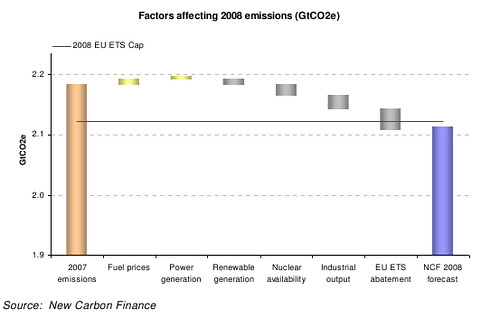
Various commenters suggested that the 3% cut in EU CO2 emissions was essentially down to the recession. Here’s a chart from the report I linked to, which gives a rather different analysis. I don’t have the underlying figures, so there are limits to how far I can critically engage. But the take-out is that fuel-shifting or saving driven by CO2 pricing and renewables development were much bigger contributors than change in industrial capacity utilisation, and better reliability at British and Spanish nuclear power stations was a surprisingly big factor.

Contributions to net CO2 emissions change in Europe

Here Hare Here

To the National Theatre for David Hare’s one-man show on Berlin. I wasn’t at all sure what to expect, but I didn’t expect this. Quite simply, it was embarrassingly, exasperatingly awful.

Hare, in person, is a fan of the southern English amateur/eccentric shtick. He makes much play of not knowing his way around despite having regularly visited Berlin, as he tells us with monotonous regularity, since the early 1970s. Couldn’t he get a map? Or learn some German? But it’s crucial to the amateur/eccentric thing that your put-on ignorance isn’t read to affect your status. In fact, it wouldn’t work if it didn’t sit over a vast pool of arrogance and self-satisfaction; pretending to be a buffoon is a luxury for those who don’t have to worry about being believed.

Self-satisfaction. Yes, there is a lot of this. We hear a hell of a lot about his brilliant friends, that some of them are French government ministers, that he gets free tickets to the Berlin Philharmonic. He works through a repertoire of annoying gestures under his Michael Heseltine hairdo. And so much about buying property. Yes, now. Yes, from a well-known Marxist. But it wouldn’t be so bad, if it wasn’t for the content.

Berlin was the centre of the confrontations of the 20th century. Hitler, then Stalin. Wall. Wall gone. Nobody wants to talk about it – imagine! The RAF bombed it a lot. The Nazis had several million Jews murdered. There are lots of new buildings, and some of them are not to his taste. But now it’s full of young Europeans who appear to be having fun. People tend to leave home and go there and find ways of life that their parents don’t understand (how does this differ from, say, San Francisco or Bombay?) The bastards.

Gripping stuff, eh. There was worse, though – a succession of tiresome jokes about pompous and patriotic Frenchmen, bureaucratic Germans, ignorant Brits, some truly weird politics, and some observations about Berlin scenes that were factually impossible. We got a lot of stuff about Tempelhof airport without hearing that he can’t always fly there, as he claims, because it’s been shut for three months. The Theater am Schiffbauerdamm is apparently a huge domineering building, rather like the Comedie Francaise, and it stands opposite a giant shopping mall.

None of these statements are true; I’ve been there, although like Hare I’ve never been to a play there. I don’t know if the comparison with the Comedie Francaise is valid. The theatre, for what it’s worth, is not at all huge and is situated discreetly behind trees. Am Schiffbauerdamm is a quiet river embankment – the name means “On the Shipbuilders’ River Embankment” which ought to be a clue, but then, Hare’s German is atrocious – with some nice restaurants, but which faces towards the huge railway viaduct that carries both the great east-west main lines and the S-Bahn through the city centre. (Hey, look at the overhead imagery.) In fact, the railway station the theatre looks across to (Friedrichstraße) was once the major crossing point between West and East Berlin, and far from a shopping mall, part of the station was once the border-control checkpoint known as the Hall of Tears (Tränenhalle).

Hare goes for a walk down what he refers to as the Ost-West Achse in the Tiergarten. Well, it’s been called the Straße des 17 Juni since 1953, which is quite important. When he comes to discuss the building of the wall, he attacks Prime Minister Harold MacMillan for not “calling for insurrection in the East”. The street name should have set him sensible. There was an insurrection in the East, on the 17th of June, 1953, when the workers of East Germany rebelled against what called itself the Socialist Nation of Workers and Peasants, the police vanished, the Party network vanished, and Walter Ulbricht’s government called the Red Army and the KGB in to save themselves. The rebels were crushed under the T-34 tracks, in some places literally. After that, and the Hungarian revolution of 1956, the CIA dreams of “rollback” (very popular with Joe McCarthy) were definitively consigned to the archive. After the Bay of Pigs in 1961, this extended beyond Europe.

What could MacMillan have achieved with this calling-for? Quite a few East German policemen and soldiers deserted rather than build the wall, but they had plenty more. The ones who did didn’t need any speeches on the radio, and one wonders if speeches would have moved the others. As Carlo Levi said about southern Italy under Mussolini, all that came from Rome were speeches on the radio, and the only thing MacMillan could have offered would have been speeches on the radio.

He could probably have got more people locked up or shot, in the best-case scenario. In the worst case, well – this was 1961, when worst-case scenarios were worse. During the Cuban crisis a year later, MacMillan and his defence secretary Peter Thorneycroft kept the leaders of RAF Bomber Command on a short leash, refusing to let them disperse the V-Bomber force for security because this would be an unmistakably provocative gesture, on bases several flying hours closer to Moscow than those of Strategic Air Command.

Hare is a long-time unilateral nuclear disarmer and pacifist. Does he really believe that what the international scene of 1961 needed was more provocation of a superpower by a major nuclear power? What on earth is he on about?

There is a broader issue here; the phrase “to call for” repels me more and more. Its function is to get you out of responsibility for your opinions. I didn’t want war – I merely called for solidarity with the US in fighting terrorism. It also acts as a way of escaping the healthy discipline of detail. It is telling that it is fashionable with the neoconservatives, the Decents, and the hard left all at once – all the retailers of the goods dream-hungry youth demand, according to Leszek Kolakowski.

I call for action on Darfur! But I say nothing of the mountainous problems of projecting force into the roadless and railless interior of western Sudan, nothing of whose infantry are to actually go and get killed there, nothing of who exactly they are meant to kill or threaten effectively to kill, or for what aims. I just called for. Let’s decommission this phrase, like a worn-out nuclear power station – switch it off gracefully, sever the lines and fill the damn thing with concrete, and watch it carefully for a hundred years to see nothing leaks out.

For a slightly more constructive critique, my partner suggested Hare retitle the show as being “Meditations on Flight No…” where the number is the BA flight from London to Tegel. She’s right – everything about it that wasn’t obvious, trivial, or simply wrong was more interesting as an account of international art-bureaucrat culture than of Berlin, or London.

Europe Cuts CO2 by 3% in 2008

Perhaps no surprise with the doomflow of neganews slinking catlike through your windows, but it looks like the EU cut its emissions of carbon dioxide by 3% last year. Worldchanging quotes an analyst report that reckons this is attributable to the European emissions trading system. I’m not so sure; what about all the cliff-diving?

However, the target of 80% reduction by 2050 means an annualised cut of 1.95%. Who would argue with a fair wind?

Mass-producing the change; the Constructivists in London

The Tate has a major exhibition of the Russian Constructivists Alexander Rodchenko and Lyubov Popova. It’s a brilliant and seminal look at a movement that practically buzzes with contemporary relevance and all must see it now.

Constructivism began as a sort of parallel development to Cubism; breaking form down into elements that could be recast and remixed. But it also had a fascination for technology – they considered themselves as technicians of images, creating a universal artistic tool-kit to replace representational art. This phase of the movement rose through the First World War and came into its own with the Revolution, being entirely identified with the Left.

But the really exciting change was yet to come; in 1922, the Constructivists decided to abolish painting itself, on the grounds that artists in a Marxist society should integrate their work into the process of production and that only by inserting art into industry could they reach the masses. Instead, they fanned out into a variety of trades – graphic design, product design, architecture, film, theatre, fashion. With the arrival of the New Economic Policy, Rodchenko and the poet Mayakovsky started a graphics and advertising business.

There is an old joke about the Soviet Union that suggests they decided to experiment with socialist advertising during the Khrushchev thaw, but gave up after the slogan “Fly by Aeroplane” hit the streets. As you might expect, Rodchenko & Mayakovsky’s treatments were rather punchier. And indeed, this was explicitly socialist advertising; the Constructivists were opposed to NEP and one of Mayakovsky’s motivations was to help the industries that had already been collectivised compete with the Nepmen. Popova designed prints and eventually whole outfits for the textile industry; they all contributed to the Novy Byt project, which aimed to produce a suitably revolutionary range of home products in fulfilment of Trotsky’s Questions of Everyday Life, whose cover Rodchenko designed.

Technology played an interesting role; the new media, radio, the cinema, power-jacquard textiles and newspapers were a major theme. Popova remarked that no achievement had been as satisfying as seeing a peasant woman buying a bolt of one of her fabrics to make a dress; Rodchenko designed a prefabricated Workers’ Club as a sort of integrated Constructivist experience, as classroom, clubhouse, library, cinema, union meeting hall – an immersive user interface for the revolution, which would wrap around film, print, radio, and theatre as the revolution’s communications system.

Of course, it didn’t turn out like that; the politicians they agreed with won on the issue of NEP, which was absolutely the worst thing that could have happened. Looking back, a Tito-like compromise between big state industry, small private business, and perhaps a third sector of workers’ cooperatives sounds like the best possible outcome from where they started. Instead, the command economy was extended to cover absolutely everything, the new leader was Stalin, and the cultural revolution was dropped in favour of Socialist Realism.

Every attempt to break away from the GOSPLAN legacy was eventually squashed or subverted; in the late 40s, after Krushchev, and it’s arguable that the power interests – the secret services, the military industries, and the bosses of agriculture and oil – chose to destroy the Soviet Union rather than accept the Gorbachev reforms. Perhaps the final guarantee of Constructivism’s relevance was that it was incompatible with Stalinism; a truly frightening percentage of the faces in the photos from the early 1920s ended up dead in a variety of horrifying ways, and those who survived the Terror rarely survived the second world war. Soviet culture would never recover Constructivism’s innovation, panache, or humanity, and who could say that Soviet product design ever achieved much?

So far, Constructivism sounds like chilly, serious stuff, and quotes like Rodchenko’s remark that all his paintings were “as useless as a church” but it would be a shame to burn them because of all the work involved seem to bear it out. It’s a valid critique, and it was one thing where the Constructivist women provide a saving grace; Popova’s Space-Force Constructions, painted onto bare timber, playing with the warmth of the wood, are far more humane. (Varana Stepanova’s paintings are pretty stellar, too.) Similarly, you could compare her dresses with Rodchenko’s cover for the 1923 edition of All-Russian Postal and Telecoms Statistics, and you’d be right, even if the whole project reminds a little of this.

The link goes to Bruce Sterling’s blog, which is highly appropriate. After all, Constructivism was a movement dedicated to the proposition that rather than being the change, you should mass-produce it. Sterling’s own Viridian Design Movement was intended to reach the people through the material culture. In a real sense, the best of Internet culture is highly Constructivist; you wonder what would have happened when those clubs started talking back on the expanding telephone and radio networks.