About David Weman

The founder of A Fistful of Euros. He is Swedish, and was born in 1980. Works as a translator and subtitler.

Instant speculation, instantly out of date

What will happen after the election? If there’s a Lib-Lab majority, which seems likely, though not certain, Nick Clegg, among others, have a few unpleasant decisions ahead of him.

One unusual factor is that any coalition agreement or pact has to be voted on through several levels of the party. Exactly what qualifies as an agreement is a bit vague, however.

If the Tories would agree to PR, Clegg would most likely support them. They almost certainly won’t though. They’re an uncompromising lot and FPTP has served them very well.

Clegg will probably let Cameron through without a good deal on PR. I don’t actually think it’s sensible. (CF) I think Clegg may be savvy about election campaigns, but not about these sort of things. He’s not bloody minded enough. Tories getting a shot has become what’s expected, what’s supposed to happen. From a not-losing the-three day news cycle perspective it would make sense, and because people sort of expect a Tory minority, because the immediate reaction to a Labour-liberal deal would be negative. Never underestimate the feeble mindedness of anyone who isn’t actively evil.

If Clegg makes a less attractive deal, he risks getting overruled, so I reckon he’ll tolerate Cameron without any preconditions, to bypass the grassroots.

If there’s a Lib-Lab pact or actual coalition, the Tories will almost certainly get much high poll numbers fairly soon – the Lib Dems won’t be in opposition anymore, and the economy will still be crap. So if the Lib Dems lets them through with only a vague promise of PR, they’ll soon be in the position to say: “we dare you to vote us down”. And there’s a good chance the grass roots will nix it. The Lib Dems will do very badly in the next election then, whether it’s early or in 2015.

But will Labour offer a good deal? Even if a majority of them wants to, will the leadership be unified enough to offer something some figures are strongly against, with no one in charge and election campaigns starting (for both leader and deputy)?

If both larger parties are uncompromising, Clegg will have no less than six, maybe seven shit sandwiches to choose from. A pact with Labour, or with the Tories. Letting either of them in without ANY deal, to bypass the grassroots. Immediate early elections, which doesn’t only risk a Tory majority, but global economic meltdown (or so people will say). Or outside chance, a national unity gov’t. I think he may then choose what may be the shittiest shit sandwich.

Having said all that, I think the combined odds of a Lib-Lab pact or toleration, either now or somewhat later after some unpleasant twists and turns, is slightly higher than a long term Tory gov’t.
Of course, in thinking about the future we should also consider the risk of the economy imploding because of political uncertainty, even if we get the in my opinion lesser evil in the cabinet.

Update: If Clegg lets Cameron through and then the next Labour leader and Clegg wants to do a deal, could they avoid a new election? My understanding is now that Clegg and the next Labour leader could avoid a new election. This would make letting Cameron in more likely and a bit less irrational. If Cameron goes down to no confidence and doesn’t see it coming soon enough to call a new election, the leader of the opposition gets a shot at forming a government.

Thanks to Ajay, Alex and Keir for their input.
The Myrdals and feminist natalism

Re this Yglesias post about Sweden, and comment thread, female participation in the labor force is influenced by government policies as well as culture, such as subsidized daycare and paid parental leave, with a month reserved for daddies, which makes it easier for both parents to never leave the workforce. (There’s also surely a feedback loop between policies and culture.)

The Swedish approach goes back all the way to the 30’s and the natalist feminist stance Gunnar and esp. Alva Myrdal persuaded the Social Democrat government to adopt. Continental countries, maybe especially CDU-dominated Germany chose a very different approach, which encouraged women to be homemakers, and now perhaps discourages them from becoming mothers.

The Myrdals were motivated by feminism, but also by their worries about declining birth rates in the 30s, and interest in Edward’s favorite subject, the connection between economics and demography. People stopped paying attention to those issues when the baby boom started.

That Sweden’s birth rates haven’t declined to the same extent as Germany’s is then the outcome of conscious policies.

Natalism is generally associated with reactionary politics in many countries, but feminist natalism is the kind that actually works.

Not so socialist Europe

In case you’re wondering why there’s such an rightwing dominance in the first place (and it’s pretty much always been that way in parliament elections): Some countries aren’t polarized between a leftwing block and a rightwing block, which has meant nonsocialist parties are dominant.

Some, like Benelux countries and Finland, have centrist supermajority coalitions and aren’t unusually rightwing in policy. Ireland and Poland and the Baltics are a different story.

Then there’s the Lib Dem’s, and various other left-liberal parties that belong to ALDE in the European Parliament.

The caucus groups are fairly important, and sometimes vote as a block. So even if from one perspective, the rightwing dominance is an illusion, it does give rightwingers a bit of a structural advantage in the Parliament.

The new parliament: A bit like the old one

By some wonderful magic, all media reports of an event tend to go with the same storyline, often kind of off. The storyline after the elections was “The right and anti-immigrant parties win big.”

Figuring out if it was accurate took some work, because some parties, for example the Tories and the Italian Democratic Party, plan to change caucuses and the official results site counts them as unattached. I had to do a lot of very tedious counting and adding up to make this post, the kind of thing journalists need us bloggers to do. I’ve assigned most nominally unattached parties to a group. This is based on known plans plus a few educated guesses, but the guesses mostly involve tiny parties.

As it turns out, PES+greens+commie parties will go from a combined 38, 3% of seats in 2004 to 36,2%.

If we count the liberals (reasonable-ish in the Parliament context), the present mainstream right went from a combined 55,0% of seats to 56,2%.

By my count, 2% of the old parliament’s non-inscrits were extreme nationalists, and 3,1% of the new parliament’s.

Results by group:

EPP-ED+UEN parties (including the Tories and ODS and Law) 44,2% of seats. (42,3% in the old parliament)

Counting them separately is pointless since they’re about to merge and split. This process of musical chairs tend to happen after every election.

* ALDE/ADLE: 10,9%. (12,6%).
They’re the liberal group (well, basically). The members parties mostly line up as center-right domestically, but some are center-left or just vaguely centrist.

* PES 25,2% (27, 6%)
Worse than it seems, because all parts of Italy’s Democratic Party, which didn’t exist in 04 is included in my count.

*Greens/EFA 7,1% (5,5%)
Impressive considering the many countries with no green representation

*GUE/NGL 4,5% (5,2%)
This is the far left

ID, the eurosceptic group went from 2, 8% to 2, 6%

So the storyline’s not flat wrong, but the changes aren’t very dramatic.

Breakdown 1979

The Swedish economy is in free fall, if you believe the latest report from the National Institute of Economic Research. [They] expect GNP to fall 3,9 percent this year. … In the industrial sector, every sixth job will disappear.*

The National Institute of Economic Research calculates that it could take until 2016 before unemployment will decline from the expected peak of 11 percent to a more normal level of six percent.*

The People’s Party’s spokesman for economic policy, Carl B Hamilton, says “No thanks” to a expansive fiscal policy. … Hamilton compares the situation with the seventies, when the rightwing government didn’t get anywhere with that kind of policies.*

It’s always 1979 with these people. That’s when the modern right (and center-right) was formed, and everything will always be seen through that lens.

Those stabilizers

Couldn’t someone, somewhere try to calculate how much the automatic stabilizers of European economies compensate for the difference between our stimulus packages and the US? I could settle for something problematic and rough and ready. Put a number on it.

A little map I made

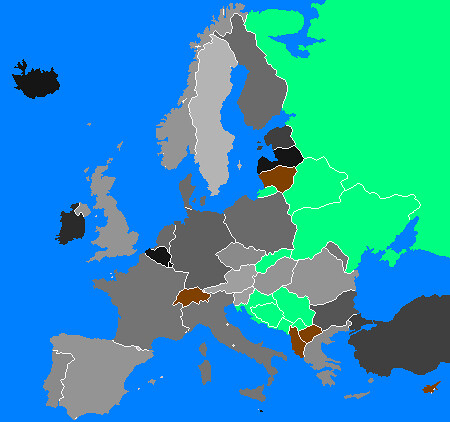
Here’s a little map I made a while ago.

Right-left-europe

It shows the political allegiance of the heads of government from 1989 to 1/1 2009. The lighter the hue the more years the country had a leftleaning head of government.

The most obvious thing you could say is that centre-right parties have been more successful in most countries, even more so than I expected. The supermajority coalition type countries in Benelux and Finland actually exaggerate leftwing performance by some counts, and Tony Blair wasn’t much of a leftwinger. I think most earlier starting points would show even greater rightwing dominance in western Europe. I think I’ll refrain from speculating as to why right now, but feel free to do so in comments.

The correlation between rightwing government, and rightwing policies is obviously weak, (cf Belgium) but I think the dark hue of the Baltics and Ireland seem about right, and Iceland’s less incongruous than you’d have thought a year ago.

On reflection, I think the tendency is to understate the importance of partisan affiliations. Britain and Spain have become tangibly more progressive in some ways in the last 20 years. That can’t be said of too many other countries.

Green means too few easily categorizeable heads of government. Brown means I couldn’t be bothered.

Unfortunately the contrasts can make countries seem darker or lighter than they are.
I could make a less imperfect map, but that’s never gonna happen.

In a similar vein (but less half assed) here’s a chart of the rich-poor gap in conservative vote share in a bunch of countries, courtesy of Andrew Gelman.

…Slightly reworded to be clearer. By rightwing I mean mainstream liberal, conservative and christian democratic parties.